

In today’s highly competitive business environment, superior products and competitive pricing alone are no longer enough to secure long-term customer loyalty. Organizations across every industry are recognizing that customer experience (CX) has become one of the strongest drivers of revenue growth, brand reputation, and competitive differentiation.
Every interaction—from a customer’s first website visit to after-sales support—shapes how they perceive a business. A single negative experience can influence purchasing decisions, reduce customer retention, and damage brand credibility, while consistently positive experiences create loyal customers who become long-term advocates.
However, improving customer experience requires more than collecting occasional feedback. It demands structured research, continuous analysis, and data-driven decision-making.
Customer Experience Research enables organizations to understand customer expectations, identify pain points, measure satisfaction, and uncover opportunities to improve every stage of the customer journey.
For executives, investors, government organizations, and enterprise leaders, CX research is no longer simply a marketing initiative—it is a strategic investment that directly influences profitability and sustainable business growth.
Industry Overview
Digital transformation has fundamentally changed how customers interact with organizations.
Customers today expect:
- Personalized experiences
- Fast response times
- Consistent service across channels
- Transparent communication
- Simple purchasing processes
- Reliable post-sale support
Whether operating in banking, healthcare, retail, telecommunications, manufacturing, government services, or B2B industries, organizations compete as much on experience as they do on products and pricing.
Several trends are driving the increased importance of customer experience research:
Digital Customer Journeys
Customers increasingly engage through websites, mobile applications, social media, chat platforms, and self-service portals. Organizations must understand how these touchpoints influence customer satisfaction.
Rising Customer Expectations
Consumers compare every interaction against the best experiences they have had with any brand—not just competitors within the same industry.
Competitive Differentiation
As products become increasingly similar, customer experience has become a primary competitive advantage.
Data-Driven Customer Strategies
Organizations now combine customer feedback with behavioral analytics, transaction data, and operational metrics to gain a comprehensive understanding of customer needs.
Key Challenges Organizations Face
Despite investing heavily in customer service and digital transformation, many organizations struggle to consistently deliver exceptional customer experiences.
Limited Understanding of Customer Expectations
Internal assumptions often differ from actual customer needs.
Without structured research, organizations may prioritize improvements that have little impact on customer satisfaction.
Fragmented Customer Journeys
Customers interact through multiple channels including websites, mobile apps, physical locations, email, call centers, and social media.
Disconnected experiences across these channels reduce trust and loyalty.
Poor Customer Retention
Acquiring new customers is often significantly more expensive than retaining existing ones.
Organizations that fail to understand why customers leave lose valuable revenue and future growth opportunities.
Inadequate Measurement
Many businesses monitor operational metrics such as response times but fail to measure customer perceptions, emotions, and overall experience.
Operational efficiency does not always translate into customer satisfaction.
Slow Response to Changing Customer Needs
Customer preferences evolve rapidly.
Organizations without continuous customer research often react too slowly to changing expectations.
Market Research Insights
Leading organizations treat customer experience as a measurable business function supported by continuous research and analytics.
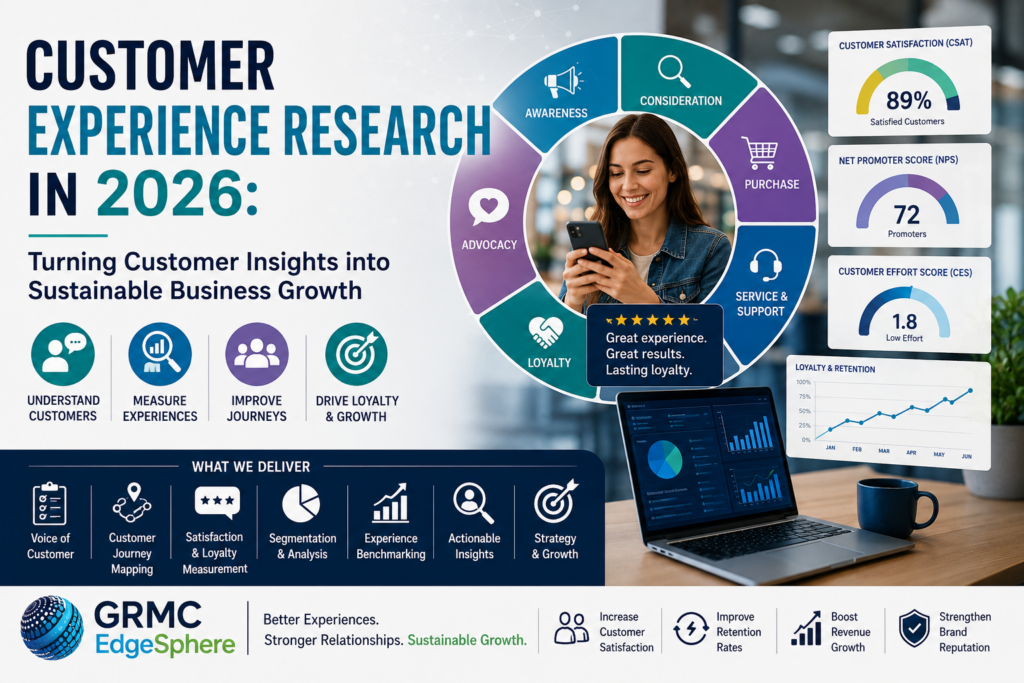
Customer Journey Mapping
Understanding every interaction between customers and the organization reveals friction points that may otherwise remain hidden.
Effective journey mapping evaluates:
- Awareness
- Research
- Purchase
- Onboarding
- Service delivery
- Customer support
- Renewal or repeat purchase
- Advocacy
This holistic view enables targeted improvements across the entire customer lifecycle.
Voice of Customer (VoC) Programs
Successful organizations establish structured Voice of Customer programs that gather feedback through surveys, interviews, online reviews, customer support interactions, and digital analytics.
These programs help organizations identify recurring issues before they become widespread problems.
Customer Segmentation
Different customer groups often have different expectations.
Segmenting customers by demographics, industry, behavior, or purchasing patterns enables organizations to design more personalized experiences.
Customer Satisfaction and Loyalty Measurement
Research commonly includes indicators such as:
- Customer Satisfaction (CSAT)
- Net Promoter Score (NPS)
- Customer Effort Score (CES)
- Customer Retention Rate
- Churn Analysis
Monitoring these metrics over time provides valuable insight into customer relationships and business performance.
Competitive Customer Experience Benchmarking
Organizations increasingly compare their customer experiences against industry leaders rather than relying solely on internal performance measures.
Benchmarking identifies opportunities to exceed customer expectations and strengthen competitive positioning.
Practical Recommendations
Organizations seeking to improve customer experience should adopt a structured and research-driven approach.
Establish Continuous Customer Feedback Mechanisms
Collect feedback regularly rather than relying on annual surveys.
Real-time insights allow organizations to respond more quickly to emerging issues.
Integrate Multiple Data Sources
Combine survey responses with operational data, customer support records, website analytics, CRM information, and social listening to create a comprehensive understanding of customer behavior.
Prioritize High-Impact Improvements
Not every issue requires immediate action.
Focus resources on the customer pain points that have the greatest influence on satisfaction, loyalty, and revenue.
Empower Leadership with Customer Intelligence
Customer experience should be discussed at the executive level.
Regular reporting enables leadership teams to align operational improvements with strategic objectives.
Build a Customer-Centric Culture
Customer experience is not solely the responsibility of customer service teams.
Every department—from product development and operations to marketing and IT—contributes to the overall customer journey.
Organizations that embed customer-centric thinking across the business consistently outperform competitors.
How GRMC EdgeSphere Can Help
GRMC EdgeSphere delivers comprehensive Customer Experience Research solutions designed to help organizations understand customer needs, strengthen loyalty, and improve business performance.
Our research methodologies combine qualitative insights, quantitative analysis, behavioral analytics, and strategic consulting to support evidence-based customer experience improvements.
Our Customer Experience Research Services Include
- Customer Satisfaction Studies
- Voice of Customer (VoC) Research
- Customer Journey Mapping
- Customer Loyalty and Retention Analysis
- Customer Segmentation Research
- Brand Perception and Experience Assessment
- Mystery Shopping Programs
- Service Quality Evaluation
- Digital Experience Research
- Customer Experience Benchmarking
- Customer Feedback Analytics
- Executive CX Strategy Consulting
Our consultants work with enterprises, government agencies, financial institutions, healthcare providers, retailers, technology companies, and international organizations to transform customer insights into measurable business outcomes.
Conclusion
Customer experience has become one of the most influential factors in business success. Organizations that understand their customers, continuously measure experiences, and act on research insights are better positioned to increase customer loyalty, strengthen brand reputation, and achieve sustainable growth.
Customer Experience Research provides the evidence organizations need to improve service delivery, optimize customer journeys, reduce churn, and identify opportunities for innovation.
As customer expectations continue to evolve, businesses that place customer intelligence at the center of strategic decision-making will gain a lasting competitive advantage.
At GRMC EdgeSphere, we help organizations transform customer insights into practical strategies that drive measurable improvements in satisfaction, retention, operational performance, and long-term business value.