

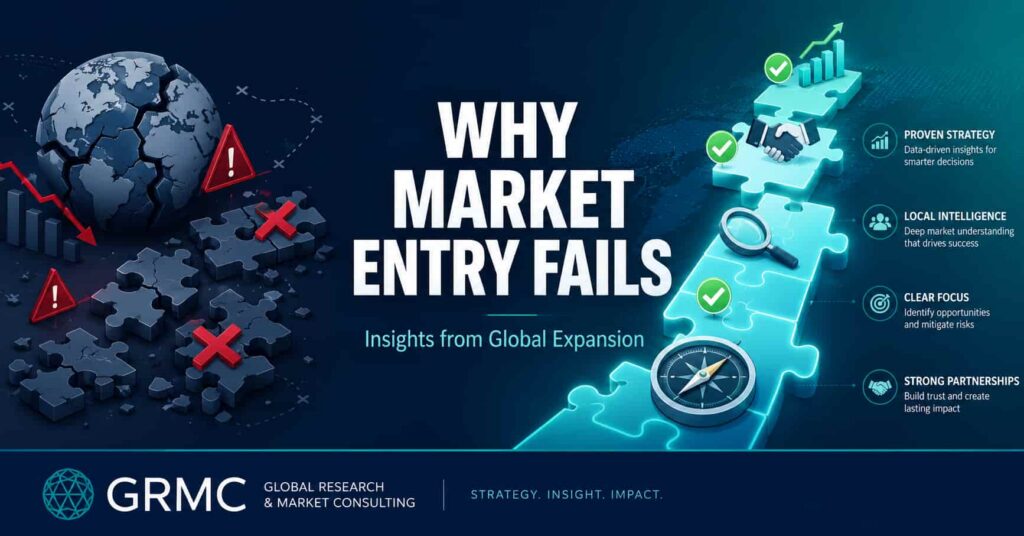
For every company that successfully navigates international expansion, countless others retreat quietly, having discovered—too late—that their proven domestic playbook held little relevance in a new cultural or economic landscape. Global market entry is one of the highest-stakes strategic decisions an organization can make. The difference between success and failure is rarely capital or brand recognition. It is the quality of insights guiding the decisions.
At GRMC EdgeSphere, we have observed a recurring pattern in our work with businesses across the Caribbean, LATAM, Africa, and beyond: companies frequently underestimate the depth of adaptation required to thrive in a new region. A well-designed global market entry strategy—grounded in rigorous research, cultural intelligence, and regulatory awareness—is the cornerstone of sustainable international growth . Without this foundation, even the most ambitious expansion plans are susceptible to predictable, and often costly, failure.
The High Cost of “Copy-Paste” Expansion
The impulse to replicate a successful domestic model is understandable. It is efficient, scalable, and often reflects the very confidence that drove the decision to expand in the first place. Yet, as a growing body of evidence suggests, business models are rarely as transferable as leadership teams hope. The failure to adapt to local realities has led to some of the most notable and expensive market entry failures in modern business history.
Consider the experiences of globally recognized brands: Walmart’s nearly decade-long struggle in Germany stemmed from a fundamental misreading of cultural expectations and labor laws . Target’s rapid, unsupported entry into Canada showcased that brand familiarity cannot compensate for operational and supply chain unpreparedness . Uber’s aggressive foray into China underestimated the power of a well-entrenched, locally-adapted competitor and the complexity of the regulatory environment . These are not cautionary tales for cash-strapped startups; they are evidence that the “copy-paste” approach carries immense risk for enterprises of any size.
These case studies reveal a clear, common thread. The failures were not typically due to a lack of capital or intent. They were failures of insight . Each company operated under the assumption that its value proposition, operational model, and cultural assumptions would resonate internationally. This overconfidence, often the byproduct of domestic success, can blind leadership to the critical nuances of a new target market.
The “Temporal Optimism Trap” and Market Realities
A growing body of academic research highlights a particularly insidious reason for market entry failure: the “temporal optimism trap.” This phenomenon describes the tendency for multinational companies to maintain an overly optimistic view of how quickly they can achieve success in unfamiliar environments . This optimism is often rooted in a “clock time” perspective—common in Western markets—where time is measured linearly and success is expected on a strict schedule.
In many emerging markets, however, time is often perceived as cyclical and relational (“event time”), where success depends more on the organic development of relationships and the natural evolution of market conditions . A study of GlaxoSmithKline’s (GSK) expansion into emerging markets illustrates this perfectly. GSK set ambitious three-year timelines for its asthma medication, Rotacaps, expecting rapid uptake. However, the necessary infrastructure, physician training, and patient education lagged behind, leading to significant losses. In contrast, the company’s Ventolin Nebules succeeded because it adopted a more deliberate, flexible, and partner-centric approach, aligning its expectations with local realities .
How Companies Fall into the Trap
The temporal optimism trap often manifests in three distinct ways:
- Temporal Misalignment: Imposing rigid headquarters-driven deadlines that create friction with local partners and customers who operate on different cycles. Local partners often advocate for significantly longer time horizons to build the necessary relationships and infrastructure.
- The Speed Fallacy: The belief that rapid market entry and aggressive scaling create momentum. In reality, rapid expansion often amplifies existing gaps in areas like regulatory compliance, partner networks, and customer education.
- Temporal Myopia: An excessive focus on short-term results that undercuts the long-term investments required for sustainable growth. Companies may prematurely abandon a market because it fails to meet unrealistic near-term targets, forgoing the long-term returns that are often the true reward of international expansion .
Strategic Approaches to Successful Market Entry
Avoiding these pitfalls requires a systematic, research-driven approach. Success is not about moving faster; it is about moving smarter. This involves addressing several critical dimensions of the market entry challenge.
1. Timing and Market Selection
Determining when and where to expand is the first crucial decision. Leaders must evaluate the strategic fit of a market, the presence of their ideal customer profile (ICP), and their own “speed-to-win” potential . This goes beyond simple metrics like GDP or population growth.
A robust market selection framework should include an analysis of language and cultural barriers, payment infrastructure, sales cycle similarity, regulatory complexity, the competitive landscape, customer acquisition costs, and the strength of the partner ecosystem . For instance, while Asia and Latin America present rising demand fueled by growing middle classes, the feasibility of entry is heavily influenced by local requirements, tariffs, and trade restrictions .
2. The Hybrid Go-To-Market Team Model
How a company structures its go-to-market (GTM) team can significantly impact its ability to learn and adapt. A phased, “hybrid” model has proven effective. In the initial phase (months 1-6), the company can operate with a small, headquarters-based team to validate the market fit and establish core processes. This lean approach allows for rapid iteration without the burden of premature local infrastructure costs.
As the market shows a positive trajectory (months 7-12), the company can transition to establishing “local execution pods,” hiring local account executives and country managers . This ensures that decision-making is informed by on-the-ground intelligence, reducing the risk of cultural misunderstandings and operational missteps.
3. The “Test, Learn, Scale” Philosophy
Perhaps the most critical lesson from failed market entries is the importance of validation before scaling. A methodical progression—from digital testing with localized campaigns, to securing pilot customers, to market validation with a formal support process, and finally to full market entry—allows companies to test assumptions with limited risk . This iterative approach ensures that substantial resources are only deployed when the value proposition has been proven in the specific context of the new market.
Diagnostic Questions for Decision-Makers
Before finalizing any expansion plan, leadership teams must answer a series of difficult questions. The answers are rarely found in internal spreadsheets; they require primary, on-the-ground research.
- Regulatory Architecture: Is the regulatory environment welcoming or restrictive? Are there specific local requirements (e.g., for licensing, data residency, or local content) that will fundamentally impact our business model ?
- Competitive Landscape: Are there established local players with deep customer relationships and government ties? Is the market fragmented, creating an opportunity for disruption, or dominated by a few powerful incumbents ?
- Consumer Psychology: What are the actual behaviors, payment habits, and trust mechanisms of our target customers? How do these differ from our home market ?
- Distribution Reality: What is the most effective and accepted way to reach customers? Does this require adapting our channel strategy to local norms ?
- Operational Readiness: Is our supply chain, support structure, and product truly ready for the specific logistical and infrastructure challenges of the new market ?
How GRMC EdgeSphere Can Help
At GRMC EdgeSphere, we understand that successful international expansion is a complex, multi-faceted challenge that requires deep, localized expertise. We are an international market research and strategic consulting firm dedicated to helping organizations navigate this complexity . Our approach is designed to move beyond surface-level analysis to deliver the actionable intelligence that drives confident decision-making.
- Comprehensive Market Feasibility & Entry Reports: We provide in-depth analysis of target markets, examining everything from consumer behavior and competitive dynamics to regulatory frameworks and economic forecasts .
- Emerging Markets Intelligence: Our proprietary tools and regional expertise offer granular insights into high-growth areas in LATAM, the Caribbean, Africa, and Asia, helping you identify and seize high-potential opportunities .
- Cross-Border Regulatory & Compliance Advisory: We help you navigate the complex web of international regulations, including licensing, data residency (e.g., GDPR), ESG reporting, and taxation, ensuring your entry is both compliant and strategically sound .
We empower businesses, governments, and NGOs to make smarter, more resilient market entry decisions. Our blend of traditional research and advanced analytics provides the clarity needed to build a sustainable presence in any region. By treating every market as a distinct and complex challenge—rather than a blank slate for an existing playbook—we help our clients avoid the costly patterns that have derailed so many others.
Ready to expand with confidence?
Contact GRMC EdgeSphere today to begin a conversation about your unique challenges and aspirations in new markets.