
Introduction
Organizations today generate unprecedented amounts of data through customer interactions, digital platforms, business operations, IoT devices, and market research activities. While data has become one of the world’s most valuable business assets, its true value depends on how effectively it is managed.
Artificial Intelligence (AI), Business Intelligence (BI), predictive analytics, and digital transformation initiatives all rely on one critical element: high-quality, trustworthy data.
Without proper data governance, organizations risk making decisions based on inaccurate, inconsistent, or insecure information. Poor governance can lead to compliance issues, operational inefficiencies, reputational damage, and failed AI initiatives.
Data governance provides the framework that ensures data remains accurate, secure, accessible, and reliable—allowing organizations to make confident, evidence-based decisions.
What Is Data Governance?
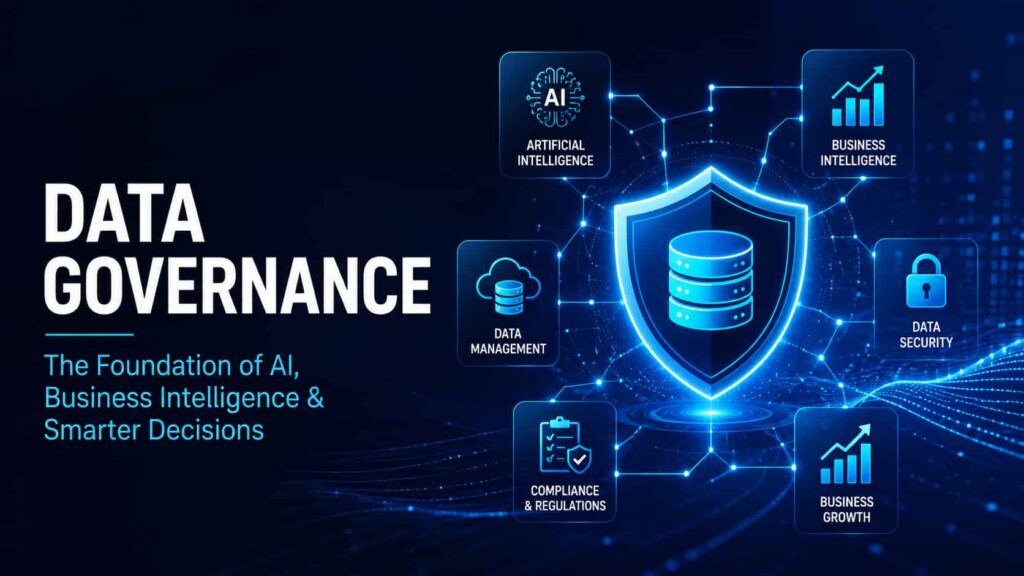
Data governance is the collection of policies, processes, standards, and responsibilities that guide how an organization’s data is collected, stored, managed, shared, protected, and used throughout its lifecycle.
Its purpose is not simply to control data but to ensure that everyone across the organization can trust it.
Effective data governance helps organizations answer important questions such as:
- Is our data accurate?
- Who owns this data?
- Who has permission to access it?
- How is sensitive information protected?
- Are we complying with applicable regulations?
When these questions have clear answers, organizations can confidently rely on their data for strategic decision-making.
Why Data Governance Matters More Than Ever
Businesses today make thousands of decisions every day based on data.
From launching new products to entering international markets, organizations increasingly depend on data to reduce uncertainty and improve outcomes.
Poor-quality data often results in:
- Incorrect business decisions
- Duplicate information
- Inconsistent reporting
- Security vulnerabilities
- Reduced customer trust
- Higher operational costs
Strong governance transforms data into a strategic asset rather than an operational challenge.
Data Governance and Artificial Intelligence
Artificial Intelligence is only as effective as the data used to train and operate it.
Even the most sophisticated AI models cannot compensate for incomplete, inaccurate, or biased information.
Organizations implementing AI should ensure that:
- Data is clean and validated.
- Information is consistently classified.
- Duplicate records are eliminated.
- Privacy requirements are respected.
- Data sources are transparent and documented.
High-quality governance improves AI accuracy while reducing bias and operational risk.
Supporting Better Business Intelligence
Business Intelligence platforms convert raw information into dashboards, reports, and performance indicators.
However, inaccurate data leads to misleading insights.
Strong governance enables Business Intelligence by ensuring:
- Consistent reporting across departments
- Reliable key performance indicators (KPIs)
- Standardized business definitions
- Real-time access to trusted information
- Improved collaboration between teams
Decision-makers can focus on strategy instead of questioning the accuracy of reports.
Key Components of an Effective Data Governance Framework
Successful organizations establish governance through several essential components.
1. Data Quality Management
Reliable decisions require reliable information.
Organizations should regularly monitor:
- Accuracy
- Completeness
- Consistency
- Timeliness
- Validity
Routine quality checks help maintain confidence in organizational data.
2. Data Security
As cyber threats continue to evolve, protecting sensitive information has become a business priority.
Effective governance includes:
- Role-based access controls
- Data encryption
- Continuous monitoring
- Secure storage
- Incident response planning
Strong security protects both organizational assets and customer trust.
3. Compliance and Regulatory Readiness
Organizations operating internationally must comply with evolving data protection regulations.
A structured governance framework supports:
- Regulatory compliance
- Audit readiness
- Transparent documentation
- Responsible data handling
Compliance should be integrated into daily operations rather than treated as an afterthought.
4. Clear Ownership and Accountability
Every critical dataset should have defined ownership.
Data owners are responsible for maintaining quality, approving access, and ensuring information remains current.
Clearly assigned responsibilities reduce confusion and improve accountability across the organization.
Benefits of Strong Data Governance
Organizations that invest in governance gain long-term strategic advantages.
These include:
- More accurate business decisions
- Improved customer confidence
- Stronger cybersecurity posture
- Better AI performance
- Faster reporting
- Lower operational costs
- Increased regulatory compliance
- Greater organizational transparency
Instead of spending time correcting data problems, teams can focus on innovation and growth.
Common Challenges Organizations Face
Although governance delivers significant value, implementation is not without challenges.
Organizations frequently encounter:
- Data stored across multiple systems
- Inconsistent reporting standards
- Limited internal expertise
- Resistance to organizational change
- Legacy technology limitations
Addressing these challenges requires executive commitment, cross-functional collaboration, and continuous improvement.
How GRMC Helps Organizations Build Data Confidence
At GRMC, data is viewed as more than information—it is a strategic business asset.
By combining market research, business intelligence, AI-driven analytics, cybersecurity expertise, and strategic consulting, GRMC helps organizations establish trusted data foundations that support confident decision-making.
GRMC works with businesses, governments, NGOs, and international organizations to develop practical solutions that improve data quality, strengthen governance practices, and enable successful digital transformation initiatives.
Whether supporting market expansion, policy development, operational improvement, or innovation, GRMC empowers clients to transform reliable data into measurable business value. GRMC’s service portfolio spans market research, strategic consulting, AI, business intelligence, cybersecurity, and digital transformation.
Looking Ahead
As AI adoption accelerates and organizations become increasingly data-driven, governance will continue to play a central role in business success.
Companies that establish trusted data foundations today will be better equipped to:
- Embrace artificial intelligence responsibly
- Deliver accurate business intelligence
- Improve customer experiences
- Strengthen cybersecurity
- Adapt confidently to changing markets
Data governance is no longer just an IT initiative—it is a strategic capability that supports innovation, resilience, and sustainable growth.
Conclusion
Every successful AI model, insightful dashboard, and strategic business decision begins with trustworthy data.
Organizations that prioritize data governance create an environment where information is accurate, secure, accessible, and actionable. This enables leaders to make informed decisions with confidence while reducing operational risk and supporting long-term growth.
As businesses continue their digital transformation journeys, investing in data governance is not simply about managing information—it is about building the foundation for smarter decisions, stronger performance, and lasting competitive advantage.
About GRMC
Global Research & Marketing Consultants (GRMC) is a leading international market research, strategic consulting, and business intelligence firm that helps organizations transform complex data into meaningful insights. Through advanced market research, AI-powered analytics, cybersecurity expertise, digital transformation services, and evidence-based consulting, GRMC empowers businesses, governments, NGOs, and institutions to make informed decisions and achieve sustainable growth in an increasingly data-driven world.