

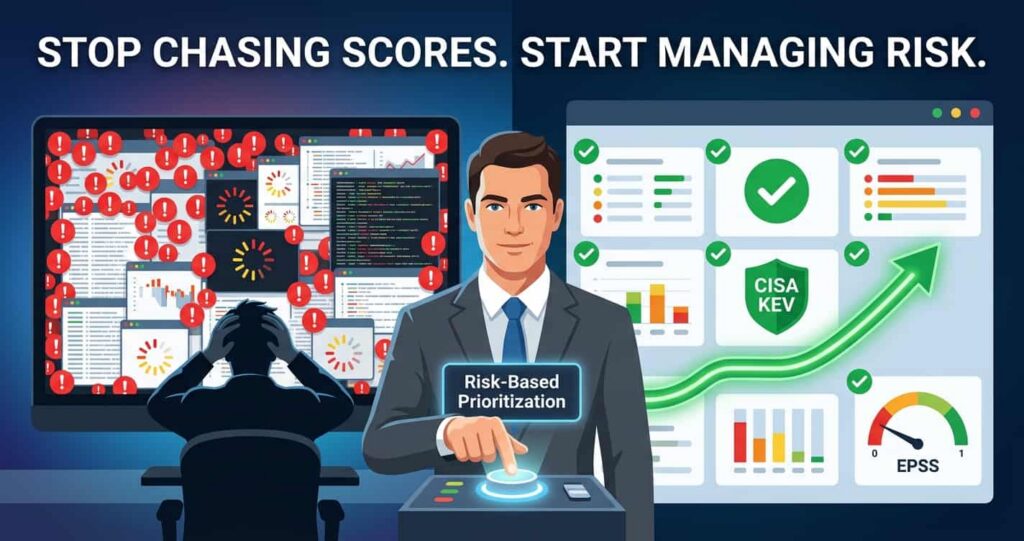
This scenario is playing out in enterprises globally—a direct result of vulnerability fatigue, where security teams are overwhelmed by the sheer volume of alerts and often prioritize the wrong issues. The data is stark: in 2025, over 48,000 new CVEs were published, yet less than 0.5% are confirmed to be exploited in the wild. This is not a resource problem; it’s a prioritization problem.
At GRMC EdgeSphere, we see this firsthand. Our approach, grounded in frameworks like NIST, ISO 27001, and Zero Trust, reframes the challenge: Risk is not a severity score; it is the intersection of exploitability, business context, and existing controls.
Why Your Dashboard is Lying to You: The CVSS Trap
The Common Vulnerability Scoring System (CVSS) is a useful technical severity metric, but it is not a business risk metric. A CVSS 9.8 (Critical) flaw from 2019 on a server behind three firewalls with an active EDR is almost certainly not your top priority. Yet, many teams waste countless hours and resources on such issues, driven by red alerts on their dashboards.
This misalignment is compounded by the recent announcement from NIST that it will no longer enrich most CVEs in the National Vulnerability Database (NVD). With CVE submissions up 263% since 2020, relying on NVD for a prioritization workflow is a permanent downgrade in data quality. The traditional approach of “sort by CVSS, patch the highest” is now publicly broken.
A Better Way: A Risk-Based Prioritization Framework
The solution is to stop managing a list of CVEs and start managing real business risk. The industry is shifting towards frameworks like the Continuous Threat Exposure Management (CTEM) and utilizing Vulnerability Prioritization Technology (VPT) . This requires a holistic view that integrates threat intelligence and business context.
Here is how you can operationalize this today:
1. Prioritize Exploitability, Not Severity
Focus on vulnerabilities that are likely to be used in an attack. Your primary signal should be the CISA Known Exploited Vulnerabilities (KEV) Catalog. If a vulnerability is on the KEV list, it should be patched immediately, regardless of its CVSS score. Complement this with the Exploit Prediction Scoring System (EPSS), which predicts the likelihood a vulnerability will be exploited in the next 30 days.
2. Understand Your Business Context
As recommended by ISO 27001 (Control A.8.8) and the CIS Controls, a vulnerability assessment must be governed by a risk-based process that links technical findings to asset criticality.
When evaluating a vulnerability, ask:
- Is the vulnerable asset internet-facing? Internet-facing systems are a higher priority than internal ones.
- Does it process sensitive data (PII, PHI, financial data)? A breach here has regulatory and reputational consequences.
- What is the business impact? Does this asset support a core revenue-generating system?
3. Apply the “Zero Trust” Mitigation Factor
Modern exposure management tools can automatically de-prioritize vulnerabilities that are already mitigated by existing controls. For example, if a critical vulnerability like Log4Shell (CVE-2021-44228) is blocked by a Zero Trust architecture (e.g., Zscaler’s ZIA or ZPA IPS), the effective risk is significantly reduced. This application of the Zero Trust principle allows teams to focus on actual, exploitable risk rather than theoretical weaknesses.
Measuring Success: From Activity to Impact
As highlighted by CTEM principles, the goal is to reduce the overall risk exposure, not just close tickets. Your board reports should not focus on the volume of vulnerabilities patched, but on the reduction in risk to the business.
Key metrics to track include:
- Mean Time to Remediate (MTTR) for vulnerabilities with active exploits (KEV/EPSS).
- Risk Reduction Over Time: Tracking how your overall exposure decreases as you fix what truly matters.
- Resource Coverage: Ensuring complete visibility of all resources in your environment.
By adopting a risk-based, exploitability-focused strategy, you move from a state of vulnerability fatigue to one of strategic resilience. You align your security operations with business objectives, comply with frameworks like NIST and ISO 27001, and most importantly, you stop chasing ghosts and start preventing breaches.