

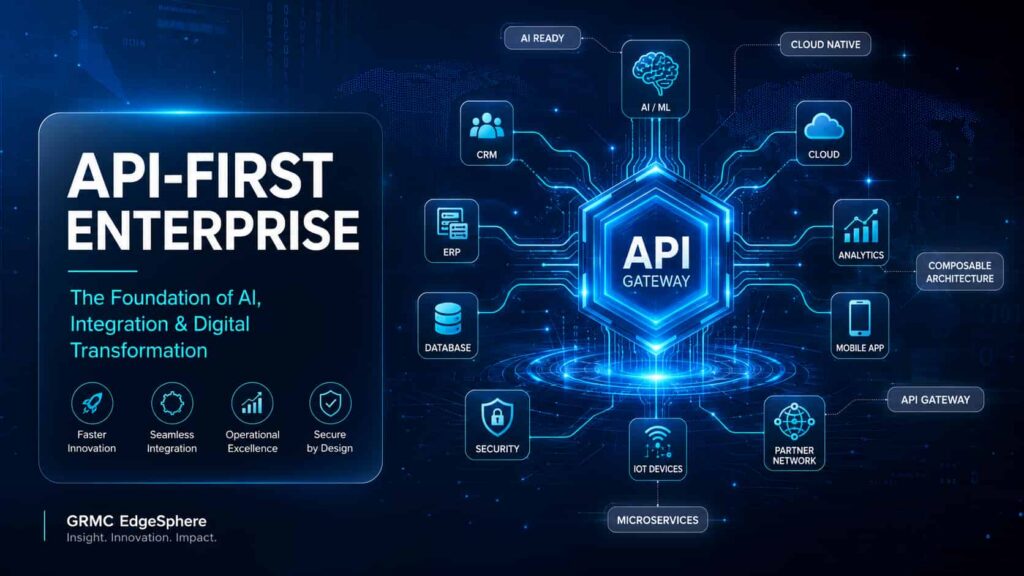
In today’s hyper-connected digital economy, the speed at which your enterprise can integrate systems, data, and partners has become the single most critical factor in determining your competitive advantage. The era of monolithic, siloed IT architectures is over. We have entered the age of the API-First Enterprise, where modularity, reusability, and seamless connectivity are not just technical preferences but strategic business imperatives.
For C-suites and innovation leaders, the message is clear: integration is no longer an IT plumbing problem; it is the foundation for scalable growth, operational efficiency, and the successful deployment of AI and automation at scale.
The Strategic Imperative of API-First
An API-first approach means designing your products, systems, and services with Application Programming Interfaces (APIs) at their core, rather than as an afterthought. This architectural philosophy champions a “contract-first” design, where the API is defined before the underlying code is written, ensuring every service is modular, reusable, and ready to connect with internal systems, customer-facing applications, partner solutions, and cloud services .
From Integration Obstacle to Strategic Enabler
Modern enterprises operate in a complex web of CRM, ERP, cloud applications, marketing tools, AI engines, and data pipelines. These systems need to communicate effortlessly to deliver real-time insights and fluid operations . An API-first strategy provides the predictable, consistent, and scalable integration paths required to make this happen.
Consider the tangible results. A Forrester Total Economic Impact™ study commissioned by MuleSoft found that a composite organization achieved a 426% ROI over three years by adopting a unified API and integration platform . This isn’t just about cost savings; it’s about enabling new revenue streams. The study revealed that by accelerating time-to-market for new products by 40%, organizations generated over $38 million in additional revenue .
Concrete Business Outcomes for the C-Suite
For the CEO, CTO, and CIO, this translates into three key strategic advantages:
1. Unmatched Development Velocity and Efficiency
An API-first architecture empowers development teams to work independently on modular capabilities. New features can be built, tested, and deployed without waiting for full system releases . The efficiency gains are profound. MuleSoft’s study showed that an API-led approach reduces the effort required for API and integration delivery by 60%, with 45% of assets being reused across multiple projects, leading to $2.8 million in labor savings over three years .
2. The Foundation for Superior Omnichannel Experiences
Customers today expect seamless continuity across mobile apps, websites, partner portals, and even IoT devices. APIs make this possible by exposing the same services and data consistently across every channel . In the financial sector, Global Credit Union leveraged its API platform to process 300 million transactions annually, reducing calls to its member service center by 26% by providing real-time transaction data. This freed up the equivalent of seven full-time employees to focus on complex problem resolution .
3. Scalable Innovation and Future-Proofing
As business needs evolve, well-designed APIs allow you to add new digital channels, partner with third parties, and scale individual components based on specific demand patterns without rebuilding core functionality . This future-proofing is essential for embracing emerging technologies like AI and agentic commerce, where autonomous systems require immediate, secure access to data and processes . The modern enterprise needs a “composable” architecture built on microservices and APIs, where components are interchangeable and can be scaled independently .
The Enabler of AI and Automation at Scale
The most compelling reason for an API-first strategy today is its role in enabling AI and automation. Agentic AI—autonomous agents that act on behalf of users—cannot function effectively in a siloed environment. These systems require clean, accessible, real-time data to understand context and mimic human behaviour . A robust API layer provides the essential “plumbing” for these agents to operate, orchestrating complex workflows and integrating with legacy systems as if they were part of a single, modern platform .
Conclusion: The Path Forward
An API-first approach is no longer a niche engineering practice; it is a fundamental business strategy that enables scale, innovation, and resilience . Organizations that adopt it will accelerate their digital transformation and stay ahead of competitors. Those that delay risk being burdened by rigid legacy systems, escalating integration costs, and the inability to capitalize on the transformative potential of AI.
GRMC EdgeSphere stands ready to guide your enterprise on this journey. By leveraging our expertise in global market research, strategic consulting, and technology-forward solutions, we help organizations build the API-driven digital fabric required to thrive in a connected world. This is the foundation for delivering insight, innovation, and lasting impact.
FAQ
What exactly is an “API-First Enterprise”?
An API-First Enterprise is one that designs its software and systems with APIs as the foundational building block from the start. Instead of building applications and then adding APIs as an afterthought, the API is designed first, ensuring that all services are modular, reusable, and easily connectable. This approach creates a more agile, scalable, and integrated digital ecosystem .
Why is integration speed now a competitive advantage?
In the digital economy, success is driven by ecosystems and seamless digital experiences. The faster you can integrate your systems, data, and partners, the faster you can launch new products, respond to market changes, and deliver superior customer experiences. This agility translates directly into revenue growth and operational efficiency, making integration speed a key strategic differentiator .
How does an API-first approach enable AI and automation?
AI and automation tools, especially autonomous agents, require access to clean, real-time data from multiple systems to function effectively. An API-first approach provides a standardized and secure way to unlock and expose this data, allowing AI engines to orchestrate complex workflows and perform tasks across the entire enterprise without manual intervention .
What are the measurable ROI benefits of an API-first strategy?
The ROI can be substantial. Industry studies have shown that organizations can achieve a 426% ROI, primarily through developer productivity gains (up to 60% reduction in effort), faster time-to-market (up to 40% faster), and significant operational efficiencies . These productivity gains lead to direct cost savings and enable new revenue opportunities by accelerating innovation and delivery .
Can an API-first strategy help modernize legacy systems?
Yes, absolutely. An API-first approach is a powerful way to modernize legacy systems without costly and risky overhauls. By creating an “API wrapper” around existing, business-critical applications (like Siebel CRM or SAP), you can expose their functionality through modern, REST-based APIs. This allows them to interoperate with new, cloud-native applications and AI agents, preserving existing investments while enabling innovation