🌍 Introduction
When organizations evaluate expansion opportunities, they often ask a familiar question:
“Which market should we enter?”
While market selection is undoubtedly important, another factor frequently determines whether an expansion succeeds or fails:
Timing.
A market with excellent long-term potential can still produce disappointing results if an organization enters too early, before customer demand has matured, or too late, after competitors have established strong market positions.
This is where Market Timing Intelligence becomes a strategic advantage.
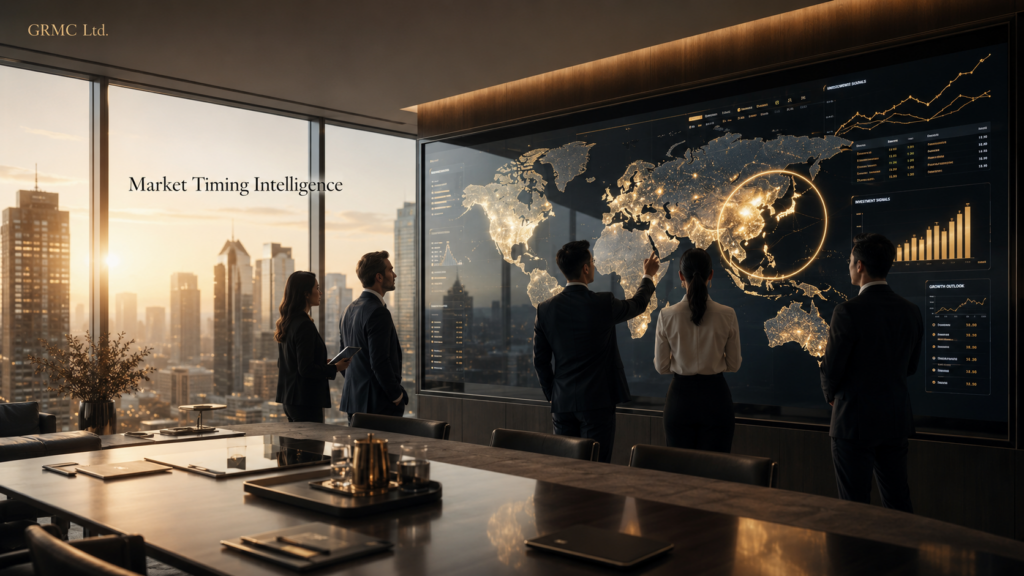
Market Timing Intelligence is the practice of using market research, competitive intelligence, economic indicators, consumer behavior analysis, investment trends, and industry forecasting to determine when organizations should launch products, enter new markets, invest in expansion, or introduce new services.
For executives, investors, government agencies, and business leaders, timing is increasingly becoming as important as location, pricing, or product quality.
📊 Industry Overview
Modern markets evolve faster than ever before.
Technological innovation, changing customer expectations, regulatory developments, geopolitical events, demographic shifts, and economic conditions continuously reshape industries.
Many organizations conduct extensive market research before expansion but overlook one critical variable—market readiness.
Successful organizations no longer ask only:
- Is there demand?
- Who are the competitors?
- What is the market size?
They also ask:
- Is the market ready today?
- Will demand increase over the next two years?
- Are customers prepared to adopt this solution?
- Are regulations favorable for expansion?
- Is this the optimal investment window?
Answering these questions requires continuous Market Timing Intelligence rather than one-time research.
⚠️ Key Challenges
⏰ Entering Too Early
Innovative organizations sometimes introduce products before customers fully understand their value.
Early entry can result in slow adoption, higher education costs, and delayed returns on investment.
🏁 Entering Too Late
Waiting too long allows competitors to strengthen brand recognition, customer loyalty, and distribution networks.
Late entrants often face higher acquisition costs and reduced market share.
📉 Misreading Economic Conditions
Inflation, interest rates, consumer confidence, and investment cycles significantly influence purchasing behavior.
Ignoring these factors can reduce expansion success.
🌍 Regulatory and Policy Changes
Government incentives, trade agreements, industry regulations, and policy reforms can rapidly improve—or reduce—a market’s attractiveness.
Organizations need timely intelligence to adapt.
🔄 Shifting Customer Expectations
Consumer priorities evolve continuously.
Products that meet today’s needs may require different positioning in just a few years.
Understanding when these shifts occur is essential for successful market entry.
📈 Market Research Insights
📊 Timing Creates Competitive Advantage
Organizations that identify emerging demand before competitors often establish stronger market positions with lower customer acquisition costs.
🌍 Leading Indicators Matter More Than Historical Data
Historical sales data explains past performance.
Leading indicators—such as investment activity, infrastructure projects, technology adoption, hiring trends, and consumer sentiment—provide clues about future opportunities.
🛒 Customer Readiness Determines Adoption
Even an excellent product may struggle if customers are not yet ready to adopt it.
Market research should evaluate not only customer needs but also their willingness and ability to change.
📍 Expansion Windows Are Often Temporary
Infrastructure investments, regulatory reforms, demographic growth, and industry development can create limited periods of exceptional opportunity.
Organizations that monitor these changes are better positioned to act at the right moment.
🌐 Continuous Monitoring Supports Better Decisions
Market timing is not a one-time assessment.
Organizations that monitor market conditions throughout the year are better equipped to respond quickly when favorable opportunities emerge.
🛠️ Practical Recommendations
📑 Monitor Leading Market Indicators
Track trends such as:
- Consumer confidence
- Investment activity
- Industry growth
- Technology adoption
- Regulatory developments
- Infrastructure expansion
These indicators often signal future market opportunities.
📊 Combine Market Size with Market Readiness
A large market does not automatically represent the best opportunity.
Evaluate customer readiness, competitive intensity, economic conditions, and regulatory support before investing.
🔍 Build an Early Warning System
Develop a structured process for identifying emerging risks and opportunities before they become widely recognized.
This enables faster and more confident strategic decisions.
🤝 Align Timing with Business Capability
Organizations should ensure they possess the operational capacity, financial resources, and workforce needed to capitalize on favorable market conditions.
📈 Review Timing Assumptions Regularly
Market conditions evolve rapidly.
Periodic reviews help organizations adjust expansion strategies before conditions change.
🤝 How GRMC Can Help
GRMC EdgeSphere helps organizations determine not only where to grow but also when to grow through advanced market research and business intelligence services.
📊 Market Timing Assessments
We evaluate market readiness, growth indicators, customer demand, and investment conditions.
🌍 Economic & Industry Intelligence
Our experts monitor economic trends, regulatory developments, and industry changes that influence market opportunities.
🔍 Competitive Intelligence
GRMC provides ongoing insight into competitor activity, market positioning, and emerging threats.
👥 Consumer Readiness Research
We assess customer behavior, adoption trends, and purchasing intentions to support successful product launches and market expansion.
📈 Strategic Growth Advisory
Our consultants help organizations align investment decisions with evolving market conditions, reducing uncertainty and improving long-term returns.
🚀 Conclusion
Choosing the right market is only part of the equation.
Choosing the right time can determine whether an investment becomes a market leader or a missed opportunity.
Market Timing Intelligence enables organizations to move beyond static market analysis by understanding when demand, competition, economic conditions, and customer readiness align to create the strongest opportunity for growth.
As business environments become increasingly dynamic, organizations that combine market research with continuous timing intelligence will make more confident investments, reduce strategic risk, and gain a lasting competitive advantage.
GRMC EdgeSphere empowers organizations with the research, intelligence, and strategic insight needed to identify the right opportunity at the right time.