

🌍 Introduction
Cybersecurity is no longer measured solely by the number of attacks an organization blocks. In today’s rapidly evolving threat landscape, business leaders are asking a more strategic question: How prepared are we compared to our industry peers?
Many organizations invest in advanced security technologies, employee awareness training, and compliance initiatives. However, without understanding how their cybersecurity maturity compares with industry standards and competitors, it is difficult to determine whether these investments are truly effective.
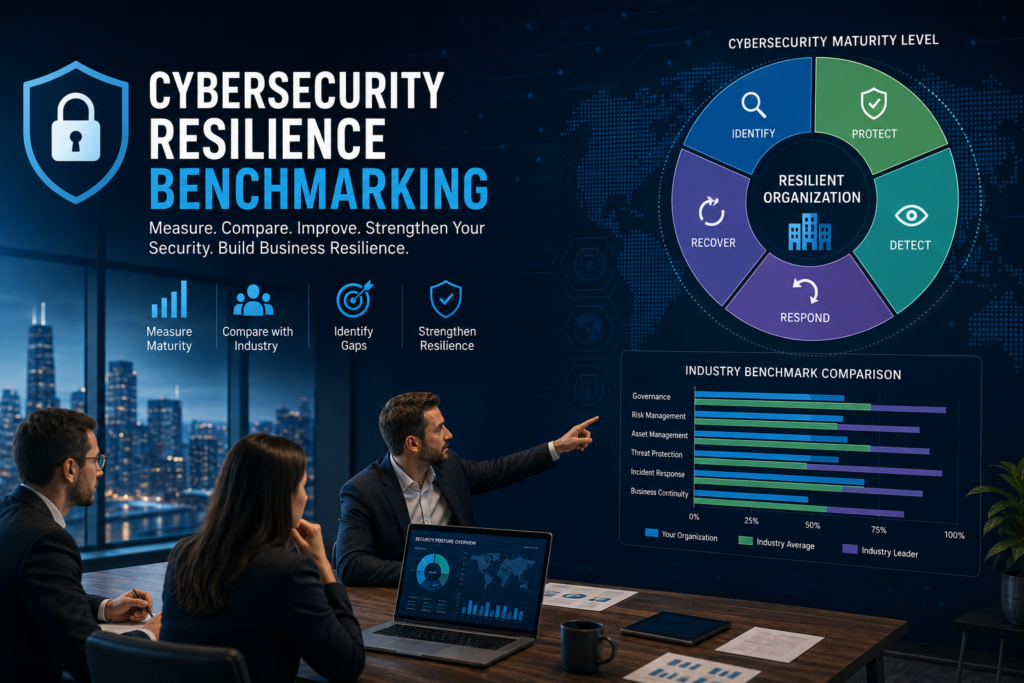
This is where Cybersecurity Resilience Benchmarking becomes essential. It is a strategic assessment process that evaluates an organization’s cybersecurity capabilities against recognized frameworks, industry best practices, regulatory requirements, and peer organizations.
Rather than focusing only on technical vulnerabilities, resilience benchmarking provides a comprehensive view of an organization’s ability to prevent, detect, respond to, and recover from cyber incidents.
For CEOs, CIOs, CISOs, boards of directors, government agencies, and enterprise leaders, cybersecurity resilience benchmarking provides valuable insights that support smarter investments, stronger governance, and long-term digital resilience.
📊 Industry Overview
Digital transformation has significantly expanded the way organizations operate. Cloud computing, hybrid work models, artificial intelligence, Internet of Things (IoT) devices, and interconnected supply chains have created tremendous business opportunities while simultaneously increasing cybersecurity complexity.
At the same time, cyber threats continue to evolve. Attackers are using automation, artificial intelligence, and sophisticated social engineering techniques to target organizations of every size. As a result, cybersecurity has become a continuous business function rather than a one-time technical project.
Industry frameworks such as the NIST Cybersecurity Framework, ISO/IEC 27001, CIS Critical Security Controls, and other internationally recognized standards provide organizations with structured approaches to improving cybersecurity maturity.
However, implementing these frameworks alone does not answer an important question:
How resilient is the organization compared to others operating in the same industry?
Cybersecurity Resilience Benchmarking helps organizations answer this question through structured assessments, maturity evaluations, and comparative analysis.
⚠️ Key Challenges
📉 Limited Visibility into Security Maturity
Many organizations understand their existing security controls but lack a clear understanding of how mature or effective those controls are compared with industry expectations.
🔍 Compliance Does Not Always Equal Security
Meeting regulatory requirements is important, but compliance alone does not guarantee protection against modern cyber threats. Organizations must evaluate operational resilience in addition to regulatory obligations.
🌐 Rapidly Changing Threat Landscape
Cyber threats evolve much faster than traditional security review cycles. Organizations that benchmark their security only occasionally may fail to identify emerging weaknesses.
🤝 Inconsistent Security Practices Across Business Units
Large enterprises often operate multiple business units with different technologies, security policies, and operational processes. These inconsistencies can create gaps that attackers may exploit.
💰 Uncertain Security Investment Priorities
Without benchmarking data, leadership teams may struggle to determine whether cybersecurity budgets are being allocated to the areas that will produce the greatest reduction in organizational risk.
📈 Cybersecurity Insights
🛡 Security Maturity Is a Continuous Journey
Cybersecurity is not a destination. Organizations that regularly assess and improve their maturity levels are better positioned to adapt to evolving threats and changing business requirements.
📊 Benchmarking Supports Better Decision-Making
Comparing cybersecurity capabilities against industry standards provides executives with measurable insights that guide investment decisions and long-term planning.
🌍 Business Resilience Extends Beyond Technology
True cyber resilience includes governance, leadership, employee awareness, incident response, business continuity, disaster recovery, and third-party risk management—not just technical controls.
🔐 Data-Driven Assessments Improve Accountability
Objective benchmarking allows organizations to measure progress over time, demonstrate improvements to stakeholders, and establish realistic cybersecurity goals based on evidence rather than assumptions.
📈 Continuous Improvement Strengthens Competitive Advantage
Organizations with mature cybersecurity programs often experience greater customer trust, stronger regulatory confidence, reduced operational disruption, and improved business continuity.
🛠️ Practical Recommendations
📋 Perform Regular Cybersecurity Maturity Assessments
Evaluate cybersecurity capabilities annually or after significant organizational or technological changes to ensure security strategies remain aligned with current risks.
📊 Benchmark Against Recognized Frameworks
Assess security controls using internationally recognized frameworks such as NIST CSF, ISO/IEC 27001, and CIS Controls to identify strengths and improvement opportunities.
🔍 Measure Operational Readiness
Go beyond technical controls by evaluating governance structures, incident response capabilities, employee awareness programs, disaster recovery planning, and executive decision-making processes.
🤝 Include Third-Party Ecosystems
Benchmark the cybersecurity maturity of suppliers, technology vendors, and strategic partners to strengthen resilience across the broader business ecosystem.
📈 Develop Continuous Improvement Roadmaps
Use benchmarking results to create prioritized action plans with measurable objectives, defined responsibilities, and realistic implementation timelines.
🤝 How GRMC Can Help
GRMC EdgeSphere helps organizations evaluate and strengthen cybersecurity resilience through comprehensive assessments, strategic advisory services, and evidence-based security intelligence.
🛡 Cybersecurity Maturity Assessments
We evaluate organizational cybersecurity capabilities against leading international standards and industry best practices.
📊 Cyber Risk Intelligence
Our experts identify emerging threats, evolving risk trends, and industry developments that influence enterprise security strategies.
🔍 Governance and Compliance Advisory
GRMC supports organizations in strengthening cybersecurity governance while aligning security initiatives with regulatory expectations and organizational objectives.
🌐 Third-Party Risk Assessments
We evaluate supplier and partner cybersecurity maturity to reduce operational and supply chain risks.
📈 Executive Cybersecurity Strategy
Our consultants help leadership teams transform assessment findings into strategic cybersecurity roadmaps that improve resilience, operational continuity, and long-term business performance.
🚀 Conclusion
Modern cybersecurity is no longer defined solely by preventing attacks—it is defined by an organization’s ability to prepare for, withstand, respond to, and recover from cyber incidents.
Cybersecurity Resilience Benchmarking provides organizations with a clear understanding of where they stand, how they compare with industry standards, and what actions are needed to strengthen long-term security.
By combining structured assessments, recognized frameworks, and strategic business intelligence, organizations can make informed cybersecurity investments, improve operational resilience, and build greater confidence among customers, regulators, investors, and stakeholders.
GRMC EdgeSphere empowers organizations to strengthen cybersecurity resilience through comprehensive benchmarking, strategic advisory services, and data-driven security intelligence, helping enterprises navigate today’s complex digital risk landscape with confidence.