

🌍 Introduction
Organizations invest heavily in advanced cybersecurity technologies to defend against an increasingly sophisticated threat landscape. Firewalls, endpoint protection platforms, identity management systems, cloud security solutions, and Security Operations Centers (SOCs) all contribute to a stronger security posture. However, despite these investments, many successful cyberattacks do not occur because security technologies are absent—they occur because those technologies are improperly configured.
A single configuration error can expose sensitive customer information, create unauthorized access pathways, weaken identity controls, or unintentionally make critical systems accessible to attackers. As organizations expand their digital infrastructure across cloud environments, remote workforces, enterprise applications, and connected devices, maintaining secure configurations becomes increasingly challenging.
This is where Cybersecurity Configuration Risk Assessment plays a vital role.
Cybersecurity Configuration Risk Assessment is a structured process that evaluates how enterprise systems, applications, cloud environments, network devices, operating systems, and security platforms are configured to identify weaknesses that could increase organizational cyber risk. Rather than focusing solely on software vulnerabilities, configuration assessments examine whether existing technologies are securely implemented, consistently managed, and aligned with recognized security best practices.
Instead of asking “Do we have security controls?”, organizations begin asking more strategic questions:
- Are our security systems configured correctly?
- Which configuration weaknesses create the highest business risk?
- How can we reduce exposure without disrupting operations?
- Are our cloud environments following security best practices?
- How do we maintain secure configurations as our infrastructure evolves?
For CISOs, CIOs, CTOs, government agencies, enterprise leaders, and IT decision-makers, Cybersecurity Configuration Risk Assessment provides the visibility needed to strengthen cyber resilience before configuration errors become business incidents.
📊 Industry Overview
Enterprise technology environments have become significantly more complex over the past decade.
Organizations now operate across hybrid cloud platforms, multi-cloud infrastructures, virtualized environments, SaaS applications, mobile devices, remote work technologies, Internet of Things (IoT) devices, operational technology (OT), and third-party integrations.
Every new technology introduces hundreds or even thousands of configurable settings.
Authentication policies, encryption standards, firewall rules, user permissions, logging configurations, API security, cloud storage permissions, network segmentation, backup policies, and endpoint protection settings must all be configured correctly to provide effective protection.
Even highly secure technologies can become vulnerable when configuration standards are inconsistent across departments or environments.
Industry frameworks such as the Center for Internet Security (CIS) Benchmarks, NIST Cybersecurity Framework, and ISO/IEC 27001 emphasize secure configuration management as one of the most important components of enterprise cybersecurity maturity.
Cybersecurity Configuration Risk Assessment enables organizations to continuously verify that systems remain securely configured as infrastructure evolves.
⚠️ Key Challenges
🔧 Configuration Complexity
Modern enterprise platforms contain thousands of configurable options.
Maintaining secure settings across diverse technologies becomes increasingly difficult without standardized configuration management processes.
☁️ Cloud Misconfigurations
Cloud environments offer flexibility and scalability but also introduce new security responsibilities.
Misconfigured storage services, identity permissions, virtual networks, or cloud security policies can unintentionally expose sensitive information.
👥 Inconsistent Administrative Practices
Different administrators may configure similar systems differently, resulting in inconsistent security controls and increased operational risk.
🔄 Continuous Infrastructure Changes
Digital transformation projects, software updates, mergers, acquisitions, and cloud migrations frequently alter enterprise environments.
Configuration changes that are not properly reviewed may weaken previously effective security controls.
📉 Limited Visibility
Organizations often lack centralized visibility into configuration changes occurring across multiple business units, cloud platforms, and geographic regions.
Without continuous monitoring, configuration risks may remain undetected for extended periods.
📈 Cybersecurity Insights
📊 Secure Configurations Reduce Attack Opportunities
Many cyberattacks exploit configuration weaknesses rather than software flaws.
Consistently applying secure configuration standards significantly reduces an organization’s attack surface.
🔐 Identity Controls Are Equally Important
Strong authentication, least-privilege access, and well-managed administrative permissions are fundamental configuration controls that limit unauthorized access.
🌍 Standardization Improves Security Maturity
Organizations that implement standardized configuration baselines across enterprise environments achieve greater consistency, simplify audits, and improve operational efficiency.
📈 Continuous Monitoring Detects Drift
System configurations naturally change over time as new services are introduced, software is updated, or business requirements evolve.
Continuous monitoring helps identify configuration drift before it creates significant security exposure.
🤝 Executive Visibility Supports Better Governance
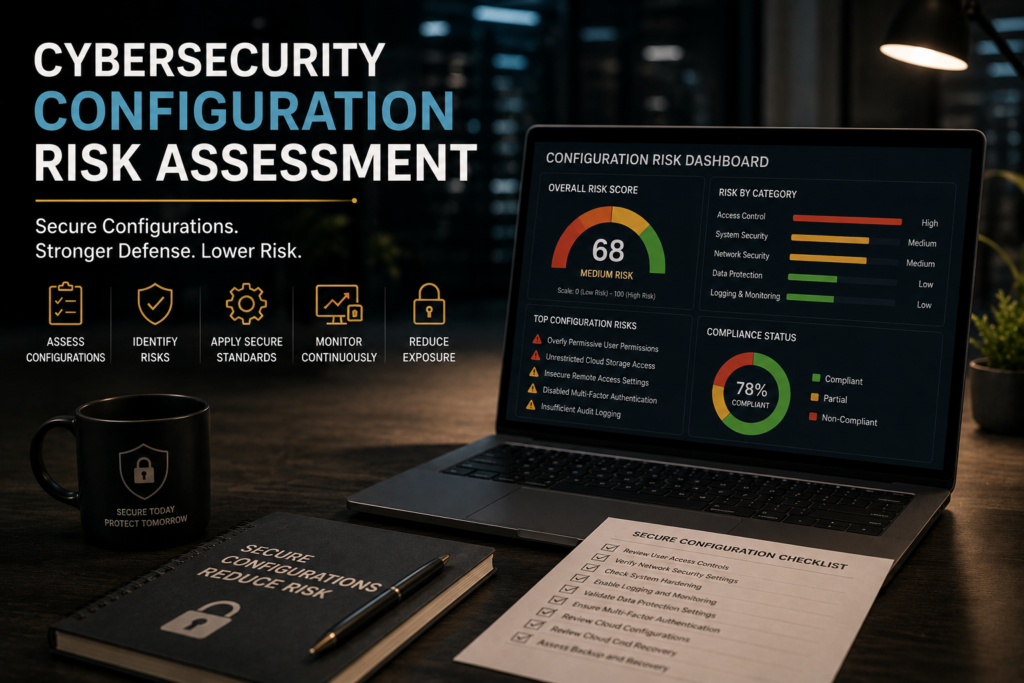
Business leaders benefit from dashboards that translate technical configuration risks into measurable business impacts, enabling informed investment and governance decisions.
🛠️ Practical Recommendations
📋 Establish Secure Configuration Baselines
Develop standardized configuration templates for servers, workstations, cloud platforms, network devices, databases, and enterprise applications using recognized security frameworks.
🔍 Perform Regular Configuration Assessments
Conduct scheduled reviews to identify unauthorized changes, insecure settings, excessive user privileges, and deviations from approved configuration standards.
☁️ Strengthen Cloud Security Configurations
Regularly evaluate cloud identity policies, storage permissions, encryption settings, virtual networking, logging, and workload isolation to reduce cloud-related risks.
🔐 Automate Configuration Monitoring
Implement automated tools that continuously monitor configuration changes, identify policy violations, and generate alerts when unauthorized modifications occur.
👥 Strengthen Change Management
Ensure every configuration change follows documented approval processes, testing procedures, and security reviews before implementation.
📊 Measure Configuration Compliance
Track compliance against organizational security baselines, regulatory requirements, and industry frameworks to support continuous improvement and executive reporting.
🤝 How GRMC Can Help
GRMC EdgeSphere helps organizations strengthen cybersecurity resilience through comprehensive configuration assessments, governance frameworks, and strategic security advisory services.
🔐 Configuration Risk Assessments
We evaluate enterprise infrastructure, cloud environments, operating systems, applications, and security technologies to identify configuration-related risks before they become security incidents.
☁️ Cloud Security Advisory
Our specialists assess cloud platforms to ensure identity management, storage configurations, networking, and security controls follow recognized industry best practices.
📊 Cybersecurity Governance
GRMC develops configuration governance frameworks that improve consistency, strengthen compliance, and support long-term cyber resilience.
🔍 Security Intelligence & Risk Analysis
We combine technical configuration assessments with business intelligence to prioritize remediation activities based on operational impact and organizational risk.
🌍 Executive Cyber Advisory
Our consultants help leadership teams strengthen cybersecurity strategies through evidence-based assessments, configuration governance, and continuous security improvement initiatives.
🚀 Conclusion
Strong cybersecurity depends not only on deploying advanced security technologies but also on ensuring those technologies are configured correctly and consistently across the organization.
Cybersecurity Configuration Risk Assessment provides organizations with the visibility needed to identify hidden configuration weaknesses, reduce cyber exposure, strengthen governance, and improve operational resilience.
By combining secure configuration standards, continuous monitoring, structured governance, and ongoing assessment, organizations can significantly reduce preventable security risks while supporting secure digital transformation.
GRMC EdgeSphere empowers organizations to strengthen their cybersecurity posture through configuration risk assessments, strategic advisory services, governance frameworks, and business-focused security intelligence—helping enterprises build secure, resilient, and future-ready digital environments.