🌍 Introduction
The future of enterprise productivity is not about replacing people with artificial intelligence—it is about enabling people and intelligent AI agents to work together effectively. As organizations adopt Agentic AI across customer service, finance, procurement, operations, cybersecurity, and business intelligence, the role of employees is evolving from executing repetitive tasks to supervising, collaborating with, and guiding autonomous AI systems.
This shift represents one of the most significant workplace transformations since the adoption of cloud computing and digital collaboration platforms.
While AI agents can process information at remarkable speed, automate routine workflows, monitor business systems continuously, and generate data-driven recommendations, they still rely on human judgment for strategic thinking, ethical decision-making, relationship building, and organizational leadership.
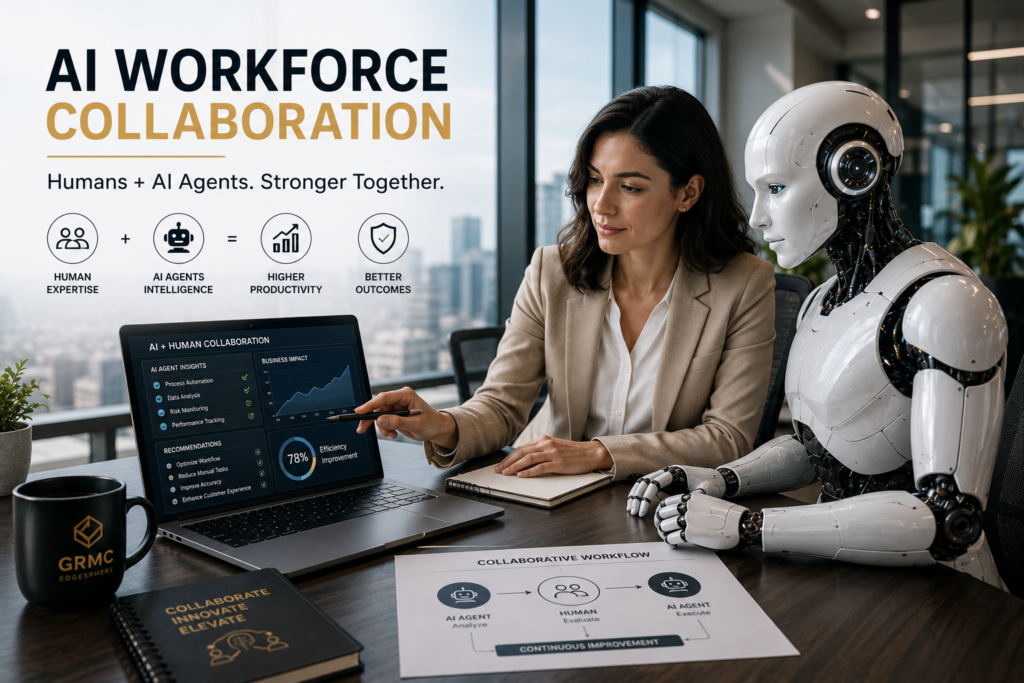
Organizations that successfully combine human expertise with autonomous AI are creating a new operating model known as AI Workforce Collaboration.
AI Workforce Collaboration is the structured integration of employees and intelligent AI agents into a unified operational environment where each contributes according to their strengths. Rather than functioning as separate resources, humans and AI collaborate to improve productivity, accelerate decision-making, enhance service quality, and support continuous innovation.
Instead of asking “How can AI replace this role?”, forward-thinking organizations are asking:
- Which responsibilities should remain human-led?
- Which repetitive processes should AI automate?
- How can employees collaborate effectively with AI agents?
- How should organizations govern human-AI workflows?
- What skills will future workforces require?
For CEOs, CIOs, CTOs, Chief Human Resources Officers, government agencies, and enterprise leaders, AI Workforce Collaboration is becoming a strategic capability that strengthens both operational performance and workforce resilience.
📊 Industry Overview
Across industries, organizations are deploying AI agents to support a growing range of business activities, including customer engagement, financial reporting, cybersecurity monitoring, supply chain management, document processing, compliance reviews, and market intelligence.
Early AI initiatives focused on automating isolated tasks. Today, organizations are moving toward integrated environments where AI agents participate in broader business workflows alongside employees.
For example, a procurement process may involve:
- An AI agent identifying inventory shortages
- Another agent evaluating supplier performance
- A finance AI validating budget availability
- A compliance AI checking purchasing policies
- A procurement manager reviewing recommendations
- Leadership approving strategic purchases
Rather than replacing employees, AI enables teams to focus on negotiation, strategic planning, relationship management, innovation, and executive decision-making.
This collaborative approach improves efficiency while preserving human accountability for critical business outcomes.
⚠️ Key Challenges
👥 Defining Roles Clearly
As AI becomes more capable, organizations must clearly define which responsibilities belong to AI agents and which require human expertise.
Poorly defined responsibilities may create confusion, duplicated work, or operational delays.
🤝 Building Employee Trust
Employees may hesitate to adopt AI if they view it as a replacement rather than a collaborative tool.
Organizations must demonstrate how AI supports productivity, learning, and professional growth.
📊 Maintaining Decision Accountability
While AI can analyze information and generate recommendations, organizations need clear governance that identifies who remains responsible for final business decisions.
🔐 Protecting Sensitive Information
AI agents often access confidential business data, customer records, financial information, and enterprise applications.
Robust identity management, access controls, and cybersecurity policies are essential.
📈 Developing New Workforce Skills
As AI adoption increases, employees require new capabilities in AI supervision, prompt engineering, workflow optimization, data interpretation, and digital collaboration.
Continuous learning becomes a business necessity.
📈 AI & Business Insights
🤖 AI Increases Workforce Productivity
Employees who collaborate with AI spend less time on repetitive administrative work and more time solving complex business problems, engaging customers, and driving innovation.
📊 Human Judgment Remains Essential
AI excels at analyzing large volumes of information, but human expertise remains critical for leadership, ethics, negotiation, creativity, and strategic planning.
🌍 Collaboration Improves Customer Experience
AI provides rapid responses and operational efficiency, while employees deliver empathy, relationship management, and personalized service.
Together, they create stronger customer experiences.
📈 Continuous Learning Strengthens Performance
Organizations that provide AI training and digital skills development enable employees to collaborate confidently with intelligent systems while adapting to changing technologies.
🔍 Governance Builds Organizational Confidence
Clearly defined policies governing human-AI collaboration improve transparency, accountability, and stakeholder trust.
🛠️ Practical Recommendations
📋 Define Human and AI Responsibilities
Map business processes to determine where AI delivers the greatest value and where human expertise remains indispensable.
Document responsibilities clearly to ensure smooth collaboration.
🎓 Invest in Workforce Development
Provide ongoing training that helps employees understand AI capabilities, limitations, governance requirements, and effective collaboration practices.
🔐 Strengthen AI Governance
Implement policies covering data access, decision approvals, monitoring, audit trails, and ethical AI use across all business functions.
📊 Measure Collaborative Performance
Track productivity improvements, employee adoption, workflow efficiency, customer satisfaction, and business outcomes to evaluate the success of AI collaboration initiatives.
🤝 Encourage Cross-Functional Collaboration
Involve business leaders, technology teams, cybersecurity specialists, HR professionals, and operational managers when designing AI-enabled workflows.
📈 Continuously Optimize Human-AI Workflows
Review AI performance regularly, gather employee feedback, identify process improvements, and refine collaboration models as business needs evolve.
🤝 How GRMC Can Help
GRMC EdgeSphere helps organizations build intelligent workplaces where employees and AI agents collaborate securely, efficiently, and strategically.
🤖 Enterprise AI Strategy
We develop AI adoption roadmaps that align workforce transformation with organizational objectives and long-term digital strategies.
👥 Workforce Transformation Advisory
Our consultants help organizations redesign business processes that maximize collaboration between employees and autonomous AI systems.
🔐 AI Governance & Risk Management
GRMC establishes governance frameworks that ensure AI collaboration remains secure, transparent, compliant, and accountable.
📊 Intelligent Workflow Design
We create AI-enabled operational models that improve productivity, streamline decision-making, and enhance enterprise performance.
🌍 Executive Advisory
Our specialists support leadership teams in implementing responsible AI strategies that strengthen workforce capabilities while driving sustainable business growth.
🚀 Conclusion
The future of work will not be defined by humans competing with artificial intelligence—it will be defined by organizations that successfully combine the strengths of both.
AI Workforce Collaboration enables enterprises to automate routine activities, accelerate decision-making, improve operational efficiency, and empower employees to focus on innovation, strategic thinking, and customer relationships.
By integrating Agentic AI with strong governance, workforce development, cybersecurity, and continuous optimization, organizations can build resilient, high-performing teams that are prepared for the next generation of digital transformation.
GRMC EdgeSphere empowers organizations to create intelligent workplaces through AI strategy, workforce transformation, governance, and digital innovation—helping enterprises unlock the full potential of human expertise and autonomous AI working together.