

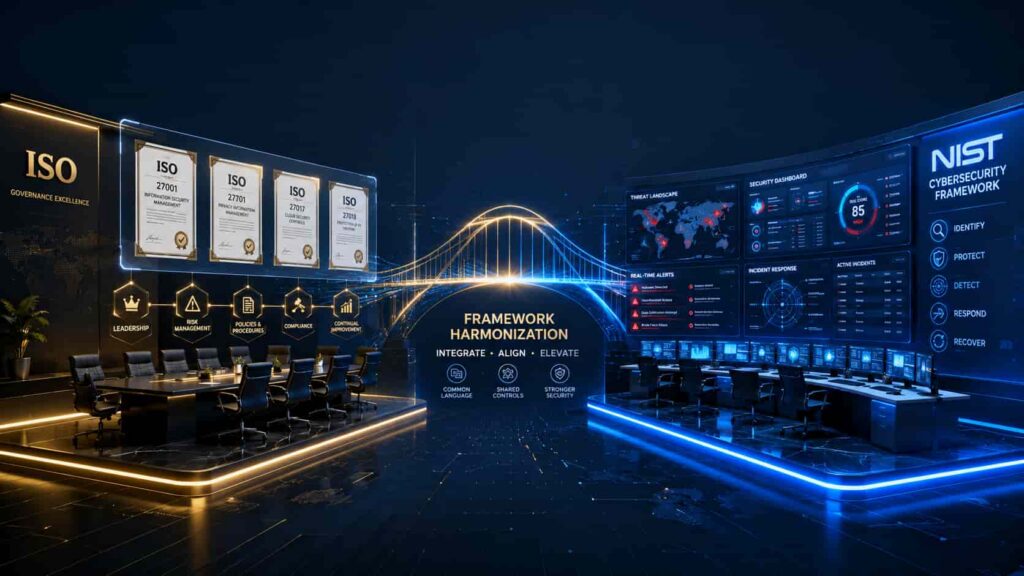
As a CISO or enterprise risk leader, you face a relentless question: “Are we secure enough?” But the more critical question is: “Are we secure in the right way?”
For organizations in finance, healthcare, critical infrastructure, and government, choosing between NIST and ISO 27001 isn’t a compliance checkbox—it is a strategic decision that shapes your entire security posture and directly influences business resilience.
The reality, however, is that this is not a binary choice. These frameworks serve distinct but complementary purposes. The most mature enterprises no longer ask which framework to use, but how to leverage both to create a security program that is both governance-driven and operationally effective.
The Core Distinction: Governance vs. Capability
Understanding the fundamental philosophy of each framework is the first step toward mapping them to your risk profile.
ISO/IEC 27001 is fundamentally a risk-based management system. It operates on a simple principle: identify your assets, assess threats and vulnerabilities, estimate likelihood and impact, and decide how to treat the risk. The emphasis is on structured decision-making and establishing a formal Information Security Management System (ISMS). It is a certifiable standard, providing third-party assurance that your governance structure is robust and auditable.
The NIST Cybersecurity Framework (CSF), on the other hand, is more control-driven and function-oriented. Its latest iteration, CSF 2.0, provides a practical and operational approach focused on building specific control capabilities and measuring maturity across six core functions: Govern, Identify, Protect, Detect, Respond, and Recover. Developed initially for U.S. government use, it is now a global best practice for organizations seeking to understand how well their security controls are actually working.
In short, ISO 27001 tells you what must be in place; NIST CSF helps you answer how well it is working.
Mapping Frameworks to Real Business Risk
For C-suite leaders, the conversation must move beyond technicalities. Here is how each framework aligns with specific business drivers:
When ISO 27001 Takes the Lead: Governance and Global Compliance
ISO 27001 is the gold standard for organizations with international operations, complex supply chains, or high regulatory scrutiny. With certified organizations in over 167 countries, it signals to global partners and regulators that security is a board-level priority.
- Use Case: A global financial institution or a healthcare provider seeking to demonstrate a mature governance model to international regulators.
- The Business Case: It builds the “management system” — the policies, procedures, and audit trail. It is ideal for deep, long-term security programs focused on continuous improvement and certification.
- The Risk Lens: It forces leadership to formally define risk appetite and ensure every control has a business justification.
When NIST CSF Takes the Lead: Maturity and Operational Resilience
NIST CSF is the preferred strategy for organizations, particularly U.S.-based enterprises, that need to align security investments with business outcomes and measure their resilience against modern threats.
- Use Case: A critical infrastructure operator, a tech firm, or a government contractor needing to mature its security architecture and communicate risk in business terms.
- The Business Case: It provides a common language for executives, security teams, and auditors to discuss cybersecurity maturity. It is flexible, voluntary, and helps prioritize investments based on risk.
- The Risk Lens: It focuses on operational capability—can you actually detect an intrusion, respond effectively, and recover quickly?
The Enterprise Approach: Framework Harmonization
The “Either/Or” debate is a trap. For large enterprises, framework harmonization is the only practical path forward. Treating NIST and ISO as competing documents leads to duplicative work, siloed teams, and governance gaps.
| Framework | Primary Role in the Enterprise Stack |
|---|---|
| NIST CSF 2.0 | Strategic direction & Maturity measurement |
| ISO/IEC 27001 | Governance, audit trail & Certification layer |
| CIS Controls | Practical, action-oriented implementation |
| Zero Trust Architecture | Modern access control & Identity verification |
NIST CSF 2.0 now features improved alignment with global standards like ISO/IEC 27001:2022, acknowledging this integration. A mature program uses ISO 27001 to govern and certify, while using NIST CSF to design controls and measure their effectiveness in real-time.
The Harmonization Strategy in Practice
- Create a Crosswalk: Map ISO 27001 Annex A controls directly to NIST CSF 2.0 functions. This creates a clear “control-to-capability” view that improves audit readiness and executive visibility.
- Build a Unified Control Architecture: Link controls from both frameworks to a single risk register. Ensure every control ties to a specific business risk or resilience outcome.
- Validate, Don’t Just Report: Use NIST CSF’s “Respond” and “Recover” functions to validate your Business Continuity and Disaster Recovery through simulations, rather than just documenting them for ISO audits.
Conclusion: From Compliance to Resilience
The question isn’t whether NIST or ISO 27001 is superior. The question is whether your organization understands the trade-offs between structured risk decisions and operational control maturity. As regulatory environments tighten—with directives like NIS2 and growing sector-specific rules—the days of operating in silos are over.
At GRMC EdgeSphere, we guide enterprises through this complexity. We don’t help you pick a single framework; we integrate these standards into a single operating model: ISO provides governance, CIS Controls enable execution, and NIST CSF validates resilience.
When security stops being about checking boxes and starts being about proving control, reducing exposure, and making security measurable, then—and only then—does compliance transform into resilience.