

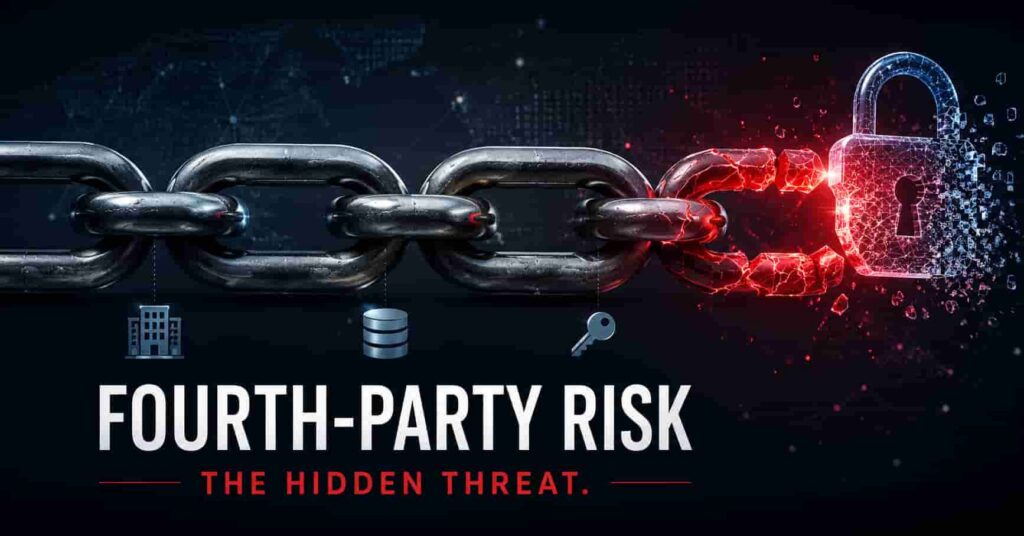
In today’s interconnected digital economy, your organization’s security posture is only as strong as the weakest link in its ecosystem. While significant resources are invested in securing direct (third-party) vendors, a more insidious and often invisible threat lurks just beyond: the fourth-party vendor. These are the subcontractors, software providers, and service firms that your trusted vendors rely on to operate. As the recent Jaguar Land Rover cyberattack demonstrated, the cascading impact of a fourth-party breach can cost billions and expose a critical weakness in modern cybersecurity defense strategies .
For CEOs, CISOs, and IT Directors, the central challenge is clear: how do you secure what you cannot see? This article explores the escalating risk of fourth-party vendors and outlines a strategic, framework-driven approach to build resilience.
The Blind Spot: Understanding Fourth-Party Risk
Your organization likely has a robust vendor risk management (VRM) program for your direct partners. However, 83% of organizations express concern about the security of their fourth parties . This concern is well-founded. A recent analysis revealed that 92% of energy companies evaluated had been exposed to a fourth-party breach .
The risk is not hypothetical. In a classic scenario, a primary vendor passes a security assessment and signs all attestations. Three months later, that vendor’s managed service provider (MSP)—a fourth party—is breached, and your customer data appears on a criminal forum . This “domino effect” occurs because your vendor’s security is only as strong as their own vendors’, a chain of trust that is rarely audited.
The statistics paint a stark picture:
- 30% of all data breaches in 2024 involved a third party, with many originating further down the supply chain .
- 41% of ransomware attacks now start through third parties, highlighting how external access points are a primary attack vector .
This threat is amplified for critical infrastructure, healthcare, and financial institutions, where a breach can lead to not just financial loss but also significant risks to public safety, patient care, and national security .
Frameworks for Resilience: Adopting a Proactive Strategy
To manage fourth-party risk effectively, organizations must move beyond static compliance checklists and embrace a continuous, framework-driven approach. GRMC EdgeSphere recommends integrating the following standards and principles:
1. Extend Zero Trust to the Ecosystem
The Zero Trust model—”never trust, always verify”—must be extended beyond your internal network. This means treating every access request from any vendor, and their vendors, as potentially hostile until proven otherwise .
- Implement Just-In-Time (JIT) and Least-Privilege Access: Ensure third and fourth parties only have access to the specific resources they need, for the exact time they need them.
- Enforce Micro-segmentation: Isolate critical systems and data to prevent lateral movement in the event a vendor account is compromised.
- Adopt Zero Trust Network Access (ZTNA): Replace traditional VPNs with ZTNA solutions, which provide secure, application-level access without exposing the entire network .
2. Operationalize NIST & ISO 27001
Established frameworks provide a structured approach to managing this complexity.
- NIST Cybersecurity Framework (CSF) 2.0: The new “GOVERN” function is critical. It mandates that supply chain risk management is a core part of cybersecurity strategy, not an afterthought. Leveraging NIST CSF 2.0 alongside ISO 27001:2022 controls can reduce third-party risk incidents by up to 65% .
- ISO 27001:2022: This standard strengthens supplier relationships, requiring organizations to define and enforce information security requirements for all relevant parties and to monitor their compliance continually .
- NIST SP 800-161: This specific publication provides comprehensive guidelines on supply chain risk management, from identifying critical suppliers to establishing continuous monitoring programs .
3. Integrate SOC and Continuous Monitoring
Due diligence is not a one-time event.
- Leverage SOC 2 Reports: When assessing vendors, prioritize those that provide SOC 2 Type II reports, which demonstrate the operational effectiveness of their security controls over time .
- Implement Continuous Monitoring: Use advanced threat intelligence and monitoring platforms to gain real-time or near-real-time visibility into your extended supply chain. This involves tracking the security posture of critical vendors to identify potential compromises before they impact your organization .
The GRMC EdgeSphere Approach: From Compliance to Resilience
At GRMC EdgeSphere, we understand that fourth-party risk management is a complex challenge that requires a blend of cybersecurity expertise, strategic insight, and business acumen. Our approach is built on the foundation of industry-leading standards, including ISO 27001 and the NIST Cybersecurity Framework.
Our certified security leadership applies a risk-based methodology to help you:
- Map Your Ecosystem: Go beyond your direct suppliers to identify and map the critical fourth-party relationships that could impact your business.
- Enforce Contractual Controls: We help embed security requirements into vendor contracts that mandate the management and reporting of their own vendor risks, ensuring accountability and visibility .
- Conduct Continuous Assessment: We move beyond annual questionnaires to continuous monitoring, aligning with SOC 2 principles to track the ongoing effectiveness of your vendors’ controls .
- Build a Resilient Culture: We provide executive and board-level education to foster a culture where cybersecurity is a shared goal and supply chain resilience is a key business priority .
The Bottom Line: In the modern threat landscape, a direct vendor’s compliance is not a guarantee of security. The real risk often lies in the digital shadows of the fourth party. By extending your security posture, embracing proven frameworks, and partnering with experienced advisors like GRMC EdgeSphere, you can transform this critical vulnerability into a competitive advantage—building a supply chain that is not just efficient, but resilient.