

🌍 Introduction
Organizations worldwide continue to increase their investment in cybersecurity technologies. Firewalls, endpoint protection, multi-factor authentication, cloud security platforms, security awareness training, intrusion detection systems, and Security Operations Centers (SOCs) have become standard components of modern security programs.
Despite these investments, cyberattacks continue to grow in frequency and sophistication. Ransomware groups evolve their tactics, attackers exploit misconfigurations, insider threats remain a concern, and new vulnerabilities emerge almost daily. The challenge is no longer simply acquiring security technologies—it is understanding whether those technologies are performing as intended.
Many organizations assume that because a security control has been deployed, it is effectively reducing risk. In reality, controls can become outdated, improperly configured, inconsistently enforced, or ineffective against new attack techniques.
This is where Cybersecurity Control Validation becomes a strategic necessity.
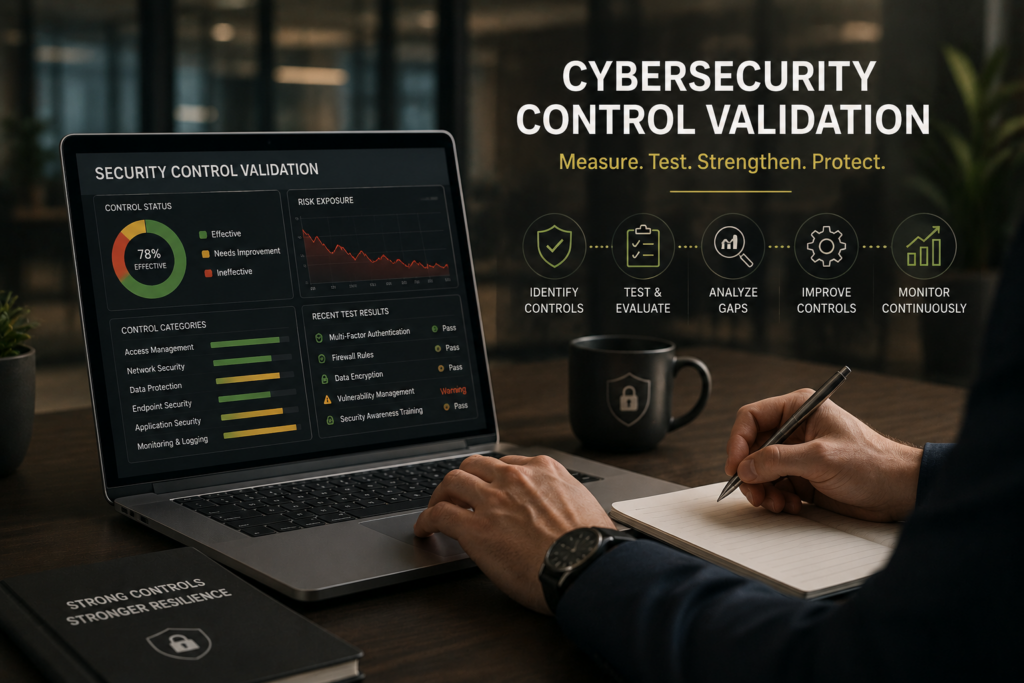
Cybersecurity Control Validation is the continuous process of testing, measuring, and verifying whether security controls are functioning as expected under real-world conditions. Rather than relying solely on compliance checklists or deployment reports, organizations use structured assessments to determine if their cybersecurity investments are genuinely protecting critical business assets.
Instead of asking “Do we have security controls?”, leading organizations ask:
- Are our security controls preventing today’s threats?
- Which controls deliver the greatest business value?
- Where are our security gaps?
- How can we continuously improve our cyber resilience?
- Are our investments aligned with organizational risk?
For CISOs, CIOs, CTOs, board members, government agencies, and enterprise leaders, Cybersecurity Control Validation provides the confidence needed to make informed security decisions while strengthening organizational resilience.
📊 Industry Overview
Modern enterprises operate within highly interconnected digital ecosystems that include cloud infrastructure, hybrid work environments, mobile devices, operational technology, SaaS platforms, third-party vendors, APIs, and artificial intelligence.
This increasing complexity creates a rapidly expanding attack surface.
Organizations often implement dozens of security solutions over time, yet many lack visibility into how these controls interact or whether they continue to provide effective protection.
Compliance requirements such as ISO 27001, NIST Cybersecurity Framework, CIS Controls, and industry-specific regulations encourage organizations to establish security controls, but maintaining those controls requires continuous validation.
Cybersecurity Control Validation bridges the gap between implementation and effectiveness by regularly evaluating people, processes, and technologies through testing, monitoring, and measurable performance indicators.
⚠️ Key Challenges
🔍 Security Controls Can Drift Over Time
Business systems evolve continuously. Software updates, infrastructure changes, cloud migrations, and new business processes may unintentionally weaken previously effective security controls.
🔐 Configuration Errors Reduce Protection
Even advanced cybersecurity technologies become ineffective when improperly configured or inconsistently managed across enterprise environments.
🌐 Expanding Attack Surface
Remote work, cloud adoption, connected devices, and digital transformation initiatives create additional entry points that require continuous validation.
📉 Compliance Does Not Guarantee Security
Meeting regulatory requirements demonstrates governance but does not necessarily prove that security controls can stop real-world attacks.
Organizations must verify operational effectiveness in addition to compliance.
👥 Limited Security Resources
Security teams often manage multiple responsibilities simultaneously, making it difficult to continuously evaluate every deployed control without a structured validation program.
📈 Cybersecurity Insights
📊 Continuous Validation Strengthens Cyber Resilience
Organizations that regularly evaluate their security controls identify weaknesses earlier and respond more effectively before attackers exploit them.
🤝 Business Context Improves Risk Prioritization
Not every security control carries the same level of importance. Validation efforts should focus first on systems supporting critical business operations and sensitive information.
🔍 Visibility Supports Better Executive Decisions
Executive leadership benefits from business-oriented reporting that demonstrates how cybersecurity investments reduce organizational risk and support operational continuity.
📈 Threat Intelligence Improves Validation
Combining threat intelligence with control testing enables organizations to evaluate whether existing defenses remain effective against evolving attack techniques.
🌍 Security Is a Continuous Process
Cybersecurity cannot be treated as a one-time project. Continuous monitoring, assessment, and improvement are essential components of a mature security strategy.
🛠️ Practical Recommendations
📋 Develop a Control Validation Framework
Establish a repeatable process for testing preventive, detective, and corrective security controls across the enterprise.
🔍 Prioritize Critical Business Systems
Focus validation efforts on systems supporting financial operations, customer data, intellectual property, executive communications, and essential business services.
📊 Perform Regular Security Assessments
Conduct vulnerability assessments, penetration testing, configuration reviews, identity audits, and incident response exercises to verify operational readiness.
🔐 Integrate Threat Intelligence
Use current threat intelligence to simulate realistic attack scenarios and evaluate whether existing controls provide adequate protection.
👥 Measure Performance with Business Metrics
Track metrics such as detection time, response time, remediation efficiency, security incident trends, and control effectiveness to support executive decision-making.
📈 Continuously Improve Security Controls
Treat validation findings as opportunities to strengthen governance, improve processes, optimize technology investments, and enhance organizational resilience.
🤝 How GRMC Can Help
GRMC EdgeSphere helps organizations strengthen cybersecurity maturity through comprehensive control validation, strategic consulting, and risk intelligence services.
🔐 Cybersecurity Control Assessments
We evaluate technical, administrative, and operational security controls to determine their effectiveness against evolving cyber threats.
📊 Security Governance Advisory
Our specialists design governance frameworks aligned with organizational objectives, regulatory requirements, and recognized cybersecurity best practices.
🔍 Vulnerability & Risk Intelligence
GRMC combines technical assessments with business intelligence to prioritize remediation based on operational impact and organizational risk.
🌍 Continuous Security Monitoring
We help organizations implement ongoing validation processes that improve visibility, reduce cyber exposure, and strengthen executive confidence.
📈 Executive Cyber Advisory
Our consultants provide strategic guidance that enables leadership teams to optimize cybersecurity investments while supporting long-term business resilience.
🚀 Conclusion
Implementing cybersecurity controls is only the first step toward protecting an organization. Long-term resilience depends on continuously verifying that those controls remain effective as technologies, business operations, and cyber threats evolve.
Cybersecurity Control Validation provides organizations with a structured, evidence-based approach to measuring security performance, identifying hidden weaknesses, and ensuring that cybersecurity investments continue to deliver meaningful business value.
By combining continuous assessment, threat intelligence, governance, and executive oversight, organizations can move beyond compliance and build a proactive cybersecurity program that supports sustainable growth and operational confidence.
GRMC EdgeSphere empowers organizations to validate, strengthen, and optimize their cybersecurity programs through strategic consulting, risk intelligence, and data-driven security assessments—helping businesses ensure their security investments deliver the protection they expect.