

🌍 Introduction
Every major business investment carries a degree of uncertainty. Whether launching a new product, expanding into an international market, adopting emerging technologies, entering a new industry, or pursuing strategic partnerships, organizations must answer one critical question before committing resources:
Is the market truly ready for this investment?
Many organizations evaluate opportunities based on market size, projected revenue, or competitor activity. While these factors are important, they rarely provide a complete picture of market readiness. A promising opportunity may still fail if customer demand is immature, regulations are uncertain, infrastructure is insufficient, or industry adoption is progressing more slowly than expected.
This is why leading organizations increasingly rely on a structured Market Readiness Index (MRI).
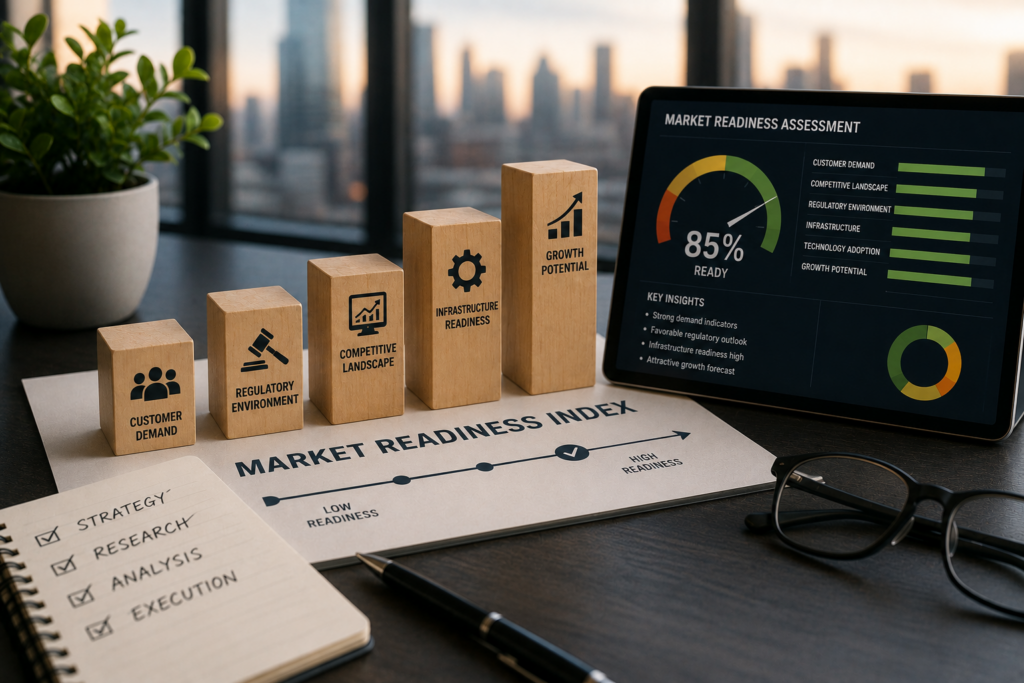
A Market Readiness Index is a comprehensive market research and business intelligence framework that evaluates multiple dimensions of market preparedness before significant investments are made. Rather than relying on assumptions, it combines customer insights, competitive intelligence, economic indicators, regulatory analysis, technology adoption, and commercial feasibility into a measurable decision-making model.
Instead of asking “Is this a good opportunity?”, organizations ask more strategic questions:
- Is customer demand mature enough?
- Are buyers prepared to adopt the solution?
- What barriers may slow market adoption?
- Is the competitive environment favorable?
- Does the timing support long-term success?
For enterprise leaders, investors, government agencies, and multinational organizations, a Market Readiness Index provides confidence, reduces uncertainty, and improves strategic investment decisions.
📊 Industry Overview
Global markets are changing faster than ever before.
Artificial intelligence, digital transformation, sustainability initiatives, evolving regulations, demographic shifts, and changing consumer expectations continuously reshape business environments.
Organizations that make investment decisions based only on historical performance often struggle to anticipate future market conditions.
Modern business leaders require evidence that evaluates not only the size of an opportunity but also its readiness for successful commercialization.
Market Readiness Index frameworks typically evaluate multiple categories, including:
- Customer demand maturity
- Market accessibility
- Competitive intensity
- Economic stability
- Technology adoption
- Regulatory readiness
- Infrastructure capability
- Supply chain resilience
- Digital maturity
- Long-term growth potential
By combining these factors into a structured assessment, organizations gain a clearer understanding of whether the market is prepared to support sustainable growth.
⚠️ Key Challenges
📉 Market Size Does Not Guarantee Success
A large market may still present significant barriers to adoption if customers lack awareness, purchasing power, or confidence in new solutions.
🔍 Investment Decisions Often Rely on Incomplete Information
Organizations frequently evaluate opportunities using isolated reports rather than integrated market intelligence.
Incomplete analysis increases investment risk.
🌐 Regulations Continue to Evolve
Changing legal requirements, trade policies, industry standards, and compliance obligations may significantly influence market readiness.
👥 Customer Adoption Varies Across Regions
The same product or service may achieve rapid adoption in one region while facing resistance in another due to cultural, economic, or technological differences.
⏳ Poor Timing Can Reduce Investment Returns
Even innovative products may struggle if introduced before customers, infrastructure, or supporting ecosystems are prepared.
📈 Market Research Insights
📊 Customer Readiness Is More Important Than Awareness
Customers may recognize a solution without being ready to purchase it.
Research into buying intent, perceived value, and adoption barriers provides deeper insights than awareness studies alone.
🌍 Technology Adoption Influences Market Timing
Digital maturity, connectivity, workforce capabilities, and technology acceptance all contribute to successful commercialization.
📈 Competitive Analysis Improves Strategic Positioning
Understanding competitor strengths, weaknesses, pricing strategies, partnerships, and customer relationships helps organizations determine whether the market offers room for meaningful differentiation.
👥 External Intelligence Strengthens Investment Decisions
Economic indicators, regulatory developments, demographic trends, and industry forecasts provide valuable context for evaluating future market conditions.
🤝 Continuous Market Monitoring Supports Agility
Market readiness is dynamic.
Organizations that monitor changing conditions regularly can adjust strategies before market shifts affect performance.
🛠️ Practical Recommendations
🔍 Develop a Structured Market Readiness Scorecard
Evaluate every investment opportunity against standardized criteria rather than relying on isolated metrics.
📊 Validate Customer Demand Through Research
Conduct surveys, executive interviews, focus groups, customer journey analysis, and commercial feasibility assessments before major investments.
🌐 Monitor Regulatory and Economic Trends
Review policy developments, taxation changes, industry regulations, and macroeconomic conditions that may influence future market performance.
👥 Benchmark Against Industry Leaders
Compare organizational capabilities with successful market participants to identify competitive gaps and operational improvements.
📈 Integrate Business Intelligence Into Investment Planning
Combine operational data, customer insights, market research, and predictive analytics into executive decision-making processes.
📋 Review Market Readiness Periodically
Markets evolve continuously.
Regular reassessments enable organizations to identify emerging opportunities and adjust investment priorities accordingly.
🤝 How GRMC Can Help
GRMC EdgeSphere helps organizations evaluate market opportunities through advanced market research, strategic consulting, and business intelligence.
📊 Market Readiness Assessments
We evaluate customer demand, commercial feasibility, market accessibility, and industry conditions to support informed investment decisions.
🔍 Competitive & Industry Intelligence
Our analysts deliver comprehensive research into market dynamics, competitor activities, regulatory developments, and emerging trends.
👥 Customer Insight Programs
GRMC uncovers customer expectations, purchasing behavior, adoption readiness, and decision-making factors that influence market success.
🌍 Business Intelligence Solutions
We integrate market research, operational performance, economic indicators, and predictive analytics into executive-level intelligence.
📈 Strategic Investment Advisory
Our consultants help organizations transform research findings into practical investment strategies that improve growth potential, reduce uncertainty, and strengthen long-term competitiveness.
🚀 Conclusion
Successful investments depend not only on identifying opportunities but also on understanding whether markets are prepared to support sustainable growth.
A Market Readiness Index enables organizations to evaluate customer demand, competitive conditions, regulatory environments, technology adoption, and commercial feasibility through a structured, evidence-based framework.
By combining comprehensive market research, business intelligence, customer insights, and strategic advisory, organizations can make more confident investment decisions while reducing unnecessary risk.
GRMC EdgeSphere empowers organizations to evaluate opportunities with greater precision through data-driven market intelligence, enabling leaders to invest at the right time, in the right markets, with the right strategy.