🌍 Introduction
Markets rarely change by chance. Behind every purchasing decision, investment trend, or industry shift lies a network of influences that shape how customers think, evaluate options, and ultimately make decisions.
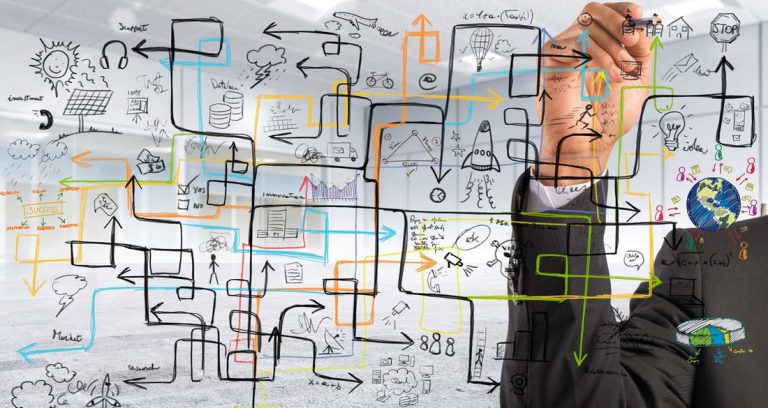
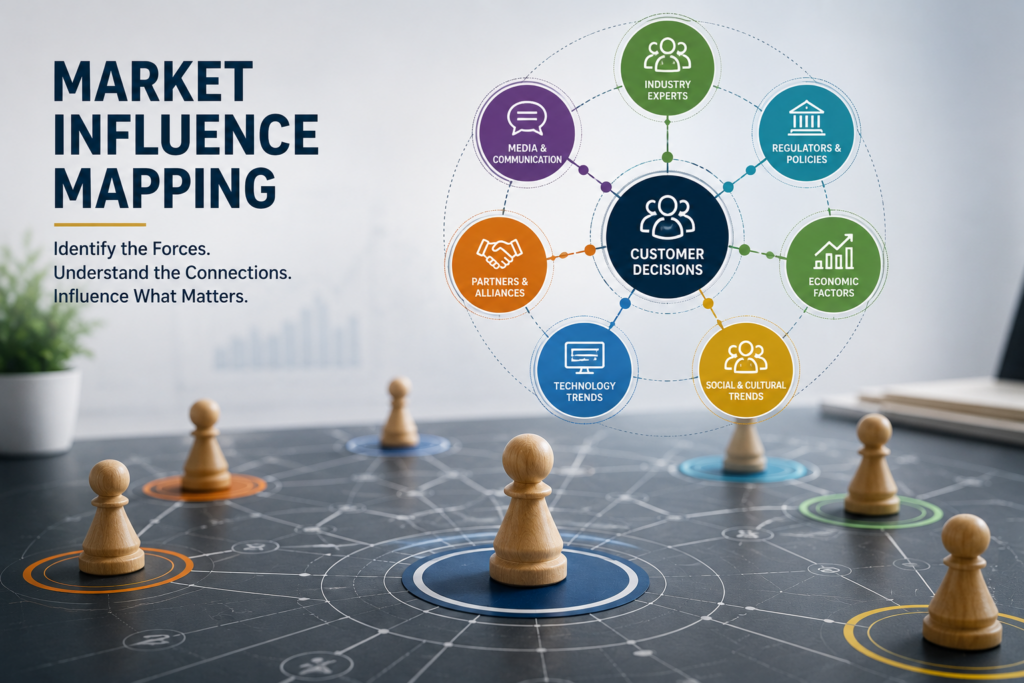
Many organizations focus their market research on customers and competitors alone. While these areas remain essential, they represent only part of the broader business environment. Consumer behavior is also influenced by economic conditions, digital communities, industry experts, regulatory developments, technological innovation, media coverage, strategic partnerships, and changing social expectations.
This interconnected ecosystem is where Market Influence Mapping provides strategic value.
Market Influence Mapping is an advanced market research methodology that identifies the people, organizations, trends, technologies, and external factors influencing purchasing behavior and market evolution. Instead of simply measuring customer demand, organizations gain a deeper understanding of why markets move, who shapes decisions, and where new opportunities are emerging.
For business leaders, investors, government agencies, and enterprise decision-makers, understanding market influence creates a stronger foundation for strategic planning, competitive positioning, and sustainable business growth.
📊 Industry Overview
Modern markets are more interconnected than ever before.
Digital platforms allow information to spread globally within minutes. Customers compare products across multiple channels, seek recommendations from industry experts, read online reviews, follow thought leaders, and evaluate brands based on trust as much as price or product features.
At the same time, organizations face increasing pressure from technological disruption, changing regulations, environmental expectations, geopolitical uncertainty, and evolving customer values.
Traditional market research often measures what customers purchased.
Market Influence Mapping explains why they made those choices.
By identifying the key influences shaping customer behavior and industry direction, organizations can respond more effectively to market changes and position themselves ahead of competitors.
⚠️ Key Challenges
🌐 Influence Networks Are Increasingly Complex
Customer decisions are rarely driven by a single factor.
Industry analysts, online communities, professional networks, economic conditions, digital media, and peer recommendations all contribute to purchasing behavior.
Without structured analysis, organizations may overlook the most influential drivers of market demand.
📉 Competitors Respond Faster
Organizations that fail to monitor external influences often recognize major market changes only after competitors have already adjusted their strategies.
🔍 Internal Perspectives Can Create Blind Spots
Businesses naturally focus on their own products, operations, and performance metrics.
Without external market intelligence, important shifts in customer sentiment and industry expectations may go unnoticed.
📊 Information Is Abundant but Not Prioritized
Organizations have access to more market information than ever before.
The challenge lies in identifying which signals genuinely influence business outcomes rather than reacting to every trend.
⚖️ Stakeholder Expectations Continue to Evolve
Customers, investors, regulators, employees, and business partners increasingly evaluate organizations based on transparency, innovation, sustainability, digital capability, and long-term value creation.
📈 Market Research Insights
👥 Customer Decisions Are Influenced by Multiple Stakeholders
Purchasing decisions often involve procurement teams, technical experts, financial decision-makers, executive leadership, and external advisors.
Understanding these influence networks helps organizations improve engagement strategies.
📊 Trust Has Become a Competitive Asset
Organizations that consistently demonstrate expertise, credibility, and transparency are more likely to influence purchasing decisions than those relying solely on promotional messaging.
🌍 Market Trends Begin with Small Signals
Emerging technologies, policy changes, investment activity, and shifts in customer expectations frequently appear as subtle signals before becoming mainstream market trends.
Monitoring these signals enables organizations to anticipate change rather than react to it.
📈 Influence Mapping Improves Strategic Planning
Understanding the forces shaping markets allows leadership teams to make more informed decisions regarding product development, expansion, partnerships, pricing strategies, and customer engagement.
🤝 Cross-Industry Insights Reveal New Opportunities
Innovations introduced in one industry often create opportunities in another.
Organizations that monitor adjacent markets are better positioned to identify emerging business opportunities before competitors.
🛠️ Practical Recommendations
🔍 Identify Key Market Influencers
Map the organizations, individuals, technologies, regulatory bodies, and industry groups that influence customer decisions within your sector.
📊 Monitor Industry Conversations
Track industry publications, executive thought leadership, professional associations, research reports, conferences, and digital discussions to identify emerging themes.
👥 Integrate Customer Research with External Intelligence
Combine customer interviews and surveys with competitive intelligence, economic analysis, and market trend monitoring to develop a comprehensive understanding of business environments.
🌐 Evaluate Influence Across Different Markets
Market drivers often vary by region, customer segment, and industry.
Localized research enables organizations to tailor strategies for different geographic markets and customer groups.
📈 Review Influence Maps Regularly
Market influence evolves continuously.
Regular updates ensure strategic decisions remain aligned with changing business environments and customer expectations.
🤝 How GRMC Can Help
GRMC EdgeSphere helps organizations understand the forces shaping markets through advanced market research, competitive intelligence, and strategic business advisory.
📊 Market Intelligence Research
We identify emerging trends, industry developments, and influential market drivers that affect business performance.
🔍 Competitive & Industry Analysis
Our specialists evaluate competitor positioning, market dynamics, and external influences to support strategic planning.
👥 Customer Insight Programs
GRMC uncovers the motivations, expectations, and decision-making factors that shape customer behavior across different markets.
🌍 Business Intelligence Solutions
We integrate market research, economic indicators, customer insights, and competitive intelligence to deliver actionable business intelligence.
📈 Strategic Advisory
Our consultants transform research findings into practical business strategies that strengthen market positioning, improve decision-making, and support long-term growth.
🚀 Conclusion
Understanding customers is only one part of developing an effective business strategy. Organizations must also understand the broader network of influences shaping customer behavior, market dynamics, and industry evolution.
Market Influence Mapping enables organizations to identify these hidden drivers, anticipate emerging trends, strengthen strategic planning, and make better-informed business decisions.
By combining structured market research with business intelligence and competitive analysis, GRMC EdgeSphere helps organizations transform complex market environments into clear strategic opportunities, enabling sustainable growth and long-term competitive advantage.