

🌍 Introduction
Cybersecurity has evolved from a technical concern into a boardroom priority. As organizations increasingly rely on digital platforms, cloud infrastructure, remote work environments, connected devices, and third-party service providers, cyber risks continue to grow in both frequency and sophistication.
Many organizations invest heavily in cybersecurity technologies such as firewalls, endpoint detection and response (EDR), intrusion prevention systems, security information and event management (SIEM) platforms, and threat intelligence services. While these investments are essential, they often fail to answer a critical question:
Where is the organization most vulnerable, and which risks pose the greatest threat to business operations?
Without a comprehensive understanding of cyber risk exposure, organizations may spend significant resources protecting low-priority assets while critical vulnerabilities remain unaddressed.
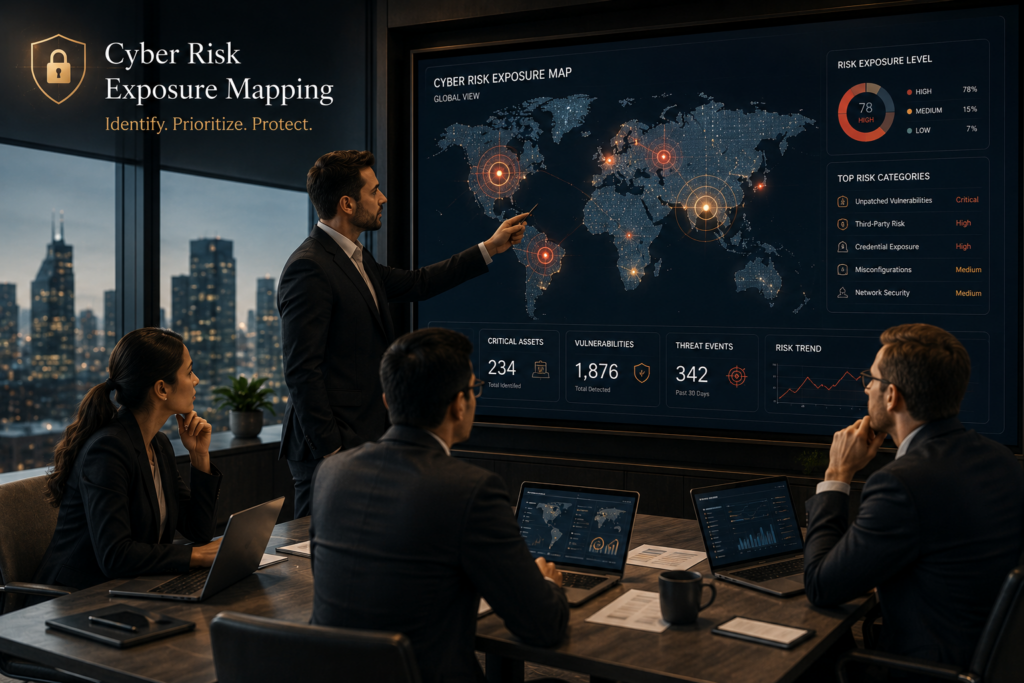
This is where Cyber Risk Exposure Mapping becomes invaluable. It is a strategic cybersecurity approach that identifies, evaluates, and prioritizes cyber risks across the entire enterprise. Rather than focusing solely on technical vulnerabilities, Cyber Risk Exposure Mapping examines how security weaknesses could impact business continuity, financial performance, regulatory compliance, customer trust, and organizational reputation.
For CEOs, CIOs, CISOs, government agencies, and enterprise leaders, understanding cyber risk exposure provides the foundation for stronger security strategies, smarter investment decisions, and long-term cyber resilience.
📊 Industry Overview
The modern business landscape is more connected than ever before. Organizations operate across multiple digital environments, including cloud platforms, mobile applications, SaaS solutions, IoT ecosystems, hybrid work infrastructures, and global supply chains.
While these technologies improve efficiency and innovation, they also expand the attack surface available to cybercriminals.
Today’s threat actors range from individual hackers and organized cybercrime groups to nation-state actors and insider threats. Their objectives may include financial theft, data exfiltration, ransomware deployment, espionage, operational disruption, or intellectual property theft.
At the same time, regulatory requirements continue to increase. Organizations must comply with industry standards and regulations such as:
- ISO 27001
- NIST Cybersecurity Framework
- GDPR
- PCI DSS
- HIPAA
- CIS Controls
- Industry-specific cybersecurity regulations
Failure to adequately manage cyber risk can result in financial losses, legal penalties, operational downtime, and significant reputational damage.
Cyber Risk Exposure Mapping enables organizations to understand their security posture in a business context and prioritize mitigation efforts based on real-world impact.
⚠️ Key Challenges
🎯 Expanding Attack Surface
Every new application, device, cloud service, remote employee, and third-party integration creates additional potential entry points for attackers.
Organizations often struggle to maintain visibility over rapidly expanding digital environments, increasing the likelihood of overlooked vulnerabilities.
🔍 Limited Asset Visibility
Many enterprises do not have a complete inventory of their digital assets.
Shadow IT, unmanaged devices, legacy systems, and forgotten applications can create hidden security risks that remain undetected until exploited by attackers.
🤝 Third-Party and Supply Chain Risks
Organizations increasingly depend on external vendors, contractors, consultants, and technology providers.
A security weakness within a trusted partner can become a direct pathway into the organization’s environment, as demonstrated by several high-profile supply chain attacks in recent years.
⚠️ Evolving Threat Landscape
Cyber threats evolve continuously.
Attackers constantly develop new techniques designed to bypass traditional security controls, exploit zero-day vulnerabilities, and target emerging technologies.
Organizations must adapt their defenses accordingly.
📉 Resource Allocation Challenges
Most organizations operate with limited cybersecurity budgets and personnel.
Without clear risk prioritization, security teams may allocate resources inefficiently, focusing on lower-priority threats while more significant vulnerabilities remain exposed.
⏳ Delayed Risk Identification
Traditional security assessments conducted once or twice per year may not identify emerging threats quickly enough.
As digital environments change rapidly, risk visibility must become continuous rather than periodic.
📈 Cybersecurity Insights
🛡 Visibility Is the Foundation of Security
Organizations cannot secure assets they cannot see.
Comprehensive asset discovery and inventory management significantly improve security effectiveness by ensuring that critical systems are monitored and protected appropriately.
Cyber Risk Exposure Mapping begins by identifying all assets that support business operations.
📊 Business Context Matters More Than Technical Severity
Not all vulnerabilities carry the same level of risk.
A medium-severity vulnerability affecting a mission-critical business system may pose a greater organizational risk than a high-severity vulnerability affecting a non-essential asset.
Effective cybersecurity programs evaluate risk based on both technical severity and business impact.
🌐 Third-Party Risk Is a Growing Concern
As organizations become increasingly interconnected, third-party security has become a major component of enterprise risk management.
Vendors often have access to sensitive systems, data, and operational processes.
Continuous assessment of third-party security practices helps reduce exposure to supply chain attacks and compliance violations.
📈 Continuous Risk Assessment Improves Resilience
Cybersecurity should not be treated as a one-time project.
Continuous monitoring, vulnerability assessments, penetration testing, and risk reviews help organizations identify emerging threats before they evolve into significant incidents.
🔐 Cybersecurity Supports Business Growth
Strong cybersecurity is not merely about defense.
Organizations with mature security programs often gain competitive advantages by improving customer trust, enabling digital transformation, supporting regulatory compliance, and reducing operational disruptions.
🛠️ Practical Recommendations
🔍 Maintain a Comprehensive Asset Inventory
Create and continuously update a centralized inventory of:
- Hardware assets
- Software applications
- Cloud resources
- Databases
- Network devices
- IoT systems
- Third-party integrations
This visibility forms the foundation of effective risk management.
🛡 Prioritize Risks Based on Business Impact
Develop a risk-ranking methodology that considers:
- Financial impact
- Operational disruption
- Regulatory consequences
- Reputational damage
- Customer impact
This ensures cybersecurity investments address the most significant organizational risks.
👥 Strengthen Security Awareness Programs
Human error remains one of the leading causes of cybersecurity incidents.
Regular training programs should educate employees on:
- Phishing attacks
- Social engineering
- Password security
- Data handling practices
- Incident reporting procedures
A well-informed workforce serves as a critical layer of defense.
🤝 Improve Third-Party Risk Management
Evaluate vendor security controls before onboarding new partners and conduct regular reviews throughout the relationship.
Organizations should establish clear cybersecurity requirements, contractual obligations, and monitoring procedures for third-party providers.
📊 Conduct Continuous Risk Assessments
Perform regular:
- Vulnerability assessments
- Penetration testing
- Security audits
- Configuration reviews
- Threat modeling exercises
Continuous evaluation ensures security programs evolve alongside changing risks.
📈 Align Cybersecurity With Business Strategy
Cybersecurity initiatives should directly support organizational objectives.
Executive leadership should integrate cyber risk discussions into strategic planning, investment decisions, digital transformation initiatives, and operational governance.
🤝 How GRMC Can Help
GRMC EdgeSphere supports organizations in building resilient cybersecurity programs through strategic advisory, cyber risk intelligence, and comprehensive security assessments.
🛡 Cyber Risk Assessments
We identify critical vulnerabilities, evaluate business impacts, and provide prioritized recommendations that strengthen organizational resilience.
🔍 Security Posture Evaluations
Our specialists assess existing cybersecurity controls, governance frameworks, and operational security capabilities to identify improvement opportunities.
🌐 Third-Party Risk Management
GRMC helps organizations evaluate vendor cybersecurity practices and reduce supply chain-related risks.
📊 Cybersecurity Intelligence
We provide actionable intelligence on emerging threats, industry trends, and evolving risk landscapes to support proactive decision-making.
📈 Strategic Cybersecurity Advisory
Our consultants work with executive teams to align cybersecurity investments with business objectives, regulatory requirements, and long-term growth strategies.
🔐 Governance, Risk, and Compliance Support
GRMC assists organizations in strengthening cybersecurity governance while supporting compliance with leading frameworks and industry standards.
🚀 Conclusion
In today’s interconnected digital economy, cybersecurity requires more than reactive defenses and periodic assessments.
Organizations must develop a clear understanding of where risks exist, how those risks affect business operations, and which vulnerabilities require immediate attention.
Cyber Risk Exposure Mapping provides a structured approach to identifying, prioritizing, and mitigating cyber risks before they become costly security incidents.
By combining comprehensive visibility, continuous risk assessment, business-focused prioritization, and strategic cybersecurity planning, organizations can strengthen resilience, improve stakeholder confidence, and support sustainable growth.
GRMC EdgeSphere empowers organizations to transform cybersecurity from a reactive function into a strategic business capability through advanced cyber risk intelligence, security advisory services, and data-driven decision-making.