
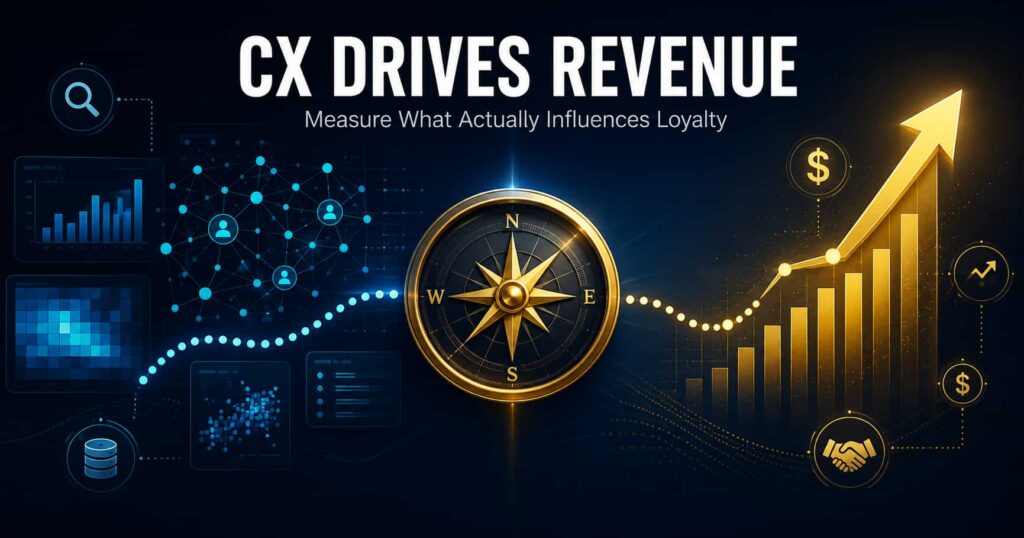
For years, the corporate world has treated customer experience (CX) as a “soft” metric—something nice to have, but often the first budget cut when economic headwinds appear. That perception is not just outdated; it is financially dangerous. Recent data from Forrester reveals a direct correlation: organizations that successfully align their brand promise with the experience they deliver can achieve up to 3.5x revenue growth and significantly higher retention rates .
The era of vanity metrics is over. The modern executive must view customer experience not as a cost center, but as a measurable, primary driver of enterprise value. The challenge lies not in believing in the importance of CX, but in accurately measuring what drives loyalty and translating those insights into bottom-line results.
The Shift from Satisfaction Scores to Revenue Metrics
Traditional surveys often fail to capture the full picture. While a high Net Promoter Score (NPS) feels good, it rarely provides the granular, actionable intelligence required to shift strategy. The market is moving toward a more sophisticated understanding of the customer journey. Forrester’s introduction of the Total Experience Score is a prime example of this evolution. This metric combines the Brand Experience Index (measuring salience, fit, and trust among prospects) with the Customer Experience Index (measuring ease, effectiveness, and emotion among current customers) to provide a “growth grid” .
Why does this matter? Because businesses often focus solely on retaining existing customers without understanding how their brand is perceived by potential ones—and vice versa. For instance, recent analysis shows that in Europe, 18 brands scored more than twice as high with their current customers as they did with non-customers . This indicates a significant brand perception gap that directly limits market share expansion. If you are not measuring the interplay between brand perception and experience delivery, you are flying blind.
Moving Beyond “Survey Fatigue” to Behavioral Economics
To truly understand what drives loyalty, we must look at behavior, not just stated preferences. The most effective loyalty strategies today rely on behavioral economics and data mining. Research suggests that financial flexibility, specifically the adoption of Buy Now, Pay Later (BNPL) options, significantly impacts loyalty. Data indicates that credit-based purchasing drives higher average basket values and, importantly, customers who use such flexible payment options demonstrate higher loyalty rates, repeat purchase behavior, and overall lifetime value .
This is a critical insight for business leaders. If you are using traditional survey methods to gauge loyalty among cash and BNPL customers, you are likely missing the significant behavioral differences that exist between these segments.
The Power of Unsupervised Learning
We are reaching a point where asking “How likely are you to recommend us?” is less effective than analyzing transaction data. Unsupervised learning techniques, such as RFM (Recency, Frequency, Monetary) modeling and clustering, allow organizations to identify high-value cohorts that are difficult to discover through standard reporting . By leveraging business intelligence tools to segment customers based on actual purchasing patterns—rather than self-reported sentiment—you can target “at-risk” customers before they churn.
Operationalizing Intelligence: The Data-CRM Synergy
Data, in isolation, is useless. The disconnect between analytical insight and operational execution is where most revenue is lost. A recent study on e-commerce retention highlighted that while Machine Learning models like XGBoost can predict churn with over 80% accuracy, the value is only realized when these predictions are integrated into CRM systems .
Your customer research is only as good as the workflows it triggers.
We recommend the following operational framework:
- Integrated Dashboards: Do not keep your insights locked in a PDF report. Integrate customer retention analytics directly into Power BI or similar platforms that are accessible to sales and marketing teams .
- Automated Workflows: When your data model identifies a valuable customer showing signs of churn, automate a loyalty offer or a service recovery protocol.
- A/B Testing: Continuously validate your hypotheses. Just because data suggests a customer segment is loyal does not mean a specific loyalty program will work for them.
The Role of GRMC EdgeSphere in Your Strategy
At GRMC EdgeSphere, we move beyond generic satisfaction tracking to implement intelligence programs that assess frontline performance and service quality through mystery shopping and Voice-of-Customer analytics . We understand that in sectors ranging from financial services to hospitality and retail, brand consistency is the foundation of loyalty.
Our approach integrates automated customer journey management with real-time analytics and AI-powered alerts for proactive service recovery. We often see a “trust deficit” in current CX programs. Research indicates that enterprises implementing distributed trust technologies (such as blockchain-based identity solutions) achieve significantly higher trust ratings and data-sharing consent rates . As executives navigate data privacy regulations, building a research framework based on transparent, customer-controlled data governance is not just ethical—it is a competitive advantage.
Conclusion and Strategic Recommendations
Measuring what influences loyalty requires a fundamental shift from asking “Are you satisfied?” to answering “What will you do?” The data is clear: alignment between brand promise and experience delivery leads to up to 3.5x revenue growth, and behavioral data is more reliable than survey responses for predicting actual loyalty .
We challenge business leaders to audit their current research methodology against these three criteria:
- Holistic Measurement: Are you measuring both non-customer brand perception and current customer experience?
- Behavioral Focus: Are you analyzing transactional data to identify behavioral patterns, or are you relying on reactionary surveys?
- Automated Action: Is your research data feeding into automated CRM workflows, or does it sit in a static dashboard?
Loyalty is no longer a “soft skill” of business; it is a quantifiable asset. It is time to treat it as such.