
🌍 Introduction
Many organizations have successfully introduced artificial intelligence into customer support, internal operations, software development, and business analytics. Yet despite these investments, a common limitation remains: most AI systems start every interaction with little or no understanding of previous work, organizational decisions, or business context.
Human teams build knowledge over time. They learn from past projects, remember customer preferences, understand company policies, and apply lessons from previous successes and failures. This accumulated knowledge improves decision-making and operational efficiency.
Agentic AI should operate in a similar way.
As enterprises adopt autonomous AI agents, the next stage of maturity is enabling those agents to retain, retrieve, and apply organizational knowledge responsibly. This capability—known as Agentic AI Memory—allows AI agents to move beyond isolated task execution and become context-aware collaborators that continuously improve over time.
For CIOs, CTOs, CEOs, and digital transformation leaders, enterprise AI memory is becoming a strategic capability that enhances consistency, accelerates decision-making, and preserves institutional knowledge.
📊 Industry Overview
The first generation of enterprise AI focused on automation.
The second generation introduced autonomous AI agents capable of planning, reasoning, and completing complex workflows.
The next evolution is enabling these agents to remember.
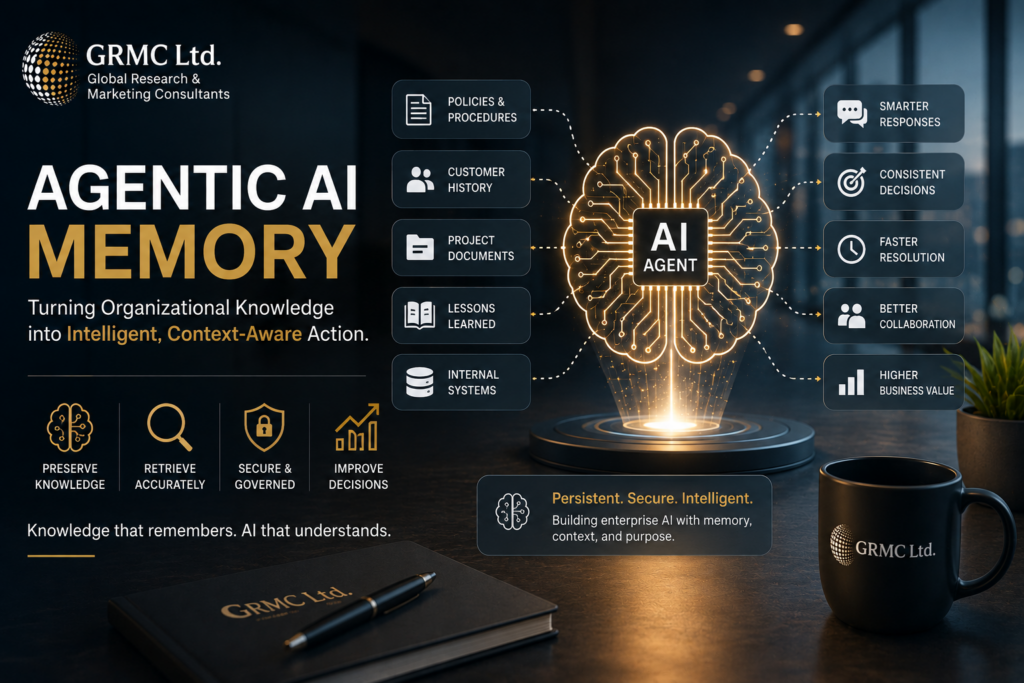
Enterprise AI memory is not about storing conversations alone. It involves securely organizing and using business knowledge such as:
- Company policies
- Standard operating procedures
- Customer histories
- Project documentation
- Technical manuals
- Lessons learned
- Business decisions
- Industry regulations
- Internal best practices
When AI agents can access relevant institutional knowledge, they produce more accurate recommendations, maintain consistency across departments, and reduce duplicated effort.
⚠️ Key Challenges
🧩 Fragmented Organizational Knowledge
Critical business information is often distributed across documents, emails, cloud storage, knowledge bases, and enterprise applications.
AI agents cannot deliver maximum value if they cannot locate or understand this information.
🔄 Repeating the Same Work
Organizations frequently solve identical problems multiple times because valuable knowledge is difficult to discover or reuse.
This increases costs and reduces productivity.
👥 Knowledge Loss
When experienced employees retire or change roles, organizations risk losing years of expertise.
Capturing and organizing institutional knowledge helps reduce this risk.
🔐 Security and Access Control
Enterprise knowledge contains sensitive information.
AI memory systems must respect user permissions, compliance requirements, and data governance policies.
📈 Keeping Knowledge Current
Business policies, regulations, and operational procedures evolve continuously.
AI memory must remain accurate and up to date to maintain reliability.
📈 Business Insights
🧠 Institutional Knowledge Is a Strategic Asset
Organizations increasingly recognize knowledge as a competitive advantage.
Making that knowledge available to AI agents improves operational consistency and decision quality.
⚡ Context Improves AI Performance
AI agents produce better outcomes when they understand:
- Previous business decisions
- Organizational priorities
- Customer relationships
- Internal terminology
- Operational procedures
Context reduces errors and improves relevance.
🤝 Knowledge Sharing Supports Collaboration
Persistent AI memory enables departments to benefit from one another’s expertise without relying solely on manual communication.
📊 Consistency Builds Trust
Employees are more likely to rely on AI recommendations when responses reflect official company policies and verified organizational knowledge.
🛠️ Practical Recommendations
📑 Create a Centralized Knowledge Repository
Organize enterprise knowledge into structured, searchable repositories that AI agents can securely access.
🔍 Establish Knowledge Governance
Define ownership, approval processes, version control, and review cycles for all critical business knowledge.
🔒 Apply Role-Based Access
Ensure AI agents retrieve only the information users are authorized to access.
📊 Measure Knowledge Effectiveness
Monitor:
- Knowledge usage
- Search success rates
- Decision accuracy
- Response consistency
- Business outcomes
🚀 Start with High-Value Business Functions
Introduce AI memory in areas where institutional knowledge delivers the greatest impact, such as customer support, compliance, technical operations, legal services, and business intelligence.
🤝 How GRMC Can Help
GRMC EdgeSphere helps organizations develop enterprise-ready AI ecosystems that leverage trusted organizational knowledge while maintaining governance, security, and scalability.
🧠 Enterprise AI Strategy
Design AI roadmaps aligned with business objectives and long-term digital transformation initiatives.
📚 Knowledge Intelligence
Structure, organize, and optimize enterprise knowledge for AI-powered decision support.
🔗 AI Integration Services
Connect AI agents with enterprise knowledge bases, document management systems, ERP platforms, CRM solutions, and analytics environments.
🛡️ Governance and Security
Implement robust access controls, compliance frameworks, and data governance practices for enterprise AI.
📊 Business Intelligence
Measure the business value of AI memory through performance analytics, operational insights, and executive dashboards.
🚀 Conclusion
The future of enterprise AI is not defined solely by how intelligently AI agents reason—it is also determined by how effectively they remember.
Organizations that equip AI agents with secure, well-governed organizational knowledge will improve consistency, accelerate decision-making, reduce duplicated effort, and preserve valuable institutional expertise.
Agentic AI Memory represents the next stage of enterprise AI maturity, enabling autonomous systems to deliver smarter, more context-aware support across the organization.
GRMC EdgeSphere helps organizations transform fragmented knowledge into an intelligent business asset, empowering AI agents to deliver measurable value while supporting secure, scalable, and sustainable digital transformation.