

🌍 Introduction
The first wave of enterprise artificial intelligence focused on individual AI tools that could answer questions, generate content, or automate repetitive tasks. Today, organizations are entering a new phase of AI adoption where multiple AI agents perform specialized functions across departments, applications, and business processes.
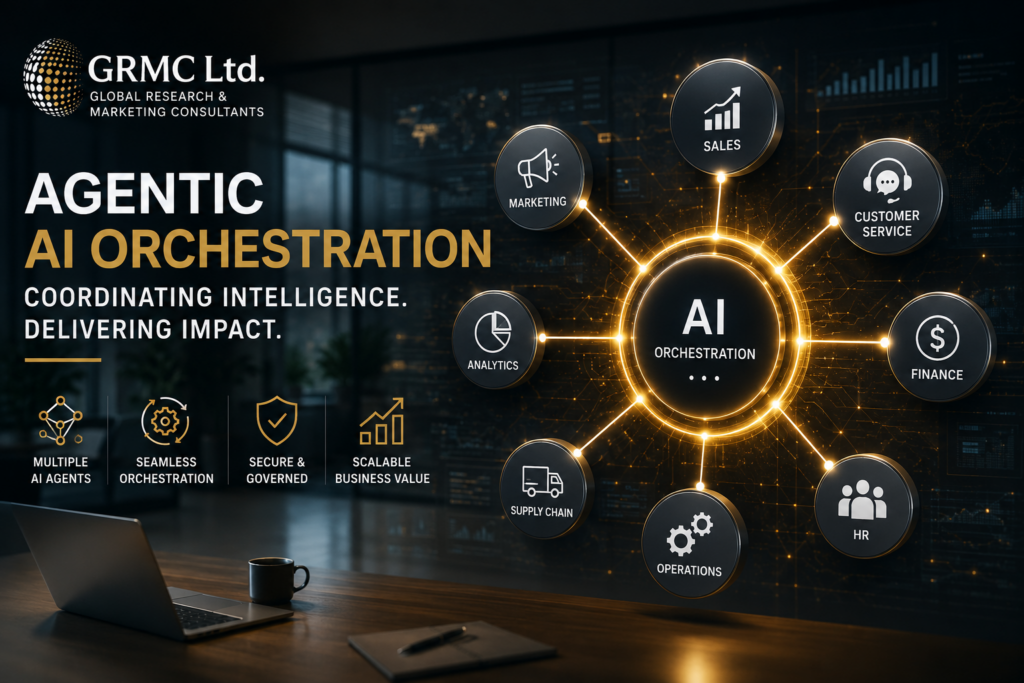
One AI agent may analyze sales performance, another may monitor cybersecurity events, while others manage procurement workflows, customer communications, financial reporting, or supply chain operations.
The challenge is no longer deploying a single AI agent—it is coordinating dozens of specialized AI agents so they work together efficiently, securely, and in alignment with business objectives.
This emerging discipline is known as Agentic AI Orchestration.
Agentic AI Orchestration provides the frameworks, governance, communication, and workflow coordination required to ensure multiple autonomous AI agents operate as a unified enterprise ecosystem rather than isolated automation tools.
For CEOs, CIOs, CTOs, innovation leaders, and digital transformation teams, orchestration is becoming the foundation for scalable and sustainable enterprise AI adoption.
📊 Industry Overview
Organizations are increasingly deploying AI agents across multiple business functions, including:
- Customer service
- Finance
- Human resources
- Procurement
- Marketing
- Cybersecurity
- Supply chain management
- Business intelligence
- Compliance
- Operations
As the number of AI agents grows, organizations face a new operational challenge.
Without coordination, AI agents may duplicate work, generate conflicting recommendations, compete for system resources, or operate with inconsistent business priorities.
Enterprise AI success increasingly depends on orchestrating these agents into a coordinated ecosystem that supports organizational goals.
⚠️ Key Challenges
🤖 AI Agent Silos
Departments often deploy AI independently.
Without enterprise coordination, organizations create disconnected AI environments that reduce efficiency and increase operational complexity.
🔄 Inconsistent Decision-Making
Different AI agents may reach different conclusions because they access different datasets, business rules, or objectives.
Consistency is essential for executive confidence.
🔐 Cross-System Integration
Enterprise AI agents frequently interact with:
- ERP platforms
- CRM systems
- Business intelligence tools
- Cloud applications
- Collaboration platforms
- Industry-specific software
Reliable orchestration ensures these systems communicate effectively.
📈 Scalability Challenges
Managing two AI agents differs significantly from managing fifty.
Organizations require scalable orchestration frameworks that support future growth without increasing operational complexity.
⚖️ Governance Across Multiple Agents
Organizations need centralized oversight to monitor:
- Agent performance
- Business outcomes
- Access permissions
- Compliance requirements
- Operational risks
📈 Business Insights
🌐 Enterprise AI Is Becoming a Connected Ecosystem
Organizations are moving away from isolated AI implementations toward integrated AI environments where specialized agents collaborate to achieve broader business objectives.
📊 Coordination Improves Business Value
The greatest value of Agentic AI is realized when specialized agents share information, coordinate tasks, and support end-to-end business processes rather than operating independently.
🏢 Executive Visibility Is Essential
Business leaders require centralized dashboards that provide visibility into AI performance, operational outcomes, and strategic impact across the enterprise.
🔄 Human Oversight Remains Critical
Even highly autonomous AI ecosystems require executive oversight, governance policies, and clearly defined escalation paths for high-impact decisions.
🛠️ Practical Recommendations
📑 Define Agent Roles Clearly
Assign every AI agent a specific business function, authority level, and performance objective.
🔗 Build Standardized Integration Frameworks
Ensure AI agents communicate through secure APIs and shared enterprise data standards.
📊 Monitor Enterprise AI Performance
Track key performance indicators such as:
- Task completion
- Process efficiency
- Decision accuracy
- Resource utilization
- Business impact
🔒 Implement Enterprise Governance
Develop centralized policies covering security, compliance, accountability, auditing, and lifecycle management for all AI agents.
🚀 Start with High-Value Business Processes
Prioritize orchestration in areas where multiple departments collaborate, such as customer onboarding, procurement, financial reporting, or supply chain management.
🤝 How GRMC Can Help
GRMC EdgeSphere supports organizations in designing and implementing enterprise-ready Agentic AI ecosystems.
🤖 Agentic AI Strategy
Develop AI roadmaps aligned with business priorities and long-term digital transformation goals.
🔗 AI Orchestration Architecture
Design scalable frameworks that enable multiple AI agents to work together across enterprise systems.
⚙️ Intelligent Process Integration
Integrate AI agents with ERP, CRM, analytics, cybersecurity, and operational platforms.
📊 AI Performance & Business Intelligence
Measure business outcomes, monitor AI effectiveness, and provide executive-level reporting.
🛡️ Governance & Risk Management
Establish policies that ensure secure, compliant, and responsible deployment of enterprise AI agents.
🚀 Conclusion
The future of enterprise AI will not be defined by the intelligence of a single AI agent, but by how effectively organizations coordinate entire ecosystems of autonomous agents.
Agentic AI Orchestration enables enterprises to transform isolated AI initiatives into integrated business capabilities that improve collaboration, scalability, and strategic decision-making.
Organizations that invest in orchestration today will be better positioned to scale AI confidently, maximize business value, and maintain operational control as autonomous technologies become an integral part of modern enterprise operations.
GRMC EdgeSphere helps organizations design, integrate, and orchestrate intelligent AI ecosystems that deliver measurable business outcomes while supporting long-term digital transformation.