

🌍 Introduction
Choosing the right location has always been a critical business decision. However, in today’s complex economic environment, selecting the right country, city, region, or industrial hub requires much more than demographic data or population statistics.
Organizations expanding into new markets, opening new facilities, launching retail locations, investing in infrastructure, or developing regional growth strategies face an increasingly challenging question:
Where should we invest to maximize long-term business success?
The answer lies in Geographic Intelligence.
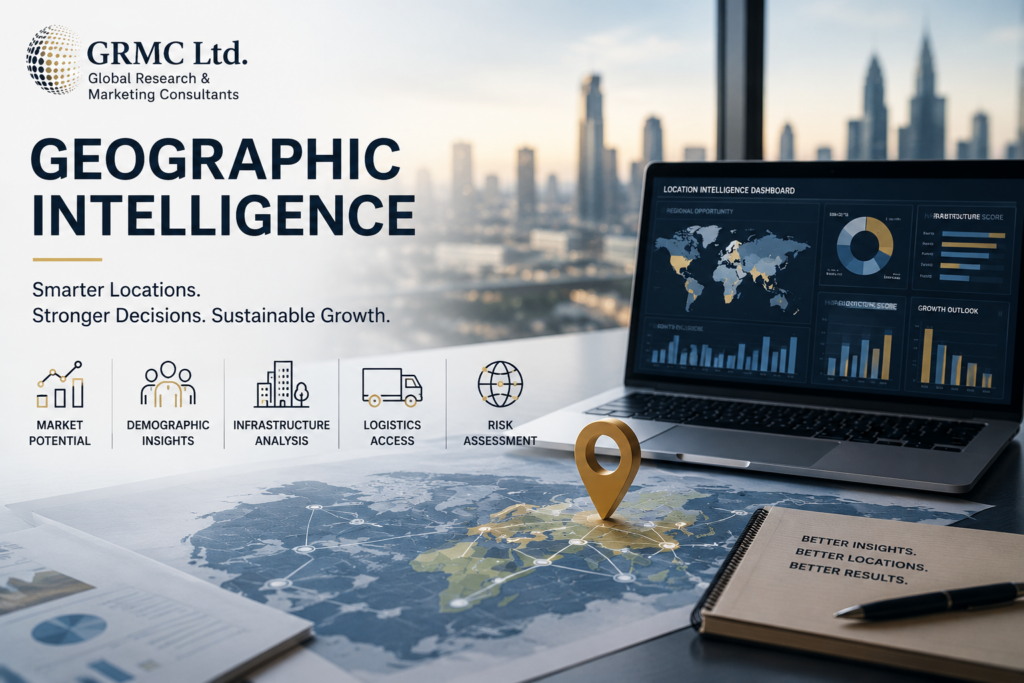
Geographic Intelligence combines market research, business intelligence, economic analysis, demographic insights, infrastructure assessment, and location analytics to help organizations understand how geography influences business performance. It enables leaders to identify locations with the strongest commercial potential while minimizing operational, financial, and strategic risks.
For enterprises, investors, government agencies, developers, and multinational organizations, Geographic Intelligence has become an essential decision-support capability for sustainable growth.
📊 Industry Overview
Business location decisions have become more strategic than ever before.
Organizations now evaluate multiple geographic factors before making investment decisions, including:
- Population growth
- Workforce availability
- Consumer purchasing power
- Transportation infrastructure
- Digital connectivity
- Supply chain accessibility
- Regulatory environment
- Competitive landscape
- Economic stability
- Industry clusters
At the same time, hybrid work models, digital commerce, regional economic development, and infrastructure investments are reshaping where businesses choose to operate.
Rather than expanding into the largest markets, many organizations are identifying high-potential regional markets that offer lower operating costs, faster growth, and less competitive pressure.
Geographic Intelligence enables decision-makers to evaluate these opportunities objectively and strategically.
⚠️ Key Challenges
📍 Selecting Locations Based on Assumptions
Many organizations continue to make expansion decisions based on familiarity, anecdotal evidence, or competitor presence.
Without comprehensive geographic analysis, businesses risk investing in markets that fail to deliver expected returns.
🌐 Regional Differences Within the Same Country
Opportunities can vary significantly between cities and regions within a single country.
Factors such as income levels, infrastructure quality, industry concentration, consumer preferences, and workforce availability often differ considerably.
A national-level assessment is rarely sufficient.
🚚 Infrastructure and Logistics Constraints
Commercial success depends not only on customer demand but also on operational efficiency.
Organizations must evaluate:
- Transportation networks
- Port accessibility
- Warehousing capacity
- Distribution channels
- Utility reliability
- Digital infrastructure
Ignoring these factors can increase operational costs and reduce competitiveness.
👥 Workforce Availability and Skills Gaps
Talent availability is becoming one of the most important location-selection criteria.
Businesses require access to qualified professionals, technical expertise, and future workforce development to support sustainable growth.
📈 Rapidly Changing Economic Conditions
Economic development initiatives, infrastructure projects, foreign investment policies, and urban expansion can quickly change the attractiveness of a location.
Organizations need current intelligence rather than relying on outdated market data.
📈 Market Research Insights
🏙️ Secondary Cities Are Creating New Growth Opportunities
Many businesses are discovering that secondary cities offer attractive investment conditions through:
- Lower operating costs
- Growing consumer markets
- Expanding infrastructure
- Government incentives
- Reduced competitive intensity
These markets often provide stronger long-term growth potential than saturated metropolitan areas.
🌎 Infrastructure Investment Influences Commercial Success
Major public and private infrastructure investments frequently reshape regional economies.
New highways, ports, airports, industrial parks, technology zones, and logistics corridors can significantly increase market attractiveness.
Monitoring these developments enables organizations to identify future growth areas before competitors.
🛒 Consumer Demand Is Becoming More Localized
Customer preferences increasingly vary across regions due to differences in demographics, income levels, lifestyles, and cultural influences.
Localized market research enables businesses to adapt products, pricing, and marketing strategies to regional demand patterns.
🏭 Industry Clusters Create Competitive Advantages
Businesses often achieve greater success by locating near established industry ecosystems.
These clusters provide access to:
- Skilled labor
- Specialized suppliers
- Innovation networks
- Research institutions
- Strategic partnerships
Geographic Intelligence helps identify these high-value ecosystems.
🌱 Sustainability Is Influencing Location Decisions
Environmental resilience, renewable energy availability, climate risks, and sustainable infrastructure are becoming important considerations for long-term investments.
Organizations increasingly incorporate sustainability metrics into geographic assessments.
🛠️ Practical Recommendations
📊 Evaluate Locations Using Multiple Criteria
Avoid making decisions based solely on market size.
Assess each location using factors such as:
- Customer demand
- Infrastructure
- Talent availability
- Regulatory environment
- Competitive intensity
- Economic outlook
- Operating costs
🗺️ Compare Multiple Geographic Scenarios
Evaluate several potential markets before selecting a final location.
Scenario analysis enables organizations to compare investment outcomes under different market conditions.
📑 Integrate Geographic Intelligence with Market Research
Location decisions should combine:
- Demographic analysis
- Consumer research
- Industry trends
- Competitive intelligence
- Economic forecasting
An integrated approach produces more reliable investment decisions.
🤝 Engage Local Stakeholders
Consulting local businesses, industry experts, chambers of commerce, and community organizations provides valuable insight into regional opportunities and challenges.
📈 Monitor Geographic Trends Continuously
Regional economies evolve over time.
Organizations should establish ongoing monitoring processes to identify emerging investment opportunities, infrastructure developments, and demographic changes.
🤝 How GRMC Can Help
GRMC EdgeSphere provides comprehensive Geographic Intelligence solutions that enable organizations to make confident location-based investment and expansion decisions.
🌍 Geographic Market Assessments
We evaluate countries, regions, cities, and industrial zones based on commercial potential, economic conditions, and market demand.
📊 Demographic and Economic Analysis
Our research examines population trends, purchasing power, workforce availability, and regional economic performance.
🏭 Industry Cluster Research
We identify established and emerging business ecosystems that support sustainable growth and competitive advantage.
🚚 Infrastructure and Location Intelligence
GRMC assesses transportation networks, logistics capabilities, digital infrastructure, and accessibility to support operational planning.
🌐 International Expansion Advisory
We help organizations identify the most suitable geographic markets across the GCC, Caribbean, North America, LATAM, Africa, and other international regions.
📈 Strategic Investment Support
Our evidence-based insights help executives, investors, and government agencies reduce location risk and maximize long-term returns.
🚀 Conclusion
Location has always influenced business success, but in today’s rapidly changing global economy, geographic decisions require deeper analysis than ever before.
Geographic Intelligence enables organizations to move beyond assumptions by combining market research, business intelligence, demographic analysis, infrastructure assessment, and economic insights into a comprehensive decision-making framework.
Whether expanding into a new country, selecting a regional headquarters, opening a manufacturing facility, or evaluating investment opportunities, organizations that leverage Geographic Intelligence gain a clearer understanding of where sustainable growth is most likely to occur.
GRMC EdgeSphere helps organizations transform location data into strategic insight, empowering leaders to make informed geographic decisions that support long-term competitiveness, operational efficiency, and profitable growth.