

Cyber Resilience Has Become the New Competitive Advantage
For years, enterprise cybersecurity strategies focused on a single objective: prevent attackers from entering the network. Organizations invested heavily in firewalls, endpoint protection, intrusion detection systems, employee awareness training, and sophisticated threat intelligence platforms.
While these investments remain essential, the cyber threat landscape of 2026 has made one reality impossible to ignore:
Even mature organizations with advanced security controls are experiencing successful ransomware incidents.
Modern ransomware groups no longer rely on simple malware campaigns. They operate as highly organized criminal enterprises that leverage AI-powered phishing, stolen credentials, supply chain compromises, cloud misconfigurations, and zero-day vulnerabilities to bypass traditional security defenses.
The question for today’s executives is no longer:
“Can we prevent every attack?”
Instead, the critical question has become:
“How quickly can our business recover when prevention inevitably fails?”
This shift represents the evolution from cybersecurity to cyber resilience—an enterprise capability that prioritizes business continuity, operational recovery, and organizational resilience alongside prevention.
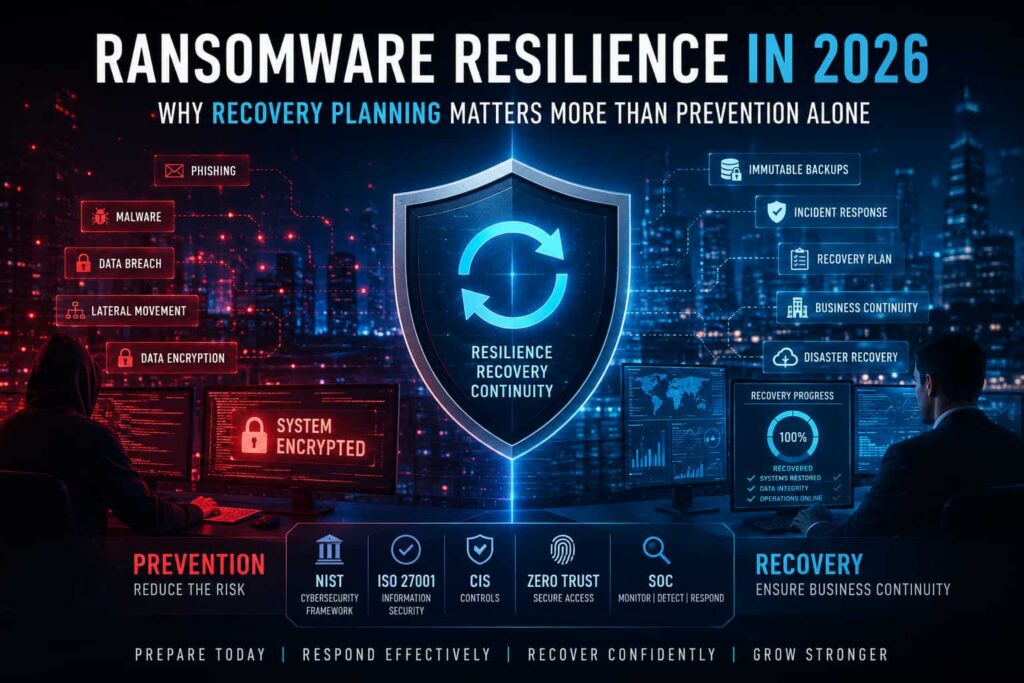
Why Prevention Alone Is No Longer Enough
Traditional cybersecurity programs often measure success by blocked attacks, reduced vulnerabilities, or lower phishing click rates.
While these metrics remain valuable, they tell only part of the story.
Today’s ransomware operators are patient. They frequently spend weeks—or even months—inside enterprise environments before launching encryption.
During this dwell time they may:
- Steal sensitive intellectual property
- Exfiltrate customer information
- Compromise privileged accounts
- Disable security tools
- Corrupt backup systems
- Move laterally across hybrid infrastructure
- Target cloud workloads and SaaS environments
When encryption finally begins, the compromise has often already evolved into a full-scale business crisis.
Organizations therefore require two complementary capabilities:
- Cybersecurity — reducing the likelihood of compromise
- Cyber resilience — minimizing operational impact after compromise
Both are essential.
The Evolution of Modern Ransomware
Ransomware has evolved far beyond file encryption.
Today’s attacks commonly involve multiple extortion techniques, including:
- Data theft before encryption
- Public leak threats
- Regulatory exposure
- Supply chain disruption
- Cloud workload compromise
- Identity infrastructure attacks
- Third-party service disruption
Many ransomware operators now target organizations whose downtime directly affects public services or critical operations, including:
- Healthcare providers
- Financial institutions
- Government agencies
- Manufacturing facilities
- Energy providers
- Transportation systems
- Critical infrastructure operators
For these organizations, prolonged downtime can result in operational disruption, regulatory penalties, reputational damage, and significant financial losses.
The Business Cost of Delayed Recovery
When ransomware strikes, recovery speed directly influences business impact.
Extended outages can lead to:
Operational Disruption
Business-critical applications become unavailable, delaying essential services and reducing productivity across departments.
Financial Losses
Organizations face revenue interruption, incident response costs, regulatory fines, legal expenses, and increased cyber insurance premiums.
Reputational Damage
Customers, partners, and investors increasingly evaluate organizations based on their ability to maintain operational resilience during cyber incidents.
Compliance Violations
Industries governed by strict regulatory frameworks may face reporting obligations, investigations, or penalties following significant cyber events.
Executive Accountability
Boards now expect measurable resilience capabilities, not simply investments in preventive technologies.
Recovery Planning Is Now a Board-Level Priority
Recovery planning extends far beyond maintaining backup copies of data.
An effective ransomware recovery strategy answers critical business questions:
- Which systems must recover first?
- What is the acceptable downtime for each business function?
- Which applications support critical operations?
- How will executives coordinate crisis communications?
- How will regulatory notifications be managed?
- How will customer services continue during disruption?
- Can backup systems be trusted?
- How quickly can clean environments be rebuilt?
These questions require collaboration across executive leadership, IT, cybersecurity, legal, compliance, communications, and business operations.
Recovery planning is therefore an enterprise governance responsibility—not solely an IT initiative.
The Role of Immutable Backups
One of the most common failures during ransomware incidents is discovering that backup systems have also been compromised.
Modern ransomware groups actively target:
- Backup servers
- Snapshot repositories
- Storage appliances
- Cloud backup credentials
- Replication infrastructure
This is why organizations increasingly implement:
- Immutable backups
- Air-gapped storage
- Offline recovery repositories
- Multi-region backup strategies
- Backup integrity validation
- Regular restoration testing
The ability to restore clean, verified data often determines whether recovery takes hours, days, or weeks.
Recovery Exercises Are Just as Important as Backups
Many organizations possess documented recovery plans that have never been tested.
Unfortunately, untested recovery plans frequently fail during real incidents.
Leading enterprises conduct regular:
- Disaster recovery exercises
- Tabletop simulations
- Ransomware attack scenarios
- Executive crisis management workshops
- Technical recovery drills
- Backup restoration validation
- Business continuity testing
These exercises expose hidden weaknesses before attackers do.
Testing also improves coordination among technical teams, executives, legal departments, and external partners.
Aligning Recovery with Cybersecurity Frameworks
Recovery planning becomes significantly more effective when aligned with internationally recognized cybersecurity frameworks.
NIST Cybersecurity Framework (CSF)
The NIST CSF emphasizes five core functions:
- Identify
- Protect
- Detect
- Respond
- Recover
The Recover function specifically focuses on restoring capabilities, maintaining resilience, and improving recovery processes following cyber incidents.
Organizations that prioritize only the first four functions leave a significant resilience gap.
ISO/IEC 27001
ISO 27001 encourages organizations to establish information security management systems that support business continuity and continual improvement.
Recovery planning should integrate with:
- Business continuity management
- Disaster recovery planning
- Risk assessments
- Incident response procedures
- Continuous improvement cycles
CIS Critical Security Controls
Several CIS Controls directly strengthen ransomware resilience, including:
- Secure backups
- Continuous vulnerability management
- Data recovery capabilities
- Security awareness training
- Account management
- Incident response management
Together, these controls reduce recovery complexity while improving organizational readiness.
Zero Trust Supports Recovery
Zero Trust is often associated with prevention, but its value extends well into recovery.
By continuously verifying users, devices, and workloads, Zero Trust helps:
- Limit lateral movement
- Contain compromised accounts
- Reduce attack propagation
- Isolate affected environments
- Accelerate recovery efforts
Smaller containment zones allow organizations to restore operations more efficiently while minimizing business disruption.
The Importance of Security Operations Centers (SOC)
A mature Security Operations Center (SOC) plays a critical role before, during, and after ransomware incidents.
Modern SOC teams enable organizations to:
- Detect suspicious activity earlier
- Monitor attacker movement
- Coordinate incident response
- Support forensic investigations
- Validate system integrity
- Assist recovery prioritization
- Improve post-incident security posture
Continuous monitoring shortens attacker dwell time and supports faster recovery decision-making.
Risk Management Drives Resilience
Every organization has finite cybersecurity resources.
Effective risk management helps leaders prioritize investments where they produce the greatest reduction in business risk.
This includes evaluating:
- Critical business processes
- Crown jewel assets
- Recovery time objectives (RTO)
- Recovery point objectives (RPO)
- Third-party dependencies
- Regulatory obligations
- Financial exposure
- Operational impact
Recovery planning should always align with enterprise risk tolerance rather than technical preferences alone.
Executive Leadership Must Own Cyber Resilience
Cyber resilience is no longer solely the responsibility of the IT department.
Boards and executive leadership increasingly oversee:
- Cyber risk governance
- Business continuity investments
- Incident preparedness
- Regulatory compliance
- Recovery capability
- Third-party resilience
- Crisis communication planning
Organizations that integrate cybersecurity into enterprise risk management consistently demonstrate stronger resilience during disruptive cyber events.
Looking Ahead
Ransomware will continue evolving as threat actors adopt artificial intelligence, automation, and increasingly sophisticated attack techniques.
While prevention technologies will remain indispensable, no security program can eliminate risk entirely.
The organizations that succeed in 2026 will not be those that simply prevent more attacks—they will be those that recover faster, maintain operational continuity, and preserve stakeholder confidence when incidents occur.
Cyber resilience is therefore no longer an optional enhancement to cybersecurity.
It has become a fundamental business capability.
Conclusion
Enterprise leaders should view ransomware recovery planning as a strategic investment rather than an emergency response exercise.
A resilient organization combines preventive security controls with tested recovery capabilities, robust governance, and continuous risk management.
By aligning recovery planning with frameworks such as NIST, ISO 27001, CIS Controls, Zero Trust, Security Operations Center (SOC) practices, and enterprise risk management, organizations can significantly reduce operational disruption and improve long-term resilience.
In an era where cyberattacks are increasingly inevitable, competitive advantage belongs to organizations that can recover with speed, confidence, and minimal business impact.
About GRMC EdgeSphere
GRMC EdgeSphere helps organizations strengthen cyber resilience through advanced cybersecurity consulting, governance, risk management, compliance, Security Operations Center (SOC) services, and enterprise security solutions. By aligning security strategies with internationally recognized frameworks and business objectives, GRMC EdgeSphere enables organizations to reduce cyber risk, improve operational resilience, and prepare for evolving threats in an increasingly complex digital landscape.