
🌍 Introduction
The rapid evolution of Agentic AI is transforming how organizations approach automation, decision-making, and operational efficiency.
Unlike traditional AI systems that respond to prompts or perform isolated tasks, Agentic AI systems can pursue objectives, interact with multiple applications, analyze information, make recommendations, and execute actions with limited human intervention.
This capability creates significant opportunities for organizations seeking greater efficiency and agility.
However, it also introduces a new leadership challenge.
As AI agents gain greater autonomy, executives must answer critical questions:
- Who is accountable for AI-driven decisions?
- How should AI authority be defined?
- What controls should govern autonomous actions?
- How can organizations maintain compliance?
- How can AI risks be identified before they become business problems?
These questions are driving the emergence of Agentic AI Governance as a critical component of enterprise AI strategy.
📊 Industry Overview
The current generation of AI deployments is evolving beyond simple automation.
Organizations are increasingly deploying AI agents capable of:
- Managing workflows
- Coordinating business processes
- Monitoring operational systems
- Generating recommendations
- Interacting with customers
- Supporting strategic planning
As adoption expands, organizations are moving from managing individual AI tools to managing ecosystems of AI agents.
This shift introduces new operational complexities that require governance frameworks comparable to those used for cybersecurity, financial controls, and regulatory compliance.
⚠️ Key Challenges
🤖 Autonomous Actions Without Clear Accountability
When an AI agent performs an action, organizations must understand:
- Why the decision was made
- Which data influenced the outcome
- Who approved the process
- How the decision can be reviewed
Without accountability structures, organizations may face operational and regulatory risks.
🔒 Security and Access Management
Agentic AI often requires access to:
- CRM platforms
- ERP systems
- Financial applications
- Customer databases
- Business intelligence platforms
Improper permissions can create significant security vulnerabilities.
📜 Regulatory Compliance Requirements
Organizations operating in regulated industries must ensure that AI-driven processes comply with:
- Data protection regulations
- Industry standards
- Internal policies
- Audit requirements
Governance frameworks help maintain compliance while enabling innovation.
⚖️ Decision Transparency
Business leaders increasingly require visibility into how AI agents reach conclusions.
Transparency becomes particularly important in:
- Financial services
- Healthcare
- Government operations
- Human resources
- Risk management
Organizations must be able to explain AI-supported decisions to stakeholders and regulators.
🌐 Managing Multiple AI Agents
Future enterprises may deploy dozens or hundreds of specialized AI agents.
Without centralized oversight, organizations risk:
- Conflicting actions
- Process inefficiencies
- Data inconsistencies
- Operational complexity
📈 Business Insights
🏢 Governance Is Becoming an AI Maturity Indicator
Organizations are beginning to recognize that successful AI adoption depends as much on governance as technology.
Mature AI programs prioritize:
- Oversight
- Accountability
- Risk management
- Continuous monitoring
🔍 Human Supervision Remains Essential
The most effective organizations view Agentic AI as a decision-support and execution capability rather than a fully independent replacement for human leadership.
Human oversight remains critical for:
- Strategic decisions
- Regulatory compliance
- Ethical considerations
- Exception management
📊 Auditability Builds Organizational Trust
Employees, customers, regulators, and investors are more likely to trust AI systems when organizations can demonstrate clear governance and transparency.
Trust accelerates adoption.
🧠 AI Governance Supports Scalability
Organizations often discover that governance frameworks enable faster AI scaling by reducing uncertainty and risk.
Structured oversight creates confidence for broader deployment.
🛠️ Practical Recommendations
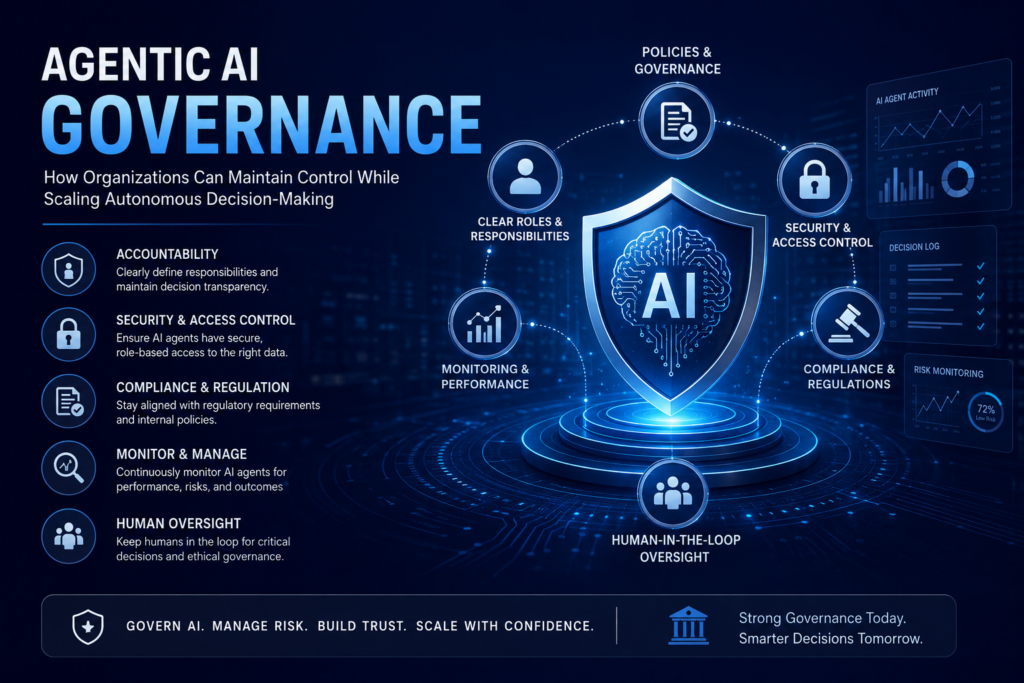
📑 Define Agent Responsibilities Clearly
Each AI agent should have:
- Specific objectives
- Defined authority limits
- Approved actions
- Escalation procedures
🔐 Implement Role-Based Access Controls
AI agents should only access information necessary to perform assigned functions.
Permission structures should align with organizational security policies.
📊 Establish Continuous Monitoring
Organizations should track:
- Agent performance
- Decision outcomes
- System interactions
- Risk indicators
Monitoring enables early identification of issues.
⚖️ Create AI Governance Policies
Governance frameworks should address:
- Accountability
- Compliance
- Security
- Data management
- Risk mitigation
👥 Maintain Human-in-the-Loop Controls
Critical decisions should continue to involve human review and approval processes where appropriate.
🤝 How GRMC Can Help
GRMC EdgeSphere helps organizations design, implement, and govern Agentic AI ecosystems that align with business objectives while maintaining security, compliance, and operational control.
🧠 Agentic AI Strategy
Developing scalable AI roadmaps aligned with enterprise goals.
🔒 AI Governance Frameworks
Establishing policies, controls, and oversight structures for responsible AI deployment.
⚙️ Intelligent Process Automation
Integrating Agentic AI into business operations while maintaining transparency and accountability.
📊 Business Intelligence and Monitoring
Providing visibility into AI performance, operational outcomes, and risk indicators.
🛡️ Cybersecurity and Risk Management
Ensuring AI systems operate within secure and compliant environments.
🚀 Conclusion
As Agentic AI becomes more capable, the conversation is shifting from “What can AI do?” to “How should organizations govern what AI does?”
The organizations that achieve long-term success with Agentic AI will not necessarily be those that deploy the most agents. They will be those that create governance structures capable of balancing innovation, accountability, security, and business value.
Agentic AI Governance is rapidly emerging as a strategic business discipline—one that will play a critical role in determining how effectively organizations scale autonomous decision-making in the years ahead.
With the right governance framework, organizations can unlock the benefits of Agentic AI while maintaining the control, transparency, and trust required for sustainable growth.