

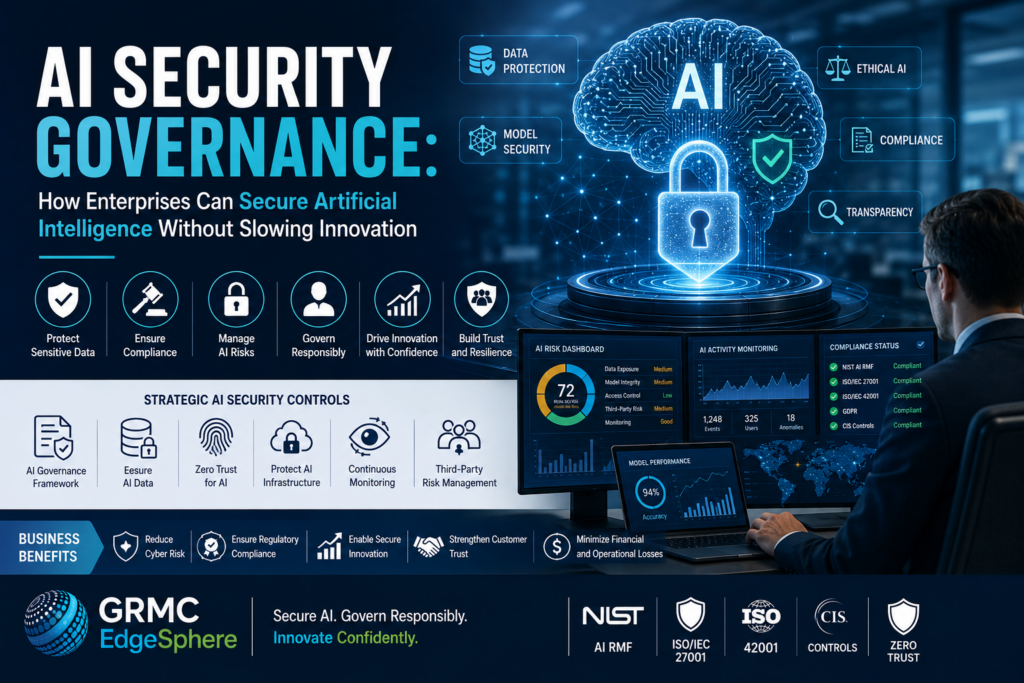
Artificial Intelligence (AI) has rapidly become a strategic asset for organizations seeking to improve operational efficiency, automate business processes, strengthen customer engagement, and gain competitive advantages. From generative AI assistants and predictive analytics to intelligent automation and machine learning models, AI is transforming nearly every industry.
However, as AI adoption accelerates, so do the associated cybersecurity, privacy, compliance, and governance challenges. AI systems process large volumes of sensitive information, integrate with critical business applications, and often rely on third-party models, APIs, and cloud infrastructure. Without appropriate security controls, these technologies can introduce significant enterprise risks.
AI Security Governance provides organizations with the policies, controls, frameworks, and oversight required to deploy AI responsibly while protecting business assets, customer data, and organizational reputation.
This article explores today’s AI threat landscape, the business risks of insecure AI adoption, practical governance strategies, and security controls aligned with international frameworks including NIST, ISO 27001, Zero Trust, and enterprise risk management principles.
The Growing Enterprise AI Landscape
Organizations across industries are embedding AI into critical business operations, including:
- Customer service automation
- Financial fraud detection
- Healthcare diagnostics
- Manufacturing optimization
- Supply chain forecasting
- Cybersecurity threat detection
- Human resource management
- Enterprise knowledge management
As AI becomes integrated into business-critical workflows, securing these systems is no longer optional—it is an essential component of enterprise risk management.
Current AI Security Threat Landscape
Prompt Injection Attacks
Attackers manipulate AI systems by crafting malicious prompts that bypass intended safeguards, reveal confidential information, or influence model behavior.
Data Poisoning
Threat actors intentionally introduce manipulated or inaccurate data into AI training datasets, causing models to produce unreliable or biased outputs.
Model Theft
Machine learning models often represent significant intellectual property. Attackers may attempt to extract or replicate proprietary models through unauthorized access.
Sensitive Data Exposure
Employees may unknowingly submit confidential business information into public AI platforms, creating risks related to intellectual property, customer privacy, and regulatory compliance.
Supply Chain Risks
Many AI solutions depend on external APIs, open-source libraries, cloud providers, and foundation models. Weaknesses within these dependencies can become attack vectors.
AI-Enabled Cyberattacks
Cybercriminals increasingly use AI to automate phishing campaigns, generate convincing social engineering content, identify vulnerabilities, and accelerate malware development.
Business Impact
Poor AI security governance can result in:
- Confidential data leakage
- Regulatory non-compliance
- Financial losses
- Intellectual property theft
- Operational disruption
- Reduced customer trust
- Legal liability
- Reputational damage
For highly regulated industries such as banking, healthcare, and government, these consequences can be particularly severe.
Enterprise Risk Analysis
Governance Risks
- Lack of AI ownership
- Undefined policies
- Poor executive oversight
Data Risks
- Unauthorized data access
- Data privacy violations
- Poor data quality
Technology Risks
- Insecure AI integrations
- Vulnerable APIs
- Weak identity management
Operational Risks
- Model drift
- Inaccurate outputs
- Unmonitored AI usage
Third-Party Risks
- Vendor security weaknesses
- Cloud service dependencies
- Open-source software vulnerabilities
Recommended Security Controls
Establish an AI Governance Framework
Create enterprise policies defining:
- Approved AI use cases
- Risk ownership
- Data handling requirements
- Security responsibilities
- Compliance obligations
Secure AI Data
Protect AI datasets using:
- Data classification
- Encryption
- Access controls
- Data Loss Prevention (DLP)
- Secure backups
Implement Zero Trust for AI
Apply Zero Trust principles by:
- Verifying every user and device
- Enforcing least privilege access
- Monitoring AI interactions continuously
- Segmenting AI infrastructure
Protect AI Infrastructure
Implement:
- Multi-Factor Authentication (MFA)
- Privileged Access Management (PAM)
- Endpoint Detection and Response (EDR/XDR)
- Secure API gateways
- Continuous vulnerability management
Continuous AI Monitoring
Organizations should continuously monitor:
- Model performance
- Security events
- API usage
- Data access
- User activity
- Anomalous behavior
Integration with a Security Operations Center (SOC) enables faster detection and response.
Third-Party AI Risk Management
Before adopting external AI platforms, evaluate:
- Security architecture
- Compliance certifications
- Data residency
- Vendor risk posture
- Incident response capabilities
- Contractual security obligations
Best Practices
Organizations should:
- Develop an enterprise AI security strategy.
- Conduct AI-specific cyber risk assessments.
- Maintain an inventory of AI systems and models.
- Classify data used by AI applications.
- Perform regular security testing of AI solutions.
- Educate employees on responsible AI usage.
- Monitor AI vendors continuously.
- Align governance with business objectives.
- Review AI policies periodically.
- Integrate AI governance into enterprise risk management.
Relevant Security Frameworks
Effective AI security governance should align with:
- NIST AI Risk Management Framework (AI RMF)
- NIST Cybersecurity Framework (CSF 2.0)
- ISO/IEC 27001
- ISO/IEC 42001 (Artificial Intelligence Management Systems)
- CIS Critical Security Controls
- Zero Trust Architecture
- Enterprise Risk Management (ERM)
These frameworks help organizations establish structured, measurable, and auditable AI security programs.
How GRMC EdgeSphere Can Help
GRMC EdgeSphere enables organizations to adopt AI securely while maintaining regulatory compliance and business resilience through:
- AI Security Risk Assessments
- AI Governance Strategy Development
- NIST AI RMF & ISO/IEC 42001 Readiness
- AI Security Architecture Reviews
- AI Data Protection & Privacy Consulting
- Secure AI Integration Assessments
- Third-Party AI Vendor Risk Evaluations
- Security Operations Center (SOC) Strategy
- Zero Trust Implementation
- Enterprise Cybersecurity & Digital Transformation Consulting
Our multidisciplinary expertise in cybersecurity, AI, digital transformation, and business intelligence helps organizations maximize AI innovation while effectively managing cyber risk.
Conclusion
Artificial Intelligence is reshaping modern enterprises, but its benefits can only be realized when security and governance evolve alongside innovation. Organizations that implement robust AI security governance frameworks will be better equipped to protect sensitive information, meet regulatory expectations, strengthen stakeholder confidence, and enable responsible AI adoption at scale.
Rather than viewing AI security as a barrier, forward-looking organizations recognize it as a strategic enabler that supports innovation, resilience, and sustainable business growth. By embedding governance, risk management, and security into every stage of the AI lifecycle, enterprises can unlock AI’s full potential with confidence.