

Introduction: The Conversation Has Moved On
The era of the enterprise chatbot was, in many ways, a proof of concept, demonstrating that AI could engage with text, answer questions, and reduce call-center volume. For many organisations, it was also a source of disappointment. Bots that could not resolve complex queries, automated responses that frustrated customers, and pilots that never scaled into enterprise-wide value became cautionary tales.
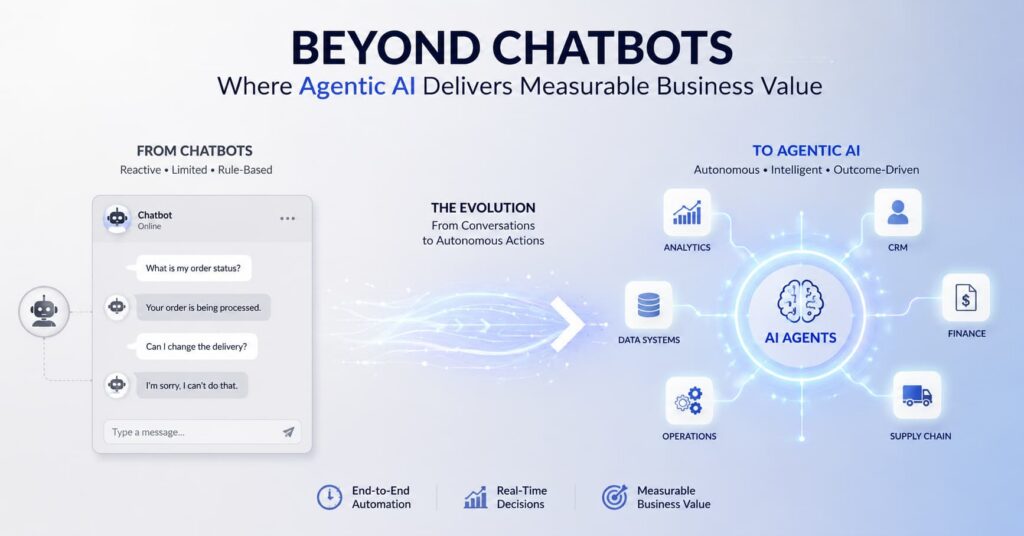
But the underlying technology did not stand still. What is reshaping enterprise operations today is not a smarter chatbot, it is agentic AI: autonomous, goal-directed systems that perceive their environment, reason across data sources, plan multi-step actions, and execute business processes end-to-end with minimal human intervention.
For CEOs, CTOs, CIOs, and digital transformation leaders, the strategic question is no longer “Should we explore AI?” It is “Where, specifically, does agentic AI generate the greatest return — and how do we deploy it at scale?”
This article provides direct, practical answers.
The Business Challenge: Complexity, Cost, and the Limits of Human Bandwidth
Modern enterprises operate in environments of compounding complexity. Data volumes are growing faster than the teams equipped to interpret them. Customer expectations are rising while tolerance for slow, fragmented service experiences is shrinking. Regulatory environments are tightening. And talent markets in high-skill functions — analytics, compliance, procurement, operations — remain persistently competitive.
Traditional automation addressed repetitive, rules-based tasks. It reduced labour costs and improved throughput in stable, predictable workflows. But it broke down wherever judgment was required — wherever a process touched ambiguous data, required contextual reasoning, or demanded dynamic decision-making.
This is precisely the gap that agentic AI is designed to fill.
Enterprises and government organisations across the Caribbean, LATAM, Africa, Asia, and North America are facing the same structural challenge: the cost of human decision-making at scale is no longer sustainable, and the limitations of conventional automation are well understood. The question is whether AI can operate reliably enough, and with sufficient contextual intelligence, to be trusted with consequential business processes.
The evidence is increasingly clear: in the right configurations, it can.
Technology Overview: What Agentic AI Actually Does
It is worth being precise about what distinguishes agentic AI from its predecessors.
A chatbot responds to prompts. It retrieves information, generates text, and answers questions. Its scope is bounded by the conversation window.
A robotic process automation (RPA) tool executes scripted tasks — clicking buttons, extracting data fields, moving files — but follows fixed rules and cannot adapt to unexpected inputs.
Agentic AI combines large language model reasoning with the ability to use tools, access external systems, retain context over time, and pursue goals across multiple steps. A well-designed AI agent can:
- Perceive — ingest data from APIs, databases, documents, emails, and real-time feeds.
- Reason — apply contextual understanding to evaluate options, identify anomalies, or formulate recommendations.
- Act — execute tasks across enterprise systems: updating CRM records, generating reports, triggering workflows, sending communications.
- Adapt — adjust behaviour based on new information or changing conditions without requiring human reprogramming.
This is not theoretical. Multi-agent architectures — where specialised AI agents collaborate on complex tasks — are now being deployed in financial services, healthcare administration, supply chain management, and public sector operations with documented, measurable outcomes.
Benefits and ROI: Where the Value Is
Enterprise AI investments should be evaluated through the same lens as any capital decision: return on investment, payback period, and strategic leverage. Agentic AI generates value across three primary dimensions.
1. Operational Efficiency
Agentic AI can compress the time required for complex, multi-step business processes from days to minutes. Document-intensive workflows — contract review, regulatory submissions, supplier onboarding, market research compilation — that previously required teams of analysts can be executed at scale with AI agents handling the cognitive load. Organisations typically report a 40–70% reduction in process cycle times in these categories.
2. Cost Reduction and Reallocation
AI agents do not replace all human roles, but they do dramatically reduce the volume of high-cost, low-complexity decision-making that consumes analyst and managerial bandwidth. Finance teams spending significant time on manual reconciliation, compliance teams manually reviewing transaction logs, or operations managers producing weekly status reports from disparate data sources — all of these represent addressable cost centres. The ROI case is typically built not on headcount reduction alone, but on reallocation: freeing skilled professionals to focus on work that requires human judgment, client relationships, and strategic thinking.
3. Scalability Without Proportional Cost Growth
Perhaps the most strategically significant benefit of agentic AI is the decoupling of operational capacity from headcount. A well-architected AI system can handle ten times the workload without a proportional increase in operating costs. For organisations with ambitions to expand into new markets or service regions — without the overhead of proportional staff growth — this is a structural competitive advantage.
Real-World Applications: Practical Enterprise Use Cases
Financial Services — Intelligent Compliance Monitoring
A regional bank deploys AI agents to monitor transaction data in real time, flag potential AML (anti-money laundering) anomalies, cross-reference customer profiles, and generate preliminary investigation reports — all before a human compliance officer reviews the case. What previously required a team working across shifts is now a continuous, automated process. Human reviewers focus on complex judgments and regulatory engagement.
Government Operations — Automated Citizen Services
A public agency implements an agentic AI system to process permit applications. The agent verifies documentation completeness, cross-references land registry and compliance databases, flags exceptions requiring human review, and communicates status updates to applicants. Processing times drop significantly, staff are redirected to complex casework, and citizen satisfaction improves.
Retail and FMCG — Predictive Demand Planning
An FMCG distributor operating across multiple markets uses AI agents to integrate point-of-sale data, regional weather patterns, promotional calendars, and supplier lead times — generating weekly demand forecasts and automated purchase order recommendations. Inventory carrying costs fall, stockouts are reduced, and the planning cycle that previously consumed three days of analyst time is completed overnight.
Professional Services — Market Intelligence Automation
A consulting firm deploys AI agents to continuously monitor competitor activity, regulatory changes, industry publications, and client news — synthesising findings into structured briefing documents delivered to account teams each morning. Analysts shift from information gathering to insight generation and client advisory.
These are not pilot programmes — they are production deployments generating measurable, recurring value.
Implementation Roadmap: From Strategy to Scale
Successful deployment of agentic AI in enterprise environments follows a consistent progression. Organisations that have struggled have typically tried to scale before validating, or have underestimated the importance of data readiness and change management.
Phase 1 — Discovery and Value Mapping (Weeks 1–4) Identify business processes that are high-volume, data-intensive, rule-bounded with exceptions, and currently consuming disproportionate human resource. Prioritise by ROI potential and implementation risk. The goal is not to automate everything — it is to identify the two or three use cases where agentic AI will generate the clearest, fastest return.
Phase 2 — Data and Infrastructure Readiness (Weeks 4–8) AI agents are only as effective as the data they operate on. This phase assesses data quality, integration requirements, API availability, and security architecture. Many organisations discover that data consolidation and clean-up is the most significant upstream investment — and also one that generates standalone value beyond AI applications.
Phase 3 — Pilot Design and Deployment (Weeks 8–16) Deploy against the priority use cases identified in Phase 1. Establish baseline metrics before deployment and measure rigorously. This phase is about validating the business case with real operational data, not demonstrating technical capability.
Phase 4 — Governance and Human-in-the-Loop Design Define clearly where AI operates autonomously, where it recommends and humans approve, and where human judgment remains primary. Well-governed AI deployments are not those with the least human involvement — they are those where human oversight is applied where it adds the most value.
Phase 5 — Scaling and Continuous Improvement Once a pilot delivers validated ROI, expand systematically. Build internal capability alongside vendor partnership. Establish feedback loops so agent performance improves over time. Plan for the governance and audit requirements that accompany AI at scale.
How GRMC EdgeSphere Can Help
GRMC EdgeSphere sits at the intersection of strategic insight and enterprise technology — combining decades of research and consulting expertise with advanced AI and automation capabilities.
Our Agentic AI & Automation practice helps enterprises and government organisations move beyond experimentation and into operational deployment. We bring together business domain knowledge, data analytics capability, and technical implementation expertise to design AI systems that work within the realities of your organisation — your data environment, your risk tolerance, your regulatory context, and your people.
Our approach is grounded in measurable outcomes, not technology advocacy. We begin with your business challenges and work backward to the AI architecture that addresses them. We are not in the business of deploying AI for its own sake — we are in the business of helping organisations generate sustainable competitive advantage.
Whether you are mapping your first AI strategy, evaluating a specific use case, or looking to scale existing pilots into enterprise-wide programmes, GRMC EdgeSphere offers the independent, expert guidance that complex AI decisions require.
Our services span the full implementation lifecycle:
- AI Readiness Assessment — data, infrastructure, and organisational capability review
- Use Case Prioritisation and Business Case Development
- Agent Architecture Design and Pilot Deployment
- AI Governance Frameworks — accountability, audit trails, and risk management
- Performance Monitoring and Continuous Optimisation
We serve clients across the Caribbean, LATAM, Africa, Asia, and North America — bringing regional context and global methodology to every engagement.
Conclusion: The Window for First-Mover Advantage Is Narrowing
Agentic AI is not a technology of the future. It is a technology of the present — and the organisations that invest in deployment now, rather than waiting for further certainty, are establishing operational and competitive advantages that will compound over time.
The organisations that will regret their hesitation are those that allowed competitors to build AI-powered workflows while they ran another internal assessment. The organisations that will regret their haste are those that deployed without strategy, governance, or a clear line of sight to business value.
The path between those two failure modes is disciplined, strategic implementation — led by people who understand both the technology and the business context in which it must operate.
That is the work GRMC EdgeSphere does every day.
Ready to move beyond the pilot phase? Connect with GRMC EdgeSphere to explore how agentic AI can deliver measurable value in your specific operational context.