

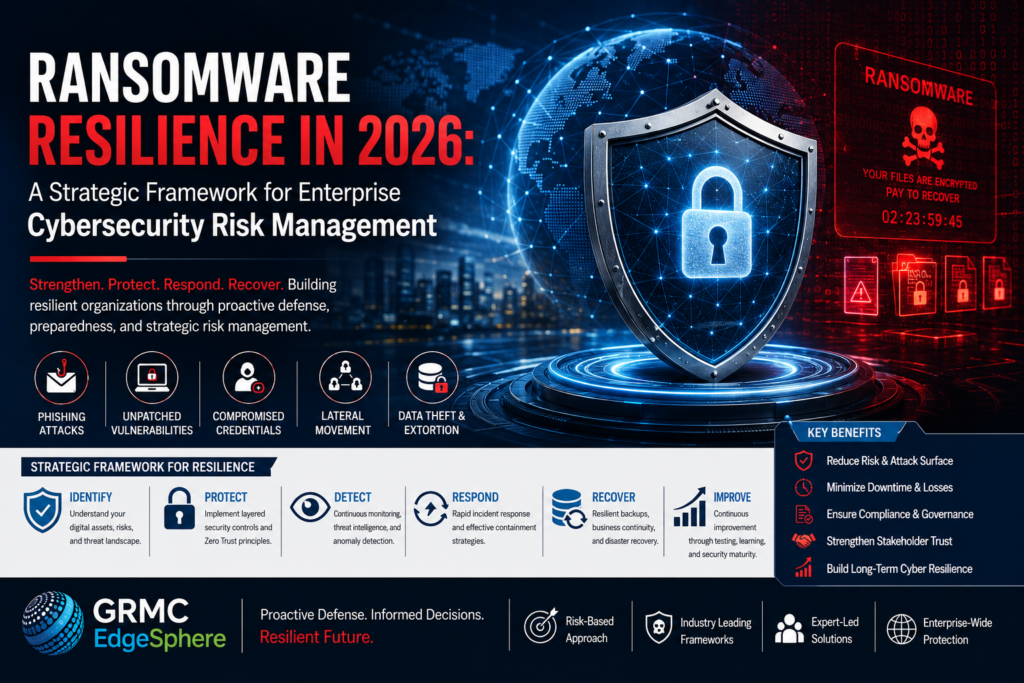
Ransomware remains one of the most disruptive and financially damaging cyber threats facing organizations worldwide. While ransomware was once primarily associated with data encryption and ransom demands, modern attacks have evolved into sophisticated multi-stage operations involving data theft, extortion, operational disruption, supply chain compromise, and reputational damage.
Organizations across government, financial services, healthcare, critical infrastructure, manufacturing, and enterprise sectors are increasingly targeted by ransomware groups that operate with business-like efficiency. Attackers leverage artificial intelligence, automated reconnaissance, stolen credentials, and third-party vulnerabilities to penetrate corporate environments.
For executive leadership, ransomware is no longer merely an IT issue—it is a business continuity, governance, compliance, and enterprise risk management challenge. Organizations must adopt proactive cybersecurity strategies aligned with internationally recognized frameworks such as NIST Cybersecurity Framework (CSF), ISO 27001, CIS Controls, and Zero Trust Architecture to strengthen resilience against evolving threats.
This article explores the current ransomware landscape, business impacts, risk considerations, and strategic controls that organizations should implement to reduce exposure and improve cyber resilience.
Understanding the Current Ransomware Threat Landscape
The ransomware ecosystem has transformed significantly over the past few years. Cybercriminal groups now operate highly organized Ransomware-as-a-Service (RaaS) models, enabling affiliates with varying technical skills to conduct attacks using sophisticated ransomware platforms.
Modern ransomware attacks typically involve:
- Initial Access Exploitation
- Credential Theft
- Privilege Escalation
- Lateral Movement
- Data Exfiltration
- Encryption of Critical Systems
- Extortion and Public Disclosure Threats
Attackers frequently target:
- Government Agencies
- Financial Institutions
- Healthcare Organizations
- Energy Providers
- Telecommunications Companies
- Manufacturing Facilities
- Transportation Networks
- Educational Institutions
Several factors contribute to the growing success of ransomware attacks:
1. Expanding Digital Attack Surface
Cloud adoption, remote work environments, IoT deployments, and third-party integrations have increased organizational exposure to cyber threats.
2. Human Error and Social Engineering
Phishing attacks continue to be one of the most successful initial access vectors. Employees remain a critical target for cybercriminals seeking unauthorized access.
3. Supply Chain Vulnerabilities
Organizations increasingly rely on vendors, contractors, cloud providers, and technology partners. Weaknesses within third-party environments often become entry points for attackers.
4. Delayed Patch Management
Unpatched vulnerabilities continue to be a leading cause of successful ransomware intrusions, particularly within internet-facing systems.
5. Identity-Based Attacks
Compromised credentials, weak passwords, and inadequate identity controls enable attackers to move laterally within enterprise environments.
Business Impact of Ransomware Attacks
The consequences of a ransomware incident extend far beyond ransom payments.
Operational Disruption
Organizations may experience:
- System outages
- Service interruptions
- Manufacturing downtime
- Supply chain disruption
- Customer service failures
For critical infrastructure operators, operational disruption may directly affect public safety and essential services.
Financial Losses
Direct and indirect financial impacts may include:
- Incident response costs
- Business interruption losses
- Legal expenses
- Regulatory penalties
- Recovery and restoration costs
- Cyber insurance impacts
In many cases, recovery costs significantly exceed the actual ransom demand.
Reputational Damage
Customer trust can be severely affected following a publicly disclosed cyber incident.
Stakeholders increasingly expect organizations to demonstrate robust cybersecurity governance and resilience capabilities.
Regulatory and Compliance Exposure
Organizations subject to regulations such as:
- GDPR
- HIPAA
- PCI DSS
- Financial Services Regulations
- Government Security Standards
may face substantial compliance implications if sensitive data is compromised.
Intellectual Property Theft
Modern ransomware groups frequently exfiltrate sensitive information before encryption, creating additional risks related to:
- Intellectual property theft
- Competitive disadvantage
- Confidential business information exposure
Enterprise Ransomware Risk Analysis
Effective ransomware defense begins with a structured cyber risk assessment.
Organizations should evaluate risks across several domains:
People Risk
Key considerations:
- Security awareness maturity
- Insider threats
- Privileged access management
- Employee cybersecurity training
Process Risk
Assessment areas include:
- Incident response readiness
- Business continuity planning
- Disaster recovery capabilities
- Vendor risk management
Technology Risk
Organizations should review:
- Endpoint security controls
- Network segmentation
- Identity and access management
- Security monitoring capabilities
- Backup and recovery systems
Third-Party Risk
Critical questions include:
- How secure are key suppliers?
- Are vendor access privileges properly controlled?
- Is cyber risk evaluated during procurement?
Strategic Risk
Executive leadership should evaluate:
- Organizational cyber maturity
- Governance oversight
- Board-level cybersecurity visibility
- Alignment with enterprise risk management programs
Recommended Controls for Ransomware Protection
A defense-in-depth approach is essential for reducing ransomware risk.
1. Implement Zero Trust Architecture
Zero Trust operates on the principle:
“Never Trust, Always Verify.”
Core Zero Trust capabilities include:
- Continuous authentication
- Least privilege access
- Device verification
- Micro-segmentation
- Continuous monitoring
Zero Trust significantly limits attacker movement within corporate environments.
2. Strengthen Identity and Access Management
Critical measures include:
- Multi-Factor Authentication (MFA)
- Privileged Access Management (PAM)
- Role-Based Access Control (RBAC)
- Passwordless Authentication
- Identity Threat Detection
Identity security remains one of the most effective defenses against ransomware.
3. Deploy Advanced Endpoint Protection
Organizations should utilize:
- Endpoint Detection and Response (EDR)
- Extended Detection and Response (XDR)
- Behavioral Analytics
- Threat Hunting Capabilities
These technologies improve visibility and accelerate threat detection.
4. Establish a Security Operations Center (SOC)
A mature SOC enables:
- 24/7 monitoring
- Threat detection
- Incident response
- Security analytics
- Continuous improvement
Organizations may choose:
- Internal SOC
- Managed SOC
- Hybrid SOC Model
depending on business requirements.
5. Maintain Secure Backup Strategies
Backups remain essential for ransomware recovery.
Best practices include:
- Offline backups
- Immutable storage
- Geographic redundancy
- Regular recovery testing
Backup effectiveness should be validated through routine disaster recovery exercises.
6. Continuous Vulnerability Management
Organizations should establish:
- Asset inventories
- Vulnerability scanning
- Risk-based prioritization
- Patch management programs
Vulnerability management aligns closely with CIS Controls and NIST CSF recommendations.
Cybersecurity Best Practices for Executive Leadership
Cyber resilience requires active leadership involvement.
Establish Board-Level Cyber Governance
Cybersecurity should be integrated into enterprise risk management and strategic planning.
Conduct Regular Cyber Risk Assessments
Periodic assessments help identify emerging threats and security gaps.
Develop Incident Response Plans
Organizations should maintain tested and documented procedures for responding to cyber incidents.
Perform Security Awareness Training
Human risk remains a major attack vector. Training should be continuous and role-based.
Evaluate Third-Party Cybersecurity Programs
Vendor risk assessments should become a standard procurement and governance practice.
Measure Cybersecurity Maturity
Organizations should benchmark against:
- NIST Cybersecurity Framework (CSF)
- ISO/IEC 27001
- CIS Critical Security Controls
to drive continual improvement.
How GRMC EdgeSphere Can Help
GRMC EdgeSphere provides enterprise-grade cybersecurity consulting and risk management solutions designed to help organizations strengthen cyber resilience and reduce business risk.
Our cybersecurity services include:
Cyber Risk Assessments
Comprehensive evaluations of organizational cybersecurity posture, risk exposure, and security maturity.
Vulnerability Assessment & Penetration Testing (VAPT)
Identification and validation of security weaknesses before attackers can exploit them.
ISO 27001 Consulting
Support for Information Security Management System (ISMS) implementation, compliance, and certification readiness.
NIST Cybersecurity Framework Alignment
Strategic guidance for building and enhancing cybersecurity programs aligned with industry best practices.
Security Operations Center (SOC) Strategy
SOC design, implementation planning, security monitoring optimization, and operational maturity assessments.
Third-Party Risk Management
Vendor security assessments, supply chain risk evaluations, and governance frameworks.
Cybersecurity Awareness Programs
Customized employee training initiatives to reduce human-related security risks.
Digital Transformation Security
Secure cloud adoption, Zero Trust implementation, identity security, and enterprise cybersecurity architecture consulting.
By combining cybersecurity expertise, business intelligence, and risk management methodologies, GRMC EdgeSphere helps organizations develop practical, scalable, and business-aligned security programs.
Conclusion
Ransomware continues to evolve as one of the most significant cyber threats facing organizations in 2026. The increasing sophistication of threat actors, combined with expanding digital ecosystems and growing regulatory requirements, demands a proactive and strategic approach to cybersecurity.
Organizations can no longer rely solely on traditional perimeter defenses. Instead, they must adopt comprehensive cyber resilience strategies built on risk management, Zero Trust principles, continuous monitoring, vulnerability management, and executive-level governance.
Enterprises that invest in cybersecurity maturity today will be better positioned to protect critical assets, maintain operational continuity, preserve stakeholder trust, and support long-term business growth.
Cybersecurity is no longer simply a technology function—it is a fundamental business imperative.