

🌍 Introduction
Every year, organizations invest millions into new facilities, business ventures, expansion projects, technology implementations, public infrastructure initiatives, and service launches. While some projects achieve their objectives, many fail to deliver expected returns due to inaccurate assumptions, underestimated risks, or insufficient market validation.
In an environment characterized by economic uncertainty, evolving customer expectations, technological disruption, and increased competition, decision-makers can no longer afford to rely solely on intuition or internal projections.
This is why feasibility studies have become a critical component of modern strategic planning.
A well-executed feasibility study provides decision-makers with an objective assessment of whether a project is commercially, operationally, financially, and strategically viable before significant resources are committed.
For investors, enterprises, government agencies, startups, and development organizations, feasibility studies help reduce uncertainty, improve resource allocation, and increase the likelihood of successful project outcomes.
📊 Industry Overview
Across both public and private sectors, investment decisions are becoming increasingly complex.
Organizations are evaluating initiatives such as:
- New manufacturing facilities
- Tourism developments
- Smart city projects
- Healthcare infrastructure
- Technology platforms
- Renewable energy investments
- Educational institutions
- Logistics hubs
- Commercial real estate developments
At the same time, stakeholders demand greater accountability regarding investment decisions.
Executives, investors, and public sector leaders increasingly require evidence-based assessments that answer fundamental questions:
- Is there sufficient market demand?
- What risks could impact success?
- What level of investment is required?
- When can returns be expected?
- Are there better alternatives?
Feasibility studies help organizations answer these questions before major commitments are made.
⚠️ Key Challenges
💰 Rising Investment Costs
Capital-intensive projects are becoming more expensive due to inflation, labor costs, supply chain pressures, and regulatory requirements.
Mistakes during project planning can result in significant financial losses.
📉 Demand Uncertainty
Many projects fail because projected demand does not materialize.
Organizations frequently overestimate:
- Customer interest
- Market size
- Adoption rates
- Revenue potential
Without objective validation, projections can become overly optimistic.
🌐 Changing Market Conditions
Market dynamics can shift rapidly due to:
- Economic fluctuations
- Technology disruption
- Policy changes
- Consumer behavior shifts
- Competitive developments
Projects must be evaluated within the context of future market conditions rather than current assumptions.
⚖️ Regulatory Complexity
Regulatory compliance can significantly influence project viability.
Factors such as licensing requirements, environmental regulations, taxation policies, and operational restrictions must be considered early in the planning process.
🏗️ Operational Execution Risks
Even when demand exists, operational challenges can undermine project success.
Organizations often underestimate:
- Infrastructure requirements
- Talent availability
- Supply chain constraints
- Technology dependencies
- Operational costs
📈 Market Research Insights
🔍 Successful Projects Begin with Validation
Organizations increasingly recognize that validation is less expensive than failure.
Leading companies now integrate feasibility assessments into strategic planning processes before allocating significant resources.
📊 Multi-Dimensional Analysis Produces Better Decisions
Modern feasibility studies extend beyond financial projections.
Comprehensive assessments examine:
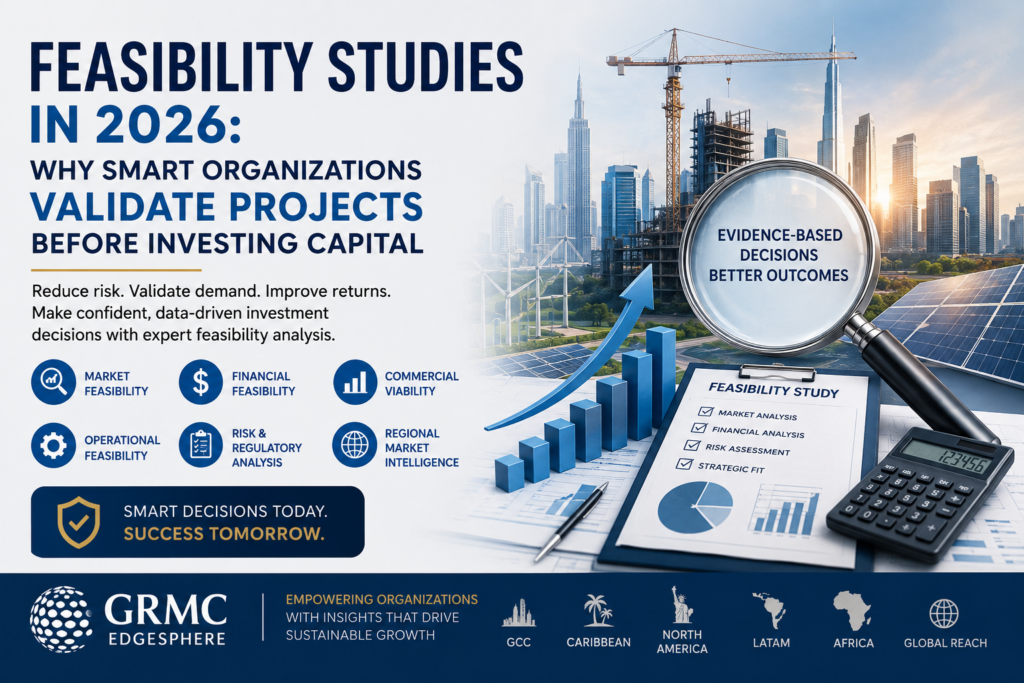
- Market feasibility
- Technical feasibility
- Operational feasibility
- Financial feasibility
- Regulatory feasibility
- Strategic feasibility
This holistic approach improves decision quality.
🌎 Regional Factors Matter More Than Ever
Projects that succeed in one region may not succeed elsewhere.
Local considerations such as demographics, infrastructure, competition, and consumer behavior significantly influence project outcomes.
📉 Risk Assessment Is Becoming a Priority
Organizations increasingly evaluate downside scenarios rather than focusing exclusively on growth projections.
Understanding potential risks enables more resilient planning.
🛠️ Practical Recommendations
📑 Define Clear Project Objectives
Before conducting a feasibility study, organizations should clearly define:
- Project goals
- Target market
- Expected outcomes
- Success criteria
Clear objectives improve assessment accuracy.
📊 Validate Demand Independently
Demand assumptions should be supported through:
- Market research
- Customer interviews
- Surveys
- Industry analysis
- Competitive assessments
Independent validation strengthens decision-making.
⚠️ Analyze Multiple Risk Scenarios
Decision-makers should evaluate:
- Best-case outcomes
- Expected outcomes
- Worst-case outcomes
Scenario planning improves preparedness.
💵 Assess Financial Sustainability
Beyond initial investment requirements, organizations should evaluate:
- Operating costs
- Revenue assumptions
- Cash flow projections
- Break-even timelines
- Long-term profitability
🌐 Incorporate Regional Intelligence
Local market conditions should influence project planning.
Regional analysis often reveals opportunities and risks that broader market data overlooks.
🤝 How GRMC Can Help
GRMC EdgeSphere provides comprehensive feasibility study services for organizations evaluating new investments, expansion initiatives, infrastructure projects, and strategic ventures.
📊 Market Feasibility Analysis
We assess market demand, customer potential, competitive conditions, and growth opportunities.
💼 Commercial Viability Assessments
Our experts evaluate revenue potential, business models, and profitability forecasts.
⚖️ Risk and Regulatory Analysis
We identify compliance requirements, operational risks, and external factors that may affect project success.
🌎 Regional Market Intelligence
GRMC delivers localized insights across GCC, Caribbean, North America, LATAM, Africa, and international markets.
📈 Strategic Decision Support
We provide actionable intelligence that helps organizations make confident investment decisions.
🚀 Conclusion
In today’s business environment, successful organizations are not necessarily those that invest the most—they are often those that invest the smartest.
Feasibility studies provide a structured framework for evaluating opportunities, understanding risks, validating assumptions, and improving investment outcomes.
Whether launching a new venture, entering a new market, developing infrastructure, or expanding operations, evidence-based planning significantly increases the likelihood of success.
GRMC EdgeSphere helps organizations transform uncertainty into informed decision-making through rigorous market research, business intelligence, and feasibility assessment services that support sustainable growth and strategic success.