

Introduction
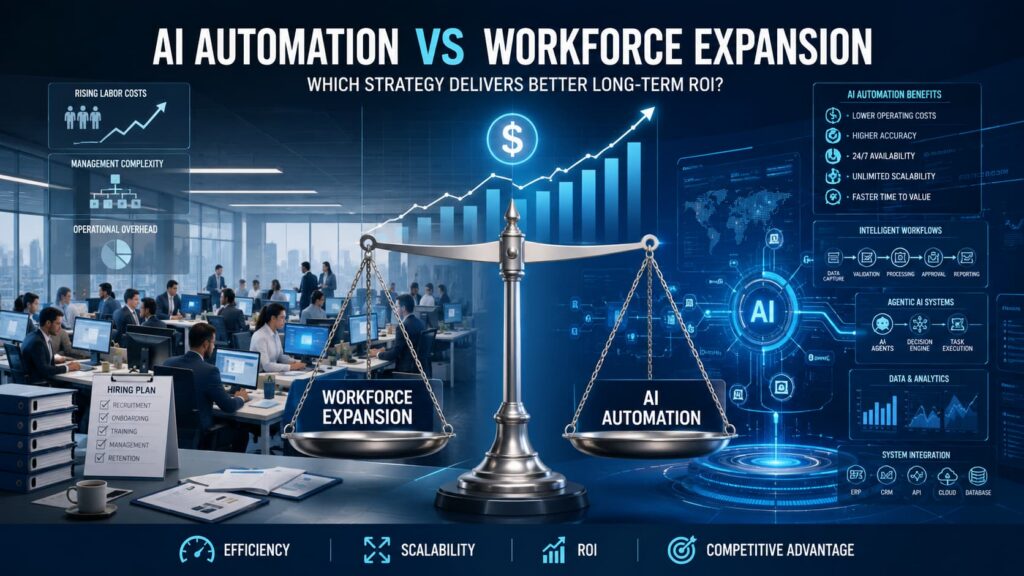
As organizations navigate economic uncertainty, increasing customer expectations, and accelerating digital disruption, business leaders face a critical strategic question: Should growth be achieved by expanding the workforce or by investing in AI-driven automation?
For decades, workforce expansion was the default path to scaling operations. More demand typically required more employees, larger teams, and higher operational costs. Today, however, advances in Artificial Intelligence (AI), Intelligent Process Automation (IPA), and Agentic AI are redefining how organizations scale.
The conversation is no longer about replacing people with machines. Instead, it is about determining the optimal balance between human expertise and intelligent automation to maximize efficiency, profitability, and long-term return on investment (ROI).
This article examines the business case for AI automation versus workforce expansion, comparing costs, scalability, productivity, and strategic value to help enterprise leaders make informed investment decisions.
The Business Challenge
Organizations across industries are under pressure to:
- Reduce operational costs
- Improve service delivery speed
- Maintain consistent quality
- Address labor shortages
- Scale operations without proportional cost increases
- Remain competitive in increasingly digital markets
Traditional workforce expansion can solve short-term capacity issues but often introduces challenges such as:
- Rising payroll expenses
- Recruitment and onboarding costs
- Training requirements
- Employee turnover
- Management overhead
- Scalability limitations
As business processes become more data-intensive and repetitive, many organizations discover that adding more personnel does not always translate into proportional productivity gains.
This challenge has accelerated interest in AI-powered automation solutions that can execute routine tasks, analyze large datasets, and support decision-making at scale.
Understanding AI Automation
AI automation combines artificial intelligence, machine learning, robotic process automation (RPA), predictive analytics, and workflow orchestration to perform tasks traditionally handled by human workers.
Modern automation capabilities include:
Intelligent Process Automation (IPA)
Automates repetitive business workflows such as:
- Invoice processing
- Claims management
- Employee onboarding
- Procurement workflows
- Data entry and validation
Generative AI
Creates and processes content including:
- Reports
- Emails
- Customer responses
- Documentation
- Knowledge management resources
Agentic AI
Autonomous AI systems capable of:
- Executing multi-step workflows
- Making contextual decisions
- Coordinating with multiple business systems
- Managing operational tasks with minimal supervision
Predictive Analytics
Uses historical and real-time data to:
- Forecast demand
- Predict customer behavior
- Identify operational risks
- Optimize resource allocation
Together, these technologies enable organizations to increase productivity while reducing manual effort.
Workforce Expansion: Benefits and Limitations
Workforce expansion remains essential in many business functions where creativity, relationship-building, strategic thinking, and leadership are required.
Benefits
Human Judgment
Employees can navigate ambiguity, manage exceptions, and apply contextual reasoning that many automated systems cannot fully replicate.
Customer Relationships
Sales, consulting, healthcare, and customer-facing roles often rely heavily on trust, empathy, and interpersonal communication.
Innovation
Human teams drive strategic thinking, product development, and organizational transformation.
Limitations
Despite these strengths, workforce growth introduces several constraints:
Linear Cost Growth
As workload increases, organizations typically need additional personnel, increasing payroll and benefits costs.
Recruitment Challenges
Finding qualified talent can be time-consuming and expensive.
Productivity Variability
Performance can vary across individuals and teams, impacting consistency.
Operational Complexity
Larger workforces require more management, compliance oversight, and administrative support.
As a result, workforce expansion often delivers diminishing returns as organizations scale.
AI Automation and Long-Term ROI
When evaluating ROI, organizations should consider more than immediate cost reduction. Long-term ROI includes productivity gains, scalability, customer experience improvements, and strategic agility.
1. Lower Operating Costs
Once implemented, AI systems can perform thousands of transactions or process requests with minimal incremental cost.
For example:
A financial services organization automating invoice processing may reduce manual processing costs by 60–80% while significantly improving processing speed.
2. Increased Productivity
AI systems operate continuously without fatigue, enabling:
- Faster response times
- Higher transaction volumes
- Improved workflow throughput
Employees can focus on higher-value activities rather than repetitive administrative tasks.
3. Enhanced Scalability
Unlike workforce expansion, AI automation scales without requiring proportional increases in staffing.
For example:
An e-commerce company experiencing seasonal demand spikes can use AI-powered customer service agents to handle significantly higher inquiry volumes without recruiting temporary staff.
4. Improved Accuracy
Automated systems reduce human errors in:
- Data processing
- Compliance reporting
- Financial transactions
- Document management
Improved accuracy often translates directly into cost savings and risk reduction.
5. Faster Decision-Making
Predictive analytics and AI-driven insights help leaders make more informed decisions using real-time data.
Organizations gain the ability to identify trends, forecast demand, and respond proactively to market changes.
Real-World Applications
Financial Services
Banks and financial institutions use AI automation for:
- Fraud detection
- Loan processing
- Customer support
- Regulatory compliance
Benefits include faster processing times, lower operational costs, and improved risk management.
Manufacturing
Manufacturers deploy predictive analytics and automation to:
- Monitor equipment performance
- Predict maintenance needs
- Optimize production schedules
The result is reduced downtime and increased operational efficiency.
Healthcare
Healthcare organizations leverage AI for:
- Appointment scheduling
- Medical documentation
- Resource planning
- Patient engagement
Automation allows healthcare professionals to spend more time on patient care.
Retail and E-Commerce
Retailers use AI to:
- Personalize customer experiences
- Forecast inventory demand
- Optimize pricing strategies
- Automate customer support
These capabilities improve revenue generation while controlling operating expenses.
Government and Public Sector
Government agencies increasingly use AI-powered automation for:
- Citizen service delivery
- Document processing
- Case management
- Data analysis
Automation improves service quality while reducing administrative burdens.
Workforce Expansion vs. AI Automation: The Strategic Perspective
The comparison should not be framed as a choice between people and technology.
The highest-performing organizations typically adopt a hybrid model where AI enhances human capabilities.
Workforce Expansion Works Best When:
- Human creativity is required
- Strategic decision-making is essential
- Relationship management drives value
- Complex problem-solving is involved
AI Automation Works Best When:
- Processes are repetitive
- High transaction volumes exist
- Speed and accuracy are critical
- Scalability is a priority
- Data-driven decisions are required
In many cases, AI automation generates the strongest ROI when it eliminates low-value manual tasks while empowering employees to focus on innovation, customer engagement, and strategic growth.
Implementation Roadmap
Successful AI adoption requires a structured approach.
Phase 1: Process Assessment
Identify:
- High-volume tasks
- Manual bottlenecks
- Cost-intensive workflows
- Automation opportunities
Phase 2: Business Case Development
Evaluate:
- Current operating costs
- Expected productivity gains
- Risk reduction benefits
- ROI projections
Phase 3: Technology Selection
Choose appropriate technologies such as:
- Intelligent Process Automation
- Generative AI
- Agentic AI
- Predictive Analytics
- Business Intelligence platforms
Phase 4: Pilot Deployment
Start with targeted use cases to validate value and measure outcomes.
Phase 5: Enterprise Scaling
Expand automation across departments while integrating governance, security, and performance monitoring frameworks.
Phase 6: Continuous Optimization
Monitor KPIs and continuously refine workflows to maximize business impact.
How GRMC EdgeSphere Can Help
At GRMC EdgeSphere, we help organizations transform operations through strategic AI and automation initiatives that deliver measurable business outcomes.
Our services include:
- AI Strategy and Roadmap Development
- Intelligent Process Automation Solutions
- Agentic AI Implementation
- Generative AI Integration
- Predictive Analytics Platforms
- Data Analytics and Business Intelligence
- API Integration and Enterprise Connectivity
- Digital Transformation Consulting
- AI Governance and Compliance Frameworks
We focus on practical, business-driven implementations that improve efficiency, reduce costs, and create sustainable competitive advantage.
Whether you are a government agency, SME, or global enterprise, our experts help identify the highest-value automation opportunities and develop scalable transformation strategies.
Conclusion
The future of business growth is not defined by choosing between people and technology—it is defined by how effectively organizations combine both.
Workforce expansion remains critical for innovation, leadership, and customer relationships. However, relying solely on headcount growth often limits scalability and increases operational costs.
AI automation offers a compelling alternative by enabling organizations to scale efficiently, improve productivity, enhance decision-making, and generate stronger long-term ROI.
The organizations that achieve lasting competitive advantage will be those that strategically integrate AI into their operating models, allowing human talent to focus on the work that creates the greatest business value.
As AI capabilities continue to mature, the question is no longer whether organizations should adopt automation—it is how quickly they can implement it to stay ahead of the competition.