

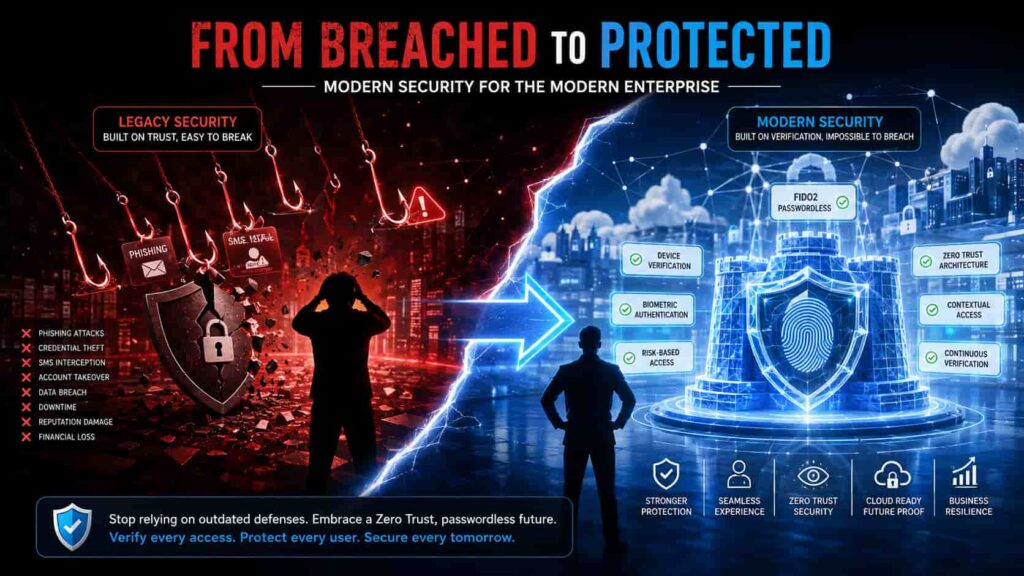
For over a decade, the enterprise cybersecurity playbook for combating phishing has remained largely unchanged: conduct mandatory security awareness training, run simulated phishing campaigns, and hope employees learn to spot the threats. This approach has become a multi-billion-dollar industry, yet the problem continues to escalate.
It is time for a candid assessment: the strategy has failed. Training employees to be the primary defense against phishing is no longer a viable security control for enterprise organizations. The modern threat landscape, characterized by AI-generated attacks and sophisticated credential-harvesting techniques, demands a fundamental shift in strategy. The solution lies not in further human education, but in phishing-resistant authentication architecture.
The Hard Data: Why Training Doesn’t Work
A landmark study conducted by UC San Diego Health, involving nearly 20,000 employees across ten simulated phishing campaigns over eight months, delivered a stark verdict on the efficacy of training: it made virtually no difference . Employees who had recently completed mandatory cyber awareness courses failed phishing tests at nearly the same rate as those who had not. The average improvement was a negligible 1.7% .
Even more concerning is employee engagement. The same study found that over 75% of employees spent less than one minute on the training page, with as many as half closing it instantly . Employees are not engaging with the material, and the material itself is becoming obsolete.
The 2026 Verizon Data Breach Investigations Report (DBIR) further validates this trend, highlighting that human risk has moved beyond the inbox . Voice and SMS phishing simulations now show a median click rate of 2%, a 40% increase compared to traditional email simulations . Furthermore, 41% of social engineering breaches now involve vectors other than email, such as social media and phone calls . The attack surface is expanding, and training cannot keep pace.
The Evolution of Phishing: AI Makes It Unstoppable for the Human Eye
Generative AI has fundamentally altered the phishing landscape. Attackers can now generate pixel-perfect, grammatically flawless spoofed login pages in under a minute . The fake site looks indistinguishable from the real one, the URL uses look-alike characters, and the phishing email reads as if it came from an internal IT department. Traditional advice like “hover over the link” or “check for spelling errors” is rendered useless when the fake looks better than the real thing.
Relying on employees to detect these AI-generated attempts is not just ineffective — it is an irresponsible security posture.
The Critical Weakness: Legacy MFA and Session Hijacking
Many organizations have already moved to Multi-Factor Authentication (MFA) as a solution. However, legacy MFA—including SMS codes, push notifications, and TOTP authenticator apps—is increasingly vulnerable.
Modern phishing kits act as man-in-the-middle relays. When an employee enters their username and password on a fake site, and then receives a legitimate MFA prompt, the fake site relays that request to the real system. The employee thinks they are approving their own login attempt, but they are actually granting access to the attacker . This exact technique is how groups like Scattered Spider have breached Fortune 500 firms.
Additionally, attackers can hijack already authenticated sessions. Over-reliance on traditional active authentication methods leaves organizations exposed. Gartner highlights that applying advanced analytics and support for Continuous Access Evaluation Protocol (CAEP) shows promise in mitigating session theft, but this points toward a need for continuous verification, not just periodic training .
The Solution: Phishing-Resistant Authentication and Zero Trust
The only effective response is to eliminate the human element from the authentication decision. Enterprises must pivot to phishing-resistant authentication. This aligns directly with NIST SP 800-63-3 and the updated -4 guidelines, which mandate verifier impersonation resistance at Assurance Level 2 (AAL2) and AAL3, formally deprecating SMS and email OTP .
Key architectural principles include:
- Cryptographic Binding: Credentials must be cryptographically bound to the domain they are authenticating against. A spoofed or relayed page simply fails the authentication process.
- Biometric Verification: Requiring a biometric match (e.g., fingerprint, facial recognition) with liveness detection ensures that even if a device is stolen or a session is hijacked, the attacker cannot proceed without the physical user.
- Proximity Enforcement: Authentication factors should enforce physical proximity to the machine logging in, neutralizing remote attackers.
- Continuous Access Evaluation: This moves beyond a binary “in/out” model to a continuous verification of trust, integrating device management and risk signals to reduce the impact of session theft.
Strategic Framework Implementation
From a governance perspective, aligning this strategy with established frameworks is critical.
- NIST SP 800-63: Transition identity and access management (IAM) systems to AAL2 or AAL3 compliance. Decommission SMS and OTP. Implement FIDO2/passkeys as the gold standard .
- CIS Controls v8.1: Move from “essential cyber hygiene” (IG1) to a more tailored approach (IG2/IG3) that includes deploying Web Application Firewalls and implementing allowlisting for authorized software .
- CISA Zero Trust Maturity Model (ZTMM): Adopt a Zero Trust architecture. Implement phishing-resistant MFA, granular access controls, and robust application security testing . Zero Trust assumes the network is compromised and verifies every request.
The Role of the CISO: A Shift in Strategy
For CISOs and IT Directors, the mandate is clear. The current model of human-centric detection must be replaced by architecture-centric resilience.
- Invest in Phishing-Resistant MFA: Prioritize solutions leveraging FIDO2 protocols. Gartner predicts that by 2027, over 90% of MFA transactions will be based on FIDO authentication protocols .
- Adopt a Zero Trust Architecture: Implement the principles of “never trust, always verify” to minimize the impact of compromised credentials.
- Retire Legacy Authentication Methods: Phase out SMS, push notifications, and email OTP in favor of cryptographic, hardware-backed authenticators.
- Re-evaluate Training Budgets: While security awareness has value for reporting and incident response culture, reallocate the majority of the budget toward technical controls. Training should focus on reporting, not detection.
Conclusion
The business risk of phishing is a technology risk, not a human resources risk. The threat actors are using AI and sophisticated relay attacks to bypass human judgment and legacy security controls. In response, enterprise security leaders must fundamentally re-architect their authentication strategies.
By investing in phishing-resistant authentication and embracing a Zero Trust framework, organizations can finally achieve resilience against phishing—protecting their employees by removing them from the line of fire and securing their critical assets against modern threats. It is time to stop training employees to be security experts and start building systems that make training irrelevant.