

🌍 Introduction
Supply chains have become increasingly complex. Organizations now depend on global suppliers, international logistics networks, regional distribution centers, digital procurement platforms, third-party service providers, and rapidly changing customer demand.
This complexity creates a major operational challenge: exceptions.
A delayed shipment, unexpected inventory shortage, supplier disruption, sudden demand increase, customs issue, production delay, or transportation problem can quickly affect multiple parts of a business. Traditionally, resolving these issues requires employees to identify the problem, collect information from different systems, contact relevant teams, evaluate alternatives, and coordinate corrective action.
By the time the right decision is made, the business impact may already have increased.
Agentic AI is introducing a different approach.
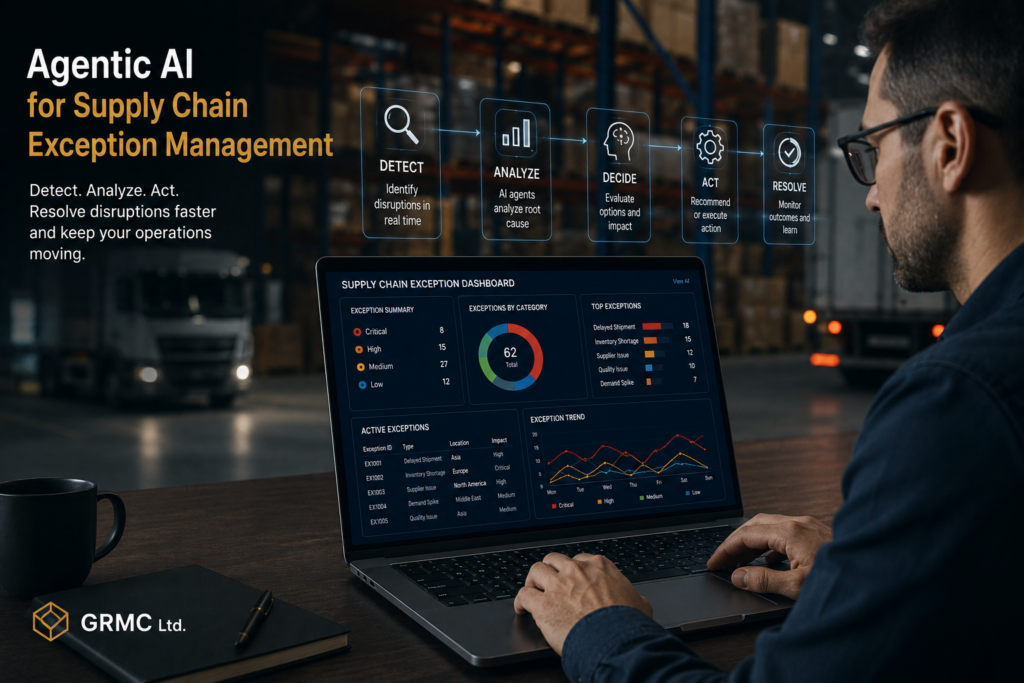
Agentic AI for Supply Chain Exception Management enables intelligent AI agents to continuously monitor supply chain activity, identify unusual conditions, investigate potential causes, evaluate response options, coordinate with business systems, and recommend or execute appropriate actions within predefined boundaries.
Instead of simply reporting that a problem exists, an AI agent can help determine what happened, why it happened, what could happen next, and what action should be considered.
For CEOs, COOs, CIOs, supply chain executives, procurement leaders, and enterprise decision-makers, this represents an important evolution from reactive supply chain management toward intelligent, proactive operations.
📊 Industry Overview
Traditional supply chain systems are generally effective at tracking orders, inventory, deliveries, suppliers, and production activities.
The challenge begins when something deviates from the expected plan.
Consider a manufacturer waiting for a critical component. A supplier suddenly reports a delay. A conventional system may generate an alert indicating that the shipment is late.
An agentic system can go further.
A specialized AI agent could identify the delayed shipment, review inventory levels, examine upcoming production schedules, analyze supplier history, check alternative suppliers, evaluate transportation options, estimate the potential financial impact, and present recommendations to the supply chain manager.
Other agents could independently evaluate procurement requirements, logistics alternatives, contractual obligations, and customer commitments before combining their findings into a coordinated response.
This changes the role of AI from notification technology to decision-support infrastructure.
The objective is not to remove humans from supply chain management. Instead, Agentic AI can reduce the amount of time employees spend investigating routine exceptions and allow experienced professionals to focus on strategic decisions, negotiations, relationships, and high-impact situations.
⚠️ Key Challenges
🚨 Too Many Exceptions
Large enterprises may generate thousands of operational alerts across procurement, inventory, transportation, manufacturing, and distribution.
Treating every alert with the same level of urgency makes it difficult for teams to identify which problems could create significant business consequences.
📊 Fragmented Supply Chain Information
Important information may be distributed across ERP systems, warehouse platforms, supplier portals, transportation systems, spreadsheets, emails, and external data sources.
AI agents need access to reliable information across these environments to understand the full context of an exception.
🌍 Supplier and Logistics Uncertainty
Supply chain disruptions can originate outside the organization’s direct control.
Weather events, transportation delays, geopolitical developments, supplier capacity constraints, and regulatory changes can influence operations unexpectedly.
🔐 Autonomous System Access
AI agents may need to interact with procurement platforms, inventory systems, logistics applications, and communication tools.
Poorly designed permissions could create operational or cybersecurity risks.
👥 Human Approval Requirements
Not every supply chain decision should be automated.
High-value purchases, supplier changes, contractual decisions, and actions affecting strategic customers may require human authorization.
📈 Agentic AI Insights
🤖 AI Can Move from Detection to Investigation
Traditional automation often identifies an exception and sends an alert.
Agentic AI can investigate the situation by gathering information from multiple sources and determining which factors may have contributed to the problem.
This reduces the amount of manual research required from supply chain teams.
📊 Exception Prioritization Can Improve Decision-Making
Not every delay deserves immediate executive attention.
AI agents can evaluate factors such as financial exposure, inventory availability, customer commitments, production dependency, and supplier importance to help prioritize exceptions according to business impact.
🔄 Multiple Agents Can Support One Business Decision
A supply chain environment may involve specialized agents for procurement, inventory, logistics, finance, supplier intelligence, and customer commitments.
Each agent can analyze its specific area while contributing information to a broader decision process.
🌍 External Intelligence Can Strengthen Supply Chain Awareness
Agentic AI can potentially combine internal supply chain information with relevant external intelligence, helping organizations recognize conditions that may affect future availability or delivery performance.
📈 Proactive Decisions Can Reduce Disruption
The greatest opportunity may not be responding faster after a disruption occurs.
AI agents can help organizations identify patterns that indicate a potential problem before it becomes a major operational event.
🛠️ Practical Recommendations
📋 Start with High-Value Exceptions
Organizations should not attempt to automate every supply chain decision immediately.
Begin with recurring exceptions that have clear business rules, measurable outcomes, and significant operational impact.
Examples may include inventory shortages, delayed shipments, supplier performance issues, or purchase order discrepancies.
🔍 Establish Clear Agent Responsibilities
Each AI agent should have a clearly defined purpose.
For example, one agent may monitor inventory exceptions while another analyzes supplier performance. Clearly defined responsibilities reduce conflicting recommendations and make governance easier.
🔐 Apply Least-Privilege Access
AI agents should only have access to the systems and information necessary for their assigned responsibilities.
Actions involving sensitive financial, procurement, or supplier information should receive appropriate controls and monitoring.
👥 Define Human Approval Boundaries
Create clear decision thresholds.
Low-risk actions may be automated, while high-value purchases, supplier changes, contractual decisions, or customer-impacting actions should require human approval.
📊 Establish a Central Exception View
Leadership and operational teams should have visibility into active exceptions, business impact, recommended actions, decision status, and outcomes.
This provides a common operational picture across departments.
📈 Measure Business Outcomes
Agentic AI should be evaluated based on business results rather than the number of automated tasks.
Useful measures may include resolution time, avoided delays, inventory efficiency, supplier performance, operational costs, and the percentage of exceptions successfully resolved.
🔄 Continuously Improve Agent Performance
Supply chain conditions change constantly.
Organizations should regularly review agent recommendations, employee feedback, exception outcomes, and system performance to improve workflows over time.
💡 A Practical Example
Imagine a retailer expecting a large shipment before a major seasonal sales period.
The shipment is delayed by several days.
Instead of simply generating an alert, an agentic AI workflow could begin an investigation.
One agent checks current inventory and determines how long existing stock will last.
Another evaluates the organization’s sales forecast and identifies which products and locations are most exposed.
A supplier intelligence agent reviews the supplier’s historical performance and current communications.
A logistics agent evaluates alternative transportation options.
A financial agent estimates the cost of different response strategies.
The system then presents the operations manager with a prioritized set of options.
The manager remains responsible for the final decision, but the time required to gather and analyze the information can be dramatically reduced.
This is where Agentic AI can create meaningful enterprise value—not simply by automating a task, but by compressing the time between a problem appearing and an informed business decision being made.
🤝 How GRMC Can Help
GRMC Ltd. helps organizations explore and implement practical Agentic AI strategies designed around measurable business outcomes.
🤖 Agentic AI Strategy
We help organizations identify business processes where autonomous and semi-autonomous AI can create meaningful operational value.
📊 Intelligent Workflow Design
Our consultants analyze existing workflows and identify opportunities for AI agents to monitor, investigate, coordinate, and support decision-making.
🔐 AI Governance & Security
GRMC Ltd. helps organizations establish appropriate access controls, approval processes, monitoring mechanisms, and governance structures for enterprise AI agents.
🌍 Enterprise Integration
AI agents can be connected with business applications, APIs, analytics platforms, operational systems, and existing digital infrastructure to support end-to-end workflows.
📈 AI Performance Advisory
We help leadership teams define measurable objectives and evaluate whether AI initiatives are improving productivity, decision speed, operational resilience, and business performance.
🚀 Conclusion
Supply chain disruption is unavoidable. The competitive advantage comes from how quickly and intelligently an organization can respond.
Agentic AI for Supply Chain Exception Management offers a new approach to operational decision-making by enabling intelligent systems to monitor complex environments, investigate exceptions, evaluate alternatives, and support coordinated action.
The greatest value does not come from allowing AI to make every decision independently. It comes from creating a balanced operating model in which AI handles information-intensive analysis while experienced professionals maintain control over decisions that require judgment, accountability, and business context.
Organizations that build this capability carefully can move from reactive exception handling toward more proactive and intelligent supply chain management.
GRMC Ltd. helps businesses explore the practical potential of Agentic AI through strategy, intelligent workflow design, governance, integration, and digital transformation—enabling organizations to turn complex operational challenges into faster, better-informed business decisions.