

The Strategic Crossroads
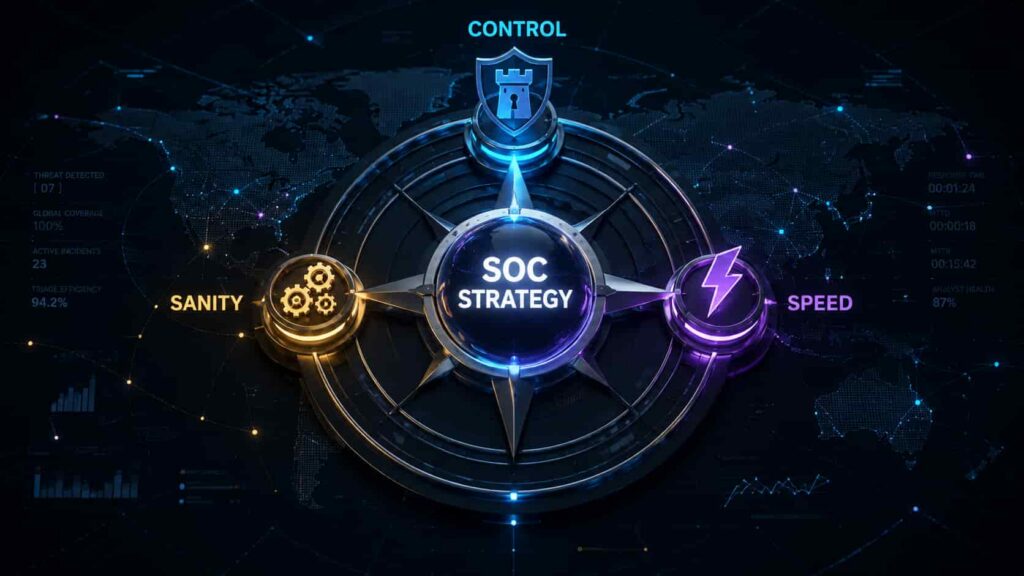
For today’s enterprise leadership—CEOs, CIOs, CTOs, and CISOs—the question of how to structure Security Operations Center (SOC) capabilities has evolved from a technical decision to a strategic business imperative. The threat landscape accelerates, regulatory scrutiny intensifies, and the cybersecurity talent gap widens. Organizations find themselves at a critical crossroads: build an in-house SOC for maximum control, outsource to external providers for speed and scale, or pursue a hybrid model that balances both.
There is no universal answer. The right choice depends on your organization’s risk profile, industry, regulatory obligations, and security maturity. However, a growing consensus among security leaders suggests that the hybrid model increasingly represents the optimal path for most enterprises .
Understanding the SOC Models
The In-House SOC: Total Control, Total Responsibility
An internal SOC places your dedicated team—analysts, engineers, and threat hunters—within your organization. This model offers deep institutional knowledge, immediate response capability, and complete operational control .
Advantages:
- Unmatched Context: Internal teams understand your business nuances, infrastructure, and risk landscape far better than any external partner. This enables faster detection, quicker containment, and more accurate threat prioritization .
- Immediate Response: When incidents occur, embedded teams enable faster decision-making without relying on third-party Service Level Agreements (SLAs) .
- Tailored Security: In-house teams can shape detection, response, and threat hunting strategies around your organization’s specific risk profile .
Challenges:
- Significant Investment: Building and maintaining an internal SOC requires substantial capital expenditure for technology, facilities, and recruitment .
- Talent Retention Crisis: SOC teams typically staff between 2 and 10 individuals, with the most common tenure between 3 and 5 years. Alarmingly, 62% of SOC professionals believe their organizations are not doing enough to retain talent .
- Staffing Demands: Operating 24/7/365 coverage requires multiple Tier 1, 2, and 3 analysts working in shifts—an expensive and challenging proposition .
The Outsourced SOC: Speed and Scale
Outsourced models shift the operational burden to specialized providers. The landscape includes Managed Security Service Providers (MSSPs), SOC-as-a-Service (SOCaaS), and Managed Detection and Response (MDR) providers .
Advantages:
- Rapid Deployment: Capabilities can be operational within days or weeks rather than months or years .
- Cost Predictability: Reduced upfront investment with operational expenditure models .
- Access to Expertise: Instant access to specialized talent and threat intelligence .
Critical Distinctions:
The outsourced landscape is not monolithic:
| Model | Capability | Customer Responsibility |
|---|---|---|
| MSSP | Infrastructure monitoring, log collection, alert generation | Investigation, decision-making, response remain with customer |
| SOCaaS | Platform-driven monitoring, detection, analytics | May still require internal personnel for processes and response |
| MDR | Active threat detection, investigation, containment | Provider handles triage, investigation, and active response |
Limitations:
- SLAs Can Slow Response: Dependency on external partners can delay critical incident response when minutes matter most .
- Limited Context: External providers lack deep understanding of your business environment .
- Control Trade-offs: Organizations must cede some operational control and rely on provider dashboards for visibility .
The Hybrid Model: The Emerging Enterprise Standard
Increasingly, organizations are settling on a hybrid SOC model: strategic security leadership and core threat response kept in-house, while 24/7 monitoring or surge capacity is supported by external partners .
Why Hybrid Works
This model reflects the reality that most organizations cannot—and arguably should not—attempt to build comprehensive in-house capabilities. The hybrid approach combines the best of both worlds:
- Governance and Control Retained: Your organization maintains oversight, strategic direction, and responsibility for critical assets .
- Specialized Expertise Leveraged: External providers deliver 24/7 monitoring, advanced threat hunting, and specialized capabilities difficult to scale internally .
- Scalability Achieved: The model allows organizations to scale up during incidents or periodic peaks without permanent staffing costs .
A Practical Implementation Approach
As Jafar Hasan’s SOC model framework illustrates, many organizations progress along a maturity path: starting with MSSP or hybrid, then gradually building internal capability as budgets and talent allow . Security leaders increasingly view the question as less about “in-house vs. outsourced” and more about “what should we own internally to truly mature our security capability?”
The Framework Foundation
An effective SOC strategy, regardless of model, must rest on established frameworks. Modern enterprise security programs integrate multiple frameworks to create a comprehensive security operating model :
| Framework | Role in SOC Strategy |
|---|---|
| NIST CSF 2.0 | Strategic direction; connects cyber risk to business outcomes |
| ISO 27001 | Governance layer; establishes management systems and audit trails |
| CIS Controls v8.1 | Practical safeguard prioritization; actionable technical controls |
| MITRE ATT&CK | Threat-informed defense; adversary behavior mapping and SOC tuning |
| Zero Trust Architecture | Modern access control; reduces implicit trust across identity, devices, networks, applications, and data |
As one security practitioner noted: “The strongest organizations do not treat these as separate documents. They combine them into one security operating model” .
The Risk Management Imperative
From a CISO perspective, the SOC decision cannot be separated from broader enterprise risk management. Consider these factors:
Regulatory and Compliance Requirements: Financial institutions, healthcare organizations, and government entities face specific mandates that may require certain capabilities. Organizations in regulated sectors may require ISO 27001 certification or specific controls that only an in-house team can evidence .
Cyber Insurance Impact: Insurers increasingly expect demonstrable SOC capabilities. The hybrid model must demonstrate active detection and response capabilities, not merely alert generation .
Business Continuity: The “Respond” and “Recover” functions of NIST CSF become critical during incidents. The speed of containment directly correlates to business impact. The hybrid model must maintain clear SLAs for response times .
The GRMC EdgeSphere Perspective
The SOC dilemma ultimately reduces to a strategic risk decision. Organizations must weigh:
- Risk Appetite: How much operational control must you retain over your security function?
- Resource Reality: Can you compete for scarce cybersecurity talent, or does outsourcing make more business sense?
- Regulatory Requirements: What specific capabilities must you demonstrate to regulators and auditors?
- Maturity Trajectory: Where are you on your security journey, and where do you need to be?
Our Recommendations
For Government Organizations and Critical Infrastructure Operators: Build a Command SOC model or In-House SOC with hybrid augmentation. The stakes of compromise demand maximum control and immediate response capabilities .
For Financial Institutions and Healthcare Organizations: Pursue a hybrid model with strong internal governance and external monitoring. Regulatory requirements demand demonstrable control, while cost realities favor selective outsourcing .
For Enterprises and Growing Organizations: Begin with a hybrid model, building internal capability over time. As Jafar Hasan advises, “Do not try to build an In-House SOC overnight—the cost and talent gap will break you” .
For All Organizations: Embed business context into your SOC. Whether in-house or hybrid, ensure you have at least one or two experienced analysts who understand your organization’s unique risk profile. As security expert Meltin Devasia warns, “Merely outsourcing a SOC or building one internally without considering these factors results in a false sense of security” .
Conclusion
The SOC decision is not about choosing between control and speed—it’s about designing a resilient security program that aligns with your business objectives. For most organizations, the hybrid model offers the optimal balance: internal teams for strategic governance and context-aware decision-making, external partners for 24/7 monitoring and specialized capabilities.
The question for today’s leadership is no longer “build or buy,” but rather “what should we own internally to truly mature our security capability?”
At GRMC EdgeSphere, we help organizations navigate this complex decision, aligning SOC strategy with business objectives, regulatory requirements, and enterprise risk appetite. Because in cybersecurity, the right strategy isn’t just about security—it’s about business resilience.