

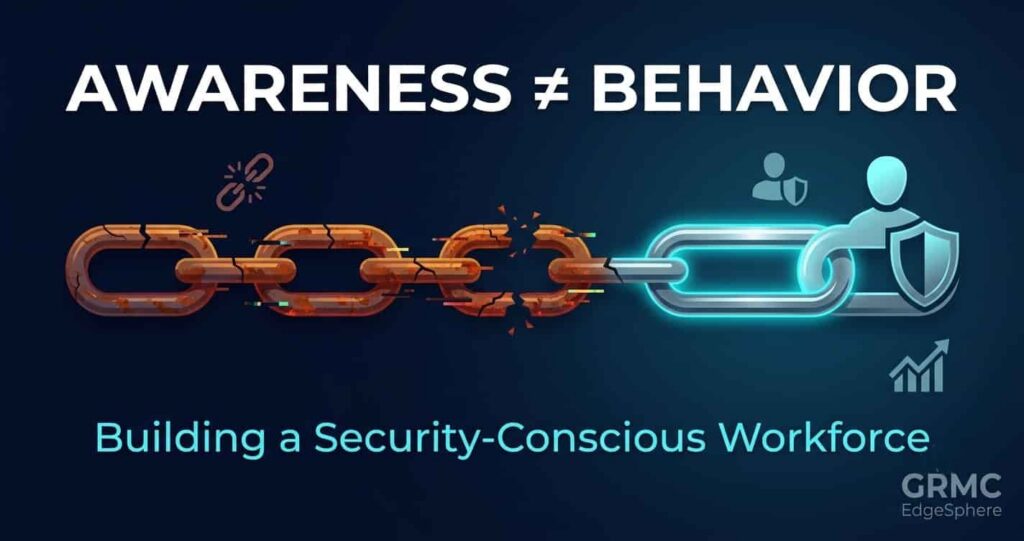
For years, organizations have poured billions into security awareness training, yet human error still accounts for an estimated 74% to 82% of data breaches. CEOs and CISOs alike are left wondering: if completion rates are hitting 100%, why are sophisticated incidents—the ones that cause sleepless nights—still traced back to user actions?
The answer is uncomfortable but clear: compliance does not equal competence, and awareness does not equal behavior change.
This article examines why traditional Security Awareness Training (SAT) programs fail to reduce enterprise risk and outlines a strategic framework for building a genuinely security-conscious workforce aligned with NIST, ISO 27001, CIS Controls, and Zero Trust principles.
The Failure Modes of Traditional Security Awareness
Mistaking Compliance for Security
Most organizations treat SAT as a compliance checkbox—a requirement for ISO 27001 Annex A.6.2, SOC 2, or regulatory mandates. The result is a “check-the-box” mentality that delivers the bare minimum: annual PowerPoint-driven sessions and generic phishing modules.
The Business Risk: Compliance verification—attendance rosters, completion screens—does not prove competence or behavioral change. Auditors may be satisfied, but adversaries are not. Your organization remains exposed while operating under a false sense of security.
Generic Content for a Diverse Risk Landscape
One-size-fits-all training is a critical failure point. Developers, system administrators, finance executives, and frontline staff face vastly different threats. Yet traditional programs deliver the same “spot the typo” phishing content to everyone.
The Business Risk: When training lacks role-specific context, it breeds cynicism among technical staff who view it as irrelevant to their actual responsibilities. More critically, privileged users—administrators, developers, and C-suite executives—are left unprepared for the sophisticated attacks that specifically target them, such as session hijacking, repo poisoning, or deepfake-driven fraud.
Annual “One and Done” Delivery
The typical annual training session is an information dump. According to the Ebbinghaus Forgetting Curve, employees forget approximately 50% of new information within a day and 90% within a week. Organizations running training only once per year are essentially ensuring that little to no knowledge remains when an actual threat emerges.
The “Gotcha” Culture
Phishing simulations conducted with a punitive, “gotcha” approach erode trust between security teams and employees. When users feel security is looking for opportunities to punish rather than protect, engagement collapses. They may become secretive, report fewer suspicious activities, and view security as an adversary rather than an ally.
The Business Risk: A disengaged workforce is not merely neutral; it is a liability. Employees who feel targeted are less likely to report genuine security incidents, increasing dwell time and incident response costs.
Building a Security-Conscious Workforce: A Strategic Framework
1. Role-Based, Contextual Competence Models
Move beyond generic awareness to role-based competence mapping. Align training content directly with specific risk profiles and job functions.
This approach aligns directly with NIST CSF v2 (PR.AT) and ISO 27001:2022 Annex A.6.2, which require organizations to ensure personnel are competent in security tasks relevant to their specific responsibilities.
2. Continuous, Spaced Reinforcement
Shift from annual sessions to continuous micro-learning. Implement a spaced-repetition model where employees receive short, focused training modules at regular intervals.
The Business Case: Organizations implementing automated, continuous training models see phishing susceptibility drop from 33% to as low as 4.1% within 12 months. This directly translates to fewer incidents, lower response costs, and demonstrable risk reduction.
3. Data-Driven Behavioral Metrics
Stop measuring completion. Start measuring outcomes. Design your program around quantifiable behavioral metrics that speak the language of business risk.
Key Metrics Infrastructure:
- Phishing Baseline & Decay Tracking: Run simulations pre-training, then at 30, 90, and 180 days post-training. Most organizations find a 3-6 month decay curve, justifying semi-annual (or more frequent) training rather than annual delivery.
- Incident Attribution: Categorize incidents by root cause to identify training-preventable failures. Track whether affected users had received relevant training and when.
- Report Rate: Measure the increase in user-reported suspicious emails—a positive behavioral indicator that demonstrates engagement.
The Business Case: CFOs and boards speak the language of financial impact. Convert your metrics into cost avoidance. If annual training costs $120k and prevents $150k in incident costs (based on reduced click rates and historical compromise rates), the ROI is demonstrable and justifiable.
4. Integrate with Zero Trust Architecture
Accept that human error is inevitable and design systems to absorb it. Security awareness is not a silver bullet; it must be supported by technical controls that minimize the impact of mistakes.
The Zero Trust Imperative:
- Eliminate Standing Privileges: Implement Just-in-Time (JIT) access via Privileged Access Management (PAM) to grant temporary, auditable access. A single compromised credential should not grant lateral movement.
- Automated Baseline Enforcement: Deploy automated remediation to revert cloud configurations to a known-good baseline upon detection of drift. This eliminates human processing delays and misconfiguration risks.
- Assume Breach: Architect environments where a single click does not equal compromise. Use sandboxing, network segmentation, and rapid disablement to neutralize mistakes.
5. Leadership and Culture as the Invisible Perimeter
Security culture starts at the top. If executives treat training as a nuisance, so will everyone else.
- Executive Participation: Senior leadership must visibly participate in training, simulations, and tabletop exercises.
- Positive Reinforcement: Celebrate secure behavior. Reward employees who identify and report vulnerabilities. Shift from a “gotcha” to a “we’ve got your back” culture.
- Empowerment, Not Burden: Frame security as career development and organizational resilience, not bureaucratic obstruction. Research shows that when employees view security as aligned with their professional goals, engagement improves significantly.
Conclusion: The Path to a Security-Conscious Workforce
Security awareness training, as traditionally implemented, is failing. It is often a compliance exercise that creates a false sense of security while leaving organizations vulnerable to sophisticated, human-centric attacks.
To build a security-conscious workforce, enterprises must:
- Adopt Role-Based Competence Models that respect the specific threats faced by different users.
- Deliver Training Continuously to reinforce knowledge and combat the forgetting curve.
- Measure What Matters—behavioral outcomes and risk reduction, not just completion rates.
- Integrate with Zero Trust Technical Controls to reduce reliance on fallible human vigilance.
- Cultivate a Positive Security Culture led from the top and reinforced through recognition and empowerment.
At GRMC EdgeSphere, we help organizations transform their security awareness programs from liability to strategic advantage. By aligning training with risk, measuring true behavioral impact, and embedding security into the fabric of the organization, we build workforces that are not just aware, but actively resilient.
Is your security awareness program reducing risk or just checking boxes? Contact GRMC EdgeSphere to conduct a maturity assessment of your human risk management strategy.