

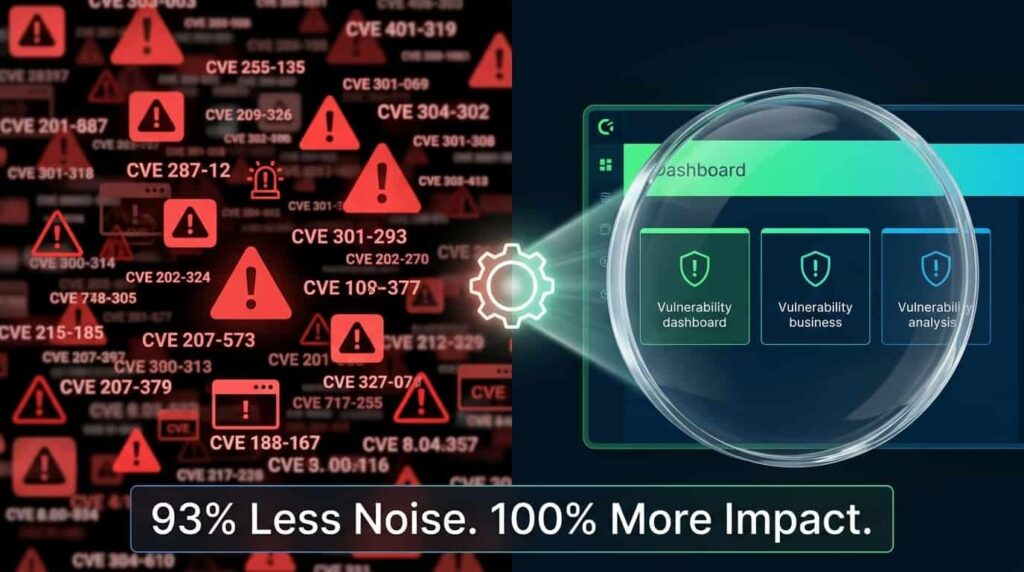
The modern enterprise faces a fundamental paradox: the volume of detected vulnerabilities has reached staggering levels, yet the majority of security incidents stem from a tiny fraction of these findings. In 2025 alone, over 48,000 new CVEs were published . A typical enterprise scan cycle can generate more than 8,000 total vulnerability findings, with over 1,500 rated “high” or “critical” by CVSS . The problem is no longer detection—it is prioritization.
Security teams drowning in alerts routinely wrestle with backlogs of thousands of “critical” vulnerabilities while serious incidents continue to occur . Traditional approaches that treat every high-severity finding as equally urgent are not only ineffective—they actively undermine security by diverting finite resources away from the vulnerabilities that truly matter.
At GRMC EdgeSphere, we advocate for a risk-based vulnerability management (RBVM) framework that aligns technical findings with business impact, threat intelligence, and operational reality. This approach transforms vulnerability management from a compliance-driven “tick-box” exercise into a strategic function that demonstrably reduces organizational risk .
The False Promise of CVSS-Centric Triage
The Common Vulnerability Scoring System (CVSS) provides a standardized measure of theoretical vulnerability severity. However, CVSS measures potential impact in isolation—without accounting for the specific role or context of a system within an organization .
A vulnerability scanner does not distinguish between a domain controller and a print server; it flags both and moves on. A SQL injection vulnerability in dead code that never executes receives the same CVSS score as an identical vulnerability in your customer-facing payment processing system . “Critical” vulnerabilities on isolated development servers are treated equivalently to “Medium” vulnerabilities on public-facing authentication portals .
The Volume Crisis
This approach collapses under scale. When the majority of findings demand urgent attention, nothing receives urgent attention . Organizations face:
- Thousands of vulnerability findings per scan cycle, with hundreds of new findings added weekly
- A small percentage of vulnerabilities driving the vast majority of actual risk—research indicates that only 3% of vulnerabilities account for 97% of real-world risk
- Patch fatigue, where teams stop trusting severity ratings entirely and vulnerability management becomes a compliance checkbox rather than a risk reduction activity
The evidence is compelling. Organizations that have transitioned to pathway-aware risk prioritization—ranking issues according to their role in concrete attacker pathways rather than scanner-provided severity—have reduced top-priority items by over 90% (from approximately 8,000 to fewer than 200) without compromising security outcomes .
The Risk-Based Approach: Context is Everything
Effective risk prioritization requires integrating multiple layers of context :
Asset Criticality
Not all assets are equal. A vulnerability affecting a customer-facing payment platform demands different treatment than the same flaw on an internal reporting tool. Organizations should classify systems based on their role in the business:
- Tier 0 (Critical): Systems whose compromise would create immediate operational or financial consequences—domain controllers, customer-facing infrastructure, payment processing platforms
- Tier 1 (Important): Email, file servers, departmental applications that support daily operations
- Tier 2 (Standard): Employee workstations, non-critical applications with manageable risk
- Tier 3 (Minimal): Isolated lab environments, legacy systems scheduled for retirement
The key insight: If both a payroll platform and an aging print server are flagged as “critical” by a scanner, the asset’s role in the business makes the response order obvious.
Threat Intelligence Integration
CVSS cannot answer whether cybercriminals are actively exploiting a vulnerability, whether ransomware groups have weaponized it, or whether working exploit code is circulating . Only a small percentage of known vulnerabilities are ever exploited in the wild .
Integrating threat intelligence means asking :
- Is anyone actually exploiting this vulnerability?
- Are ransomware groups using it in active campaigns?
- Does proof-of-concept code exist?
- Is exploitation trending upward or remaining dormant?
A vulnerability with a CVSS score of 7.5 appearing in ongoing ransomware campaigns targeting your industry deserves immediate attention—potentially ahead of a CVSS 10 vulnerability never observed in real-world attacks .
Environmental and Operational Context
The same vulnerability presents vastly different risk profiles depending on :
- Network exposure: Internet-facing or protected behind multiple security layers?
- Compensating controls: Are WAF, EDR, IPS, or network segmentation already reducing exploitation risk?
- Scale: Does it affect one legacy application or your entire server fleet?
- Practical constraints: Does a patch exist? Will deploying it break critical business operations? Can you meet change control requirements?
Scale matters—a CVSS 9.0 vulnerability affecting one isolated system generally poses less organizational risk than the same vulnerability present across hundreds of production servers .
Attack Path Analysis
Risk-based vulnerability management evaluates how vulnerabilities chain together to create exploitable routes through systems . A medium-severity vulnerability in an internet-exposed component with admin privileges poses far greater risk than a critical vulnerability in an isolated environment with no data access .
This path-oriented thinking transforms prioritization. Instead of asking “What’s the severity?” the question becomes “How does this vulnerability enable entry, lateral movement, and impact on critical assets?”
Framework Alignment
ISO/IEC 27001
ISO 27001 requires periodic risk assessments and structured treatment of information security threats. The 2022 version explicitly introduced control Annex A 8.8 (Management of Technical Vulnerabilities), which addresses identification of vulnerabilities in IT assets, risk analysis, and implementation of corrective measures . This reinforces that vulnerabilities must be addressed within a comprehensive risk management process—not treated as isolated technical findings.
NIST SP 800-30
NIST establishes that risk results from the combination of threat, vulnerability, and impact. Applied to vulnerability management, this methodology allows prioritization of fixes based on combined analysis of criticality and exploitation possibility, aligning with the NIST Risk Management Framework .
CIS Controls
CIS Control 7 (Continuous Vulnerability Management) from version 8 focuses on continuous detection of vulnerabilities, their contextual evaluation, and rapid remediation. Complementary controls—Control 1 and 2 (hardware/software inventory), Control 4 (configuration management), and Control 16 (privileged account control)—are essential to sustain a solid risk posture .
Zero Trust Architecture
Zero Trust principles directly support risk-based vulnerability management. By enforcing identity-first, least-privilege access, network segmentation, and continuous verification, organizations create compensating controls that reduce exploitation risk even when immediate patching isn’t feasible .
A Three-Pillar Framework for Prioritization
The Intelligence-Environmental-Organizational framework provides a systematic approach to cut through the noise :
Pillar 1: Intelligence—How Likely is Exploitation?
Shift focus from theoretical to actual risk. Consider:
- Real-world exploitation activity
- Ransomware campaign inclusion
- Proof-of-concept availability
- Exploitation trends
Pillar 2: Environmental—What’s Your Specific Risk?
Map generic vulnerability data to your specific infrastructure:
- Is it on an internet-facing payment server or an air-gapped development system?
- Does it affect one legacy application or your entire server fleet?
- Are vulnerable systems processing customer data or internal test data?
Pillar 3: Organizational—Can You Actually Fix It?
Acknowledge practical constraints:
- Does a patch exist?
- Will deploying it break critical business operations?
- Do you have administrative access?
- Can you meet change control requirements?
- Are there compensating controls that reduce risk without patching?
The transformation in communication: Stop saying “We have 1,000 critical vulnerabilities to patch this month.” Start saying “We’ve identified 10 vulnerabilities being actively exploited by ransomware groups targeting financial services. Eight affect our payment processing systems, and we can patch them this weekend. Two require vendor fixes we’re tracking closely, but we’ve implemented network segmentation to reduce exposure” .
Implementation Roadmap
1. Audit Your Asset Inventory
Begin Tier 1/2/3 classification even if incomplete. Document business impact—what breaks if a system goes down and how long is tolerable?
2. Integrate EPSS Alongside CVSS
Build exploit likelihood into prioritization. Make CISA’s Known Exploited Vulnerabilities (KEV) catalog a default filter .
3. Define Decision Ownership
Make clear who decides at each risk level before the next vulnerability appears .
4. Review SLAs
Determine whether they reflect risk-based prioritization or blanket severity scores. Align them with business impact .
5. Create Client-Facing Reports
Explain why vulnerabilities were prioritized. Transparency builds trust .
6. Measure What Matters
Track outcome metrics rather than activity metrics :
- Mean Time to Remediate (MTTR) for critical vulnerabilities
- Percentage reduction in high-risk exposures
- Cost avoidance from prevented breaches
- Path elimination: percentage of exploitable paths to crown-jewel assets removed
The Business Case
The Financial Impact
Organizations implementing risk-based vulnerability management report :
- 15.9 hours per week saved on investigation
- 86% reduction in unplanned downtime
- Significant reduction in high-risk backlog—from 1,847 findings to 12 critical issues in one documented case
The Strategic Shift
Risk-based vulnerability management transforms the security function from :
- Reactive firefighting to strategic risk management
- Compliance-focused ticking boxes to demonstrable risk reduction
- Technical conversations to business-aligned risk discussions
Conclusion: From Activity to Impact
Vulnerability management fails when severity scores drive priorities. You will never fix everything immediately. The real question is whether tradeoffs are intentional and aligned with business risk, or reactive and ad hoc .
Risk-based vulnerability management enables organizations to :
- Focus resources on the 3-5% of vulnerabilities that pose genuine threats
- Reduce alert fatigue and analyst burnout
- Demonstrate security ROI to executive stakeholders
- Communicate in business terms—not just technical scores
At GRMC EdgeSphere, we help organizations design and implement risk-based vulnerability management frameworks that integrate threat intelligence, business context, and practical operational constraints. Our approach—grounded in NIST, ISO 27001, CIS Controls, and Zero Trust principles—transforms vulnerability management from a compliance burden into a strategic business enabler.
The objective is clear: Identify the vulnerabilities that actually threaten your business and address them before attackers do.