

In today’s threat landscape, cyberattacks are no longer a matter of if but when. Ransomware, supply chain compromises, insider threats, and sophisticated nation-state attacks have significantly increased the need for continuous security monitoring. Organizations must be capable of detecting, analyzing, and responding to threats around the clock.
A Security Operations Center (SOC) serves as the operational heart of an organization’s cybersecurity program. It provides continuous visibility into security events, coordinates incident response, and strengthens an organization’s overall cyber resilience.
However, one strategic question continues to challenge executive leadership:
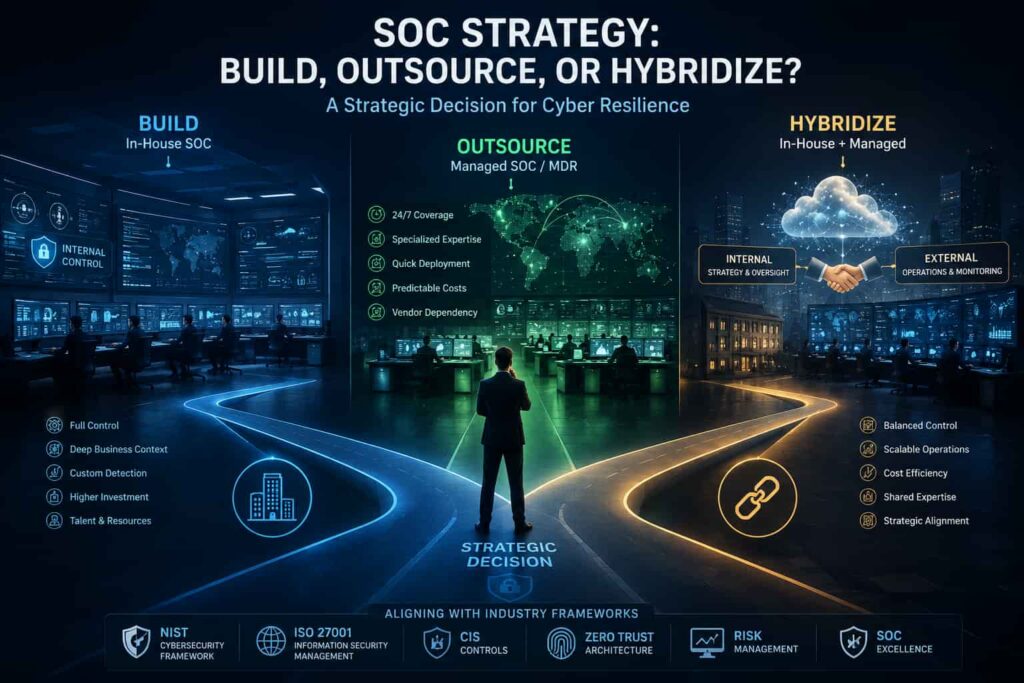
Should the organization build an in-house SOC, outsource security operations to a Managed Security Service Provider (MSSP), or adopt a hybrid model?
The answer depends on business objectives, regulatory obligations, available resources, risk tolerance, and long-term cybersecurity maturity.
Understanding the Role of a Modern SOC
A Security Operations Center is far more than a monitoring team.
A mature SOC integrates people, processes, and technology to continuously identify, investigate, and respond to cyber threats while supporting business continuity.
Core SOC capabilities typically include:
- 24/7 security monitoring
- Security Information and Event Management (SIEM)
- Endpoint Detection and Response (EDR/XDR)
- Threat intelligence integration
- Incident detection and response
- Digital forensics support
- Vulnerability prioritization
- Threat hunting
- Security automation (SOAR)
- Compliance reporting
- Continuous security improvement
An effective SOC reduces dwell time, minimizes business disruption, and enables informed decision-making during security incidents.
Option 1: Building an In-House SOC
An internal SOC provides maximum control over security operations.
Security analysts work directly within the organization, leveraging institutional knowledge to monitor business-critical systems, sensitive data, and operational technology environments.
Advantages
Complete Operational Control
Internal teams maintain direct oversight of security tools, detection logic, escalation procedures, and incident response workflows.
Business Context
Internal analysts possess a deeper understanding of:
- Business processes
- Critical applications
- Sensitive assets
- Organizational priorities
- Internal risk landscape
This context often improves detection accuracy and response effectiveness.
Stronger Regulatory Alignment
Organizations operating under strict regulatory frameworks may require greater control over:
- Data residency
- Evidence handling
- Investigation procedures
- Access management
Industries such as healthcare, finance, defense, and government frequently benefit from maintaining internal security operations.
Custom Detection Engineering
Internal SOC teams can develop highly customized detection rules tailored to organizational risks rather than relying solely on standardized detection libraries.
Challenges
Building an enterprise SOC requires significant investment.
Common challenges include:
- Recruiting experienced analysts
- Retaining cybersecurity talent
- 24/7 staffing requirements
- High technology costs
- Continuous training
- Threat intelligence subscriptions
- SIEM licensing
- SOAR implementation
- Infrastructure maintenance
Many organizations underestimate the ongoing operational costs associated with maintaining a mature SOC.
Option 2: Outsourcing the SOC
Many enterprises partner with Managed Security Service Providers (MSSPs) or Managed Detection and Response (MDR) providers.
These providers deliver security monitoring as a managed service.
Advantages
Rapid Deployment
Organizations gain immediate access to mature security capabilities without building an internal team.
Lower Initial Investment
Capital expenditure is significantly reduced.
Organizations avoid major investments in:
- Security infrastructure
- SIEM deployment
- SOC facilities
- Large analyst teams
24/7 Coverage
Established providers maintain globally distributed teams that deliver continuous monitoring across all time zones.
Access to Specialized Expertise
Providers often employ specialists in:
- Malware analysis
- Threat hunting
- Digital forensics
- Cloud security
- Incident response
- Threat intelligence
Many organizations could not realistically recruit this level of expertise internally.
Predictable Operating Costs
Subscription-based pricing simplifies budgeting while allowing organizations to scale services as business requirements evolve.
Challenges
Outsourcing introduces its own operational considerations.
Potential limitations include:
- Reduced visibility into analyst workflows
- Limited organizational context
- Communication delays during major incidents
- Vendor dependency
- Shared service models
- Data sovereignty concerns
- Integration complexity
Service quality also varies significantly between providers.
Organizations should carefully evaluate service-level agreements (SLAs), escalation procedures, response times, reporting capabilities, and governance models before selecting a provider.
Option 3: The Hybrid SOC Model
Many mature organizations adopt a hybrid approach that combines internal leadership with external operational support.
This model has become increasingly popular because it balances control, scalability, and cost efficiency.
Typical responsibilities are divided as follows:
Internal Team
- Security governance
- Risk management
- Business alignment
- Executive reporting
- Security architecture
- Incident decision-making
- Compliance oversight
External Provider
- Continuous monitoring
- Tier 1 and Tier 2 alert triage
- Threat intelligence
- Threat hunting
- Security platform management
- After-hours monitoring
- Specialized investigations
The hybrid model allows organizations to maintain strategic control while leveraging external expertise for operational efficiency.
Comparing the Three Models
| Capability | In-House SOC | Outsourced SOC | Hybrid SOC |
|---|---|---|---|
| Business Context | Excellent | Moderate | Excellent |
| Initial Cost | High | Low | Moderate |
| Operational Flexibility | High | Moderate | High |
| 24/7 Coverage | Expensive | Excellent | Excellent |
| Control | Excellent | Moderate | High |
| Scalability | Moderate | Excellent | Excellent |
| Regulatory Oversight | Excellent | Moderate | Excellent |
| Specialized Expertise | Variable | Excellent | Excellent |
Key Decision Factors for Executive Leadership
Selecting the appropriate SOC model should begin with enterprise risk assessment rather than technology preferences.
Leadership should evaluate:
Business Risk Profile
Organizations facing high-value cyber threats often require greater operational maturity.
Critical infrastructure, healthcare, financial services, and government agencies typically require enhanced detection and response capabilities.
Regulatory Requirements
Compliance obligations influence SOC architecture.
Requirements from ISO 27001, NIST Cybersecurity Framework, PCI DSS, HIPAA, GDPR, or regional cybersecurity regulations may dictate specific monitoring, logging, and incident response capabilities.
Internal Cybersecurity Maturity
Organizations with experienced security teams may successfully build or expand an internal SOC.
Organizations with limited cybersecurity expertise often realize faster value through managed services.
Budget Strategy
Executives should evaluate total cost of ownership rather than initial implementation costs alone.
SOC operations represent a long-term operational commitment.
Technology Environment
Modern enterprises increasingly operate across:
- Multi-cloud environments
- Hybrid infrastructure
- Remote workforces
- Operational Technology (OT)
- Internet of Things (IoT)
- SaaS platforms
SOC capabilities must provide visibility across these diverse environments.
Aligning SOC Strategy with Cybersecurity Frameworks
A successful SOC should support recognized cybersecurity frameworks rather than operate independently.
NIST Cybersecurity Framework (CSF)
The SOC strengthens the Detect and Respond functions while supporting Recover activities through coordinated incident management.
ISO/IEC 27001
A SOC enables continuous monitoring, security event management, incident handling, and ongoing risk treatment aligned with an Information Security Management System (ISMS).
CIS Controls
SOC operations reinforce controls related to continuous vulnerability management, audit logging, security monitoring, incident response, and defensive operations.
Zero Trust Architecture
Continuous verification is fundamental to Zero Trust. A SOC monitors identity activity, endpoint behavior, network traffic, and application access to identify anomalous behavior in real time.
The Growing Role of Automation and AI
Modern SOCs increasingly integrate artificial intelligence and security automation to improve operational efficiency.
Capabilities now include:
- Automated alert correlation
- Behavioral analytics
- Threat prioritization
- Automated containment
- Machine learning-assisted detection
- SOAR playbooks
- AI-assisted investigations
While automation significantly reduces analyst workload, human expertise remains essential for incident validation, strategic decision-making, and complex investigations.
Organizations should view AI as a force multiplier rather than a replacement for skilled cybersecurity professionals.
Building a SOC That Supports Business Resilience
The effectiveness of a SOC should not be measured solely by the number of alerts processed. Instead, organizations should focus on outcomes that strengthen resilience and reduce business risk, including:
- Reduced Mean Time to Detect (MTTD)
- Reduced Mean Time to Respond (MTTR)
- Improved incident containment
- Lower business disruption
- Enhanced regulatory compliance
- Better executive visibility into cyber risk
- Continuous improvement of detection capabilities
A SOC that aligns security operations with business objectives enables organizations to respond confidently to evolving cyber threats while supporting long-term digital transformation.
Conclusion
There is no universally correct approach to Security Operations Centers. The optimal model depends on an organization’s risk profile, regulatory obligations, internal capabilities, and strategic priorities.
An in-house SOC offers maximum control and deep business integration but requires substantial investment. An outsourced SOC provides rapid access to specialized expertise and continuous monitoring with lower upfront costs. A hybrid SOC combines the strengths of both approaches, allowing organizations to retain strategic oversight while benefiting from scalable operational support.
As cyber threats continue to evolve, organizations should regularly reassess their SOC strategy to ensure it aligns with business objectives, recognized frameworks such as NIST, ISO 27001, CIS Controls, and Zero Trust, and the organization’s broader risk management program.