

The cybersecurity landscape is no longer defined solely by human adversaries. Today, organizations face a new era of threats—augmented, accelerated, and automated by artificial intelligence. As a senior CISO advisor, I’ve observed that traditional security postures are increasingly insufficient against attacks that adapt in real-time and exploit vulnerabilities at machine speed.
For enterprises, governments, and critical infrastructure operators, this isn’t just a technological challenge; it is a fundamental business risk. This article outlines the nature of AI-driven threats and provides a strategic framework for resilience.
The Evolving Threat Landscape: AI as an Attack Vector
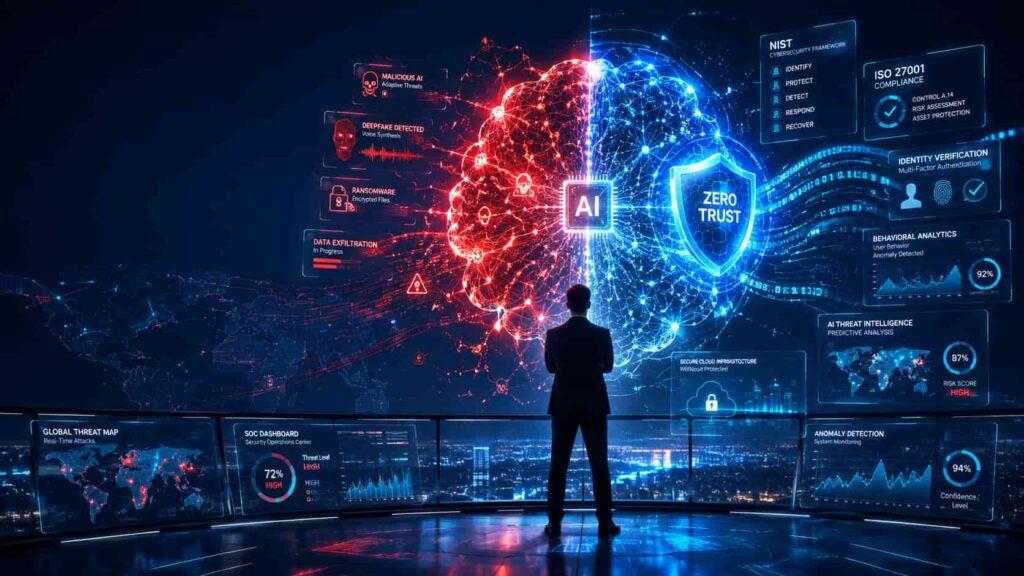
Cybercriminals are leveraging AI to enhance every stage of the attack lifecycle. We are seeing a shift from generic, “spray-and-pray” tactics to highly sophisticated, targeted operations.
Key threats include:
- Deepfake Social Engineering: AI-generated audio and video are being used to impersonate executives, authorizing fraudulent wire transfers or compromising sensitive data. This erodes the trust we place in digital communications.
- Intelligent Malware: Malware is now capable of environmental awareness. AI-powered malware can learn an organization’s defensive patterns and alter its behavior to evade detection.
- Automated Vulnerability Discovery: Attackers use AI to scan networks and codebases for vulnerabilities far faster than human penetration testers, reducing the window between a patch being issued and an exploit being developed.
The Business Impact: From Risk to Material Loss
For CEOs and Boards, the conversation must move beyond IT metrics. AI-powered attacks directly impact enterprise valuation and operational continuity.
Consider the real business risks:
- Financial Fraud: Automated spear-phishing and deepfakes lead to direct capital loss.
- Data Integrity: AI attacks can subtly manipulate data rather than steal it, leading to flawed business intelligence and regulatory fines.
- Operational Downtime: Ransomware and AI-driven DDoS attacks can paralyze production lines and critical infrastructure, impacting supply chains.
Frameworks for Resilience: A Strategic Approach
To prepare for these threats, organizations must adopt a proactive, framework-driven security architecture. At GRMC EdgeSphere, we recommend integrating the following frameworks to build a resilient security posture:
1. Zero Trust Architecture: Never Trust, Always Verify
AI attacks often exploit compromised credentials. Zero Trust is no longer optional. It requires strict identity verification for every user and device, and micro-segmentation to limit lateral movement. This ensures that even if credentials are stolen, the attacker’s mobility is restricted.
2. NIST Cybersecurity Framework (CSF)
The NIST CSF provides a lifecycle approach:
- Identify: Understand your business context and critical assets.
- Protect: Implement safeguards to limit the impact of a potential event.
- Detect: This is paramount for AI threats. Use AI to fight AI—implementing behavioral analytics to detect anomalies.
- Respond: Develop playbooks that account for AI-driven attacks.
- Recover: Ensure rapid restoration of capabilities.
3. ISO 27001 & SOC
AI threats increase the risk of data breaches. An ISO 27001-aligned Information Security Management System ensures that AI-specific risks are incorporated into your risk register. For organizations that handle sensitive client data, SOC 2 controls are essential for demonstrating trust and compliance regarding data privacy and processing integrity.
4. CIS Controls
The CIS Critical Security Controls offer a prioritized set of actions. In the context of AI threats, focusing on Data Protection, Access Control Management, and Security Awareness Training becomes critical. Employees must be trained to recognize the “perfect” phishing attempts generated by AI.
Proactive Defense: Using AI to Fight AI
The only effective way to combat machine-speed attacks is with machine-speed defense. Organizations should invest in Security AI and Automation, which involves:
- Behavioral Analytics: Moving beyond signatures to detect anomalies in user behavior.
- Predictive Threat Intelligence: Using AI to predict likely attack vectors based on current global threat data.
- Automated Incident Response: We are developing AI models that can instantly isolate compromised systems when a threat is detected, reducing the Mean Time to Respond (MTTR).
Conclusion: Building a Cyber-Resilient Enterprise
AI-powered threats represent a pivotal moment in cybersecurity. Organizations cannot afford to be reactive. By embedding frameworks like Zero Trust, NIST, and ISO 27001 into their strategy, and by leveraging AI for defense, enterprises can transform cybersecurity from a cost center into a competitive advantage.
At GRMC EdgeSphere, we are committed to helping organizations navigate this complex landscape. Our focus is not just on compliance but on building a resilient infrastructure that protects your business, your reputation, and your bottom line.