

Compliance Is Not Cybersecurity
For many organizations, cybersecurity discussions in the boardroom revolve around compliance requirements, audit findings, regulatory obligations, and certification status. While compliance frameworks such as ISO 27001, NIST Cybersecurity Framework (CSF), PCI DSS, HIPAA, and industry-specific regulations remain important, they represent only the minimum baseline for security governance.
Today’s threat landscape has evolved beyond simple regulatory checklists. Ransomware groups, nation-state actors, insider threats, supply chain compromises, and advanced persistent threats (APTs) are targeting organizations regardless of their compliance posture. In many high-profile breaches, affected organizations were fully compliant at the time of compromise.
The reality is straightforward: compliance demonstrates adherence to standards, but it does not guarantee resilience against cyber threats.
Boards and executive leadership must therefore view cybersecurity not as an IT issue or compliance obligation, but as an enterprise business risk that directly impacts operational continuity, financial performance, reputation, customer trust, and strategic objectives.
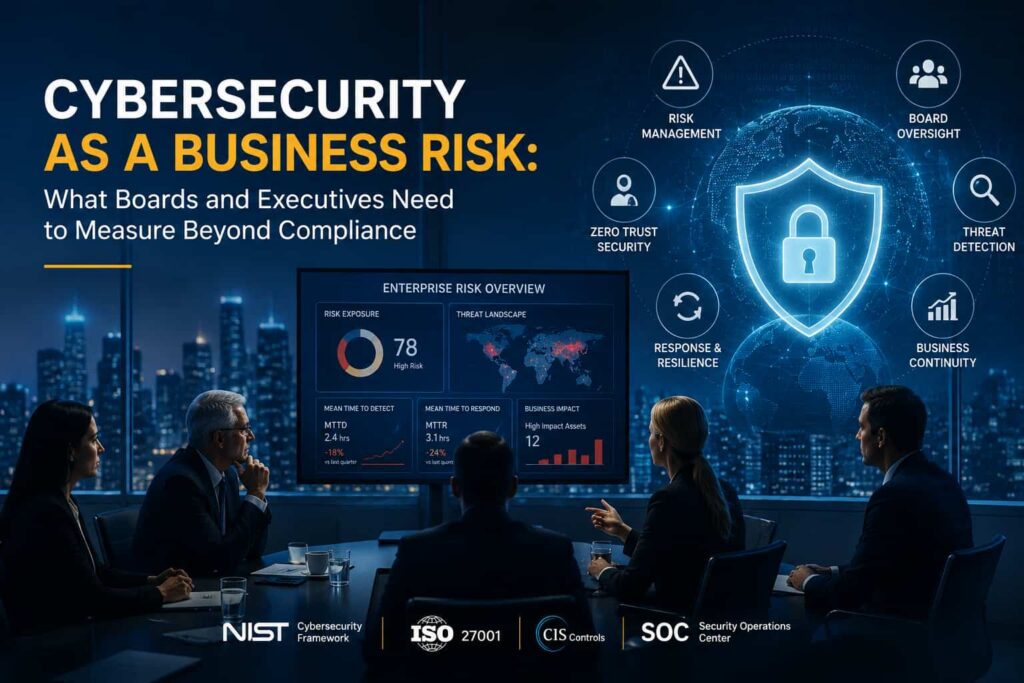
The Shift from Compliance Metrics to Risk Metrics
Traditional cybersecurity reporting often focuses on operational statistics:
- Number of vulnerabilities patched
- Percentage of systems compliant
- Security awareness training completion rates
- Audit findings resolved
- Number of security tools deployed
While these metrics provide useful operational insight, they rarely answer the questions executives care about:
- How exposed is the organization to cyber risk?
- What business processes are most vulnerable?
- What is the potential financial impact of a cyber incident?
- How quickly can critical operations recover?
- Are cybersecurity investments reducing measurable business risk?
Effective cybersecurity governance requires translating technical indicators into business risk intelligence.
Why Boards Must Treat Cybersecurity as an Enterprise Risk
Cyber incidents have become board-level concerns because their consequences extend far beyond technology.
Financial Impact
Cyberattacks can result in:
- Revenue loss
- Regulatory penalties
- Legal liabilities
- Incident response expenses
- Business interruption costs
- Increased cyber insurance premiums
A ransomware attack that disrupts operations for several days can have a significantly greater financial impact than many traditional operational risks.
Operational Disruption
Critical business functions depend on digital infrastructure.
A successful attack can disrupt:
- Manufacturing operations
- Financial transactions
- Healthcare services
- Government functions
- Supply chain operations
- Customer service platforms
Executives must understand which critical services are vulnerable and how disruptions could affect organizational objectives.
Reputational Damage
Customer trust can take years to build and only hours to destroy.
Publicized data breaches often result in:
- Customer attrition
- Investor concerns
- Brand damage
- Reduced market confidence
Reputational impact frequently exceeds the direct cost of incident recovery.
Regulatory and Legal Exposure
Data protection regulations continue to expand globally.
Organizations may face:
- Regulatory investigations
- Litigation
- Contractual penalties
- Increased compliance scrutiny
Cybersecurity failures increasingly create legal and fiduciary risks for executives and board members.
Key Cybersecurity Risk Metrics Boards Should Measure
1. Cyber Risk Exposure
Rather than counting vulnerabilities, organizations should assess:
- Critical assets exposed to threats
- Likelihood of exploitation
- Potential business impact
Risk exposure analysis should prioritize systems supporting revenue generation, customer services, operational technology (OT), and critical infrastructure.
A risk-based approach aligns with both NIST Risk Management Framework (RMF) and ISO 27005 methodologies.
2. Mean Time to Detect (MTTD)
The faster an organization identifies a threat, the lower the potential impact.
MTTD measures:
How long it takes to identify suspicious or malicious activity after compromise.
Long detection times often indicate:
- Monitoring gaps
- Insufficient logging
- Limited SOC visibility
- Weak threat intelligence integration
Organizations with mature Security Operations Centers (SOC) typically achieve significantly lower detection times.
3. Mean Time to Respond (MTTR)
Detection alone is insufficient.
Executives should measure:
How quickly security teams contain and remediate incidents.
Shorter response times reduce:
- Operational disruption
- Data loss
- Financial impact
- Regulatory exposure
MTTR is one of the strongest indicators of cyber resilience.
4. Business Impact of Critical Asset Compromise
Boards should understand:
- Which systems are mission-critical
- Which business functions depend on them
- The financial consequences of downtime
Examples include:
- Core banking systems
- Electronic health record platforms
- Industrial control systems
- Government service portals
- Customer transaction platforms
Cybersecurity reporting should include quantified business impact scenarios.
5. Third-Party and Supply Chain Risk
Modern enterprises rely heavily on vendors, cloud providers, contractors, and managed service providers.
Recent attacks demonstrate that organizations can be compromised through trusted partners.
Executives should track:
- Vendor security maturity
- Third-party risk assessments
- Critical supplier dependencies
- External attack surface exposure
Supply chain security has become a central component of enterprise risk management.
6. Identity and Access Risk
Most breaches involve compromised credentials.
Boards should monitor:
- Privileged account exposure
- Multi-factor authentication (MFA) coverage
- Excessive permissions
- Dormant privileged accounts
- Third-party access risks
Identity security forms the foundation of Zero Trust Architecture.
7. Cyber Resilience and Recovery Readiness
An organization’s ability to recover often matters more than its ability to prevent every attack.
Key resilience indicators include:
- Backup integrity testing
- Disaster recovery readiness
- Business continuity maturity
- Recovery Time Objective (RTO)
- Recovery Point Objective (RPO)
Executives should regularly review recovery capabilities through simulation exercises and tabletop scenarios.
Moving Toward a Zero Trust Security Model
Traditional perimeter-based security assumes trust inside the network.
Modern threat environments require a different approach.
Zero Trust operates on the principle:
Never Trust, Always Verify.
Core Zero Trust principles include:
- Continuous authentication
- Least-privilege access
- Device verification
- Micro-segmentation
- Continuous monitoring
For executives, Zero Trust reduces risk by limiting attacker movement and containing breaches before they become enterprise-wide incidents.
The Role of Security Operations Centers (SOC)
A mature Security Operations Center provides continuous visibility into threats across the organization.
SOC capabilities include:
- Threat monitoring
- Incident detection
- Threat intelligence
- Digital forensics
- Incident response coordination
Executives should evaluate SOC performance based on outcomes rather than technology investments alone.
Key questions include:
- Can we detect advanced threats quickly?
- Are alerts prioritized effectively?
- How rapidly can incidents be contained?
- Do we have visibility across cloud, on-premises, and hybrid environments?
SOC effectiveness directly influences organizational resilience.
Aligning Cybersecurity with Enterprise Risk Management
Leading organizations integrate cybersecurity into Enterprise Risk Management (ERM) programs.
This approach ensures cyber risks are evaluated alongside:
- Financial risks
- Operational risks
- Strategic risks
- Regulatory risks
- Supply chain risks
Frameworks such as:
- NIST Cybersecurity Framework (CSF)
- NIST Risk Management Framework (RMF)
- ISO 27001
- ISO 31000
- CIS Critical Security Controls
provide structured methods for aligning cybersecurity with business objectives.
When cybersecurity is embedded within ERM, executives gain clearer visibility into risk priorities and investment decisions.
Questions Every Board Should Ask
To improve cyber governance, boards should regularly ask:
- What are our top cyber risks today?
- Which critical business processes are most vulnerable?
- How long would it take to detect and contain an attack?
- What is our estimated financial exposure from a major cyber incident?
- Are our third-party vendors introducing significant risk?
- How resilient are our recovery capabilities?
- Are cybersecurity investments measurably reducing business risk?
- How does our cyber maturity compare with industry peers?
The quality of these answers often reveals the maturity of an organization’s cybersecurity program.
Conclusion
Cybersecurity has evolved into a strategic business risk that demands board-level oversight. Compliance remains necessary, but it is no longer sufficient. Organizations that focus exclusively on audits, certifications, and regulatory requirements may still remain vulnerable to significant cyber threats.
Boards and executives must shift their attention toward measurable risk indicators, cyber resilience, operational impact, recovery readiness, and business continuity. By leveraging established frameworks such as NIST, ISO 27001, CIS Controls, Zero Trust, and enterprise risk management methodologies, organizations can move beyond compliance and build a cybersecurity program that protects both business operations and long-term organizational value.
At GRMC EdgeSphere, we help organizations transform cybersecurity from a compliance-driven function into a strategic risk management capability—enabling leadership teams to make informed decisions, strengthen resilience, and confidently navigate today’s evolving threat landscape.